Rosatom and Kazakhstan Nuclear Power Plants signed the engineering, procurement and construction contract for the Balkhash nuclear plant on 3 September at the Eastern Economic Forum in Vladivostok. The contract covers two VVER-1200 units totaling about 2.4 GW — Kazakhstan's first nuclear power plant, and its biggest energy project since independence.
Key facts
- The EPC contract was signed on 3 September 2026 at the Eastern Economic Forum in Vladivostok by Kazakhstan Nuclear Power Plants and Atomstroyexport, Rosatom's engineering subsidiary.
- The plant will use two VVER-1200 pressurized water reactors with a combined capacity of about 2,400 MW.
- The site is near the village of Ulken on the western shore of Lake Balkhash, about 400 km from Almaty — roughly 9% of Kazakhstan's current installed generating capacity.
- Preliminary cost estimates put the project at about USD16.4 billion: USD14.4 billion for the two units plus roughly USD2 billion for infrastructure, physical protection systems and warranty-period fuel.
- Kazakhstan's Atomic Energy Agency chairman Almasadam Satkaliyev said Rosatom is expected to obtain the site license in 2027, with construction starting that year and the first unit online in 2034.
- Engineering surveys have been running since August 2025, with more than 60 boreholes drilled up to 120 metres deep to support site selection and permitting.
What happened
The signing ceremony in Vladivostok brought together Ernat Berdigulov, director-general of Kazakhstan Nuclear Power Plants, Almasadam Satkaliyev, chairman of Kazakhstan's Atomic Energy Agency, and Rosatom director-general Alexei Likhachev with first deputy director-general Andrey Petrov, according to NucNet's account. Kazakhstan's state nuclear project company signed with Atomstroyexport, Rosatom's engineering arm.
The contract defines Rosatom's scope as the full delivery chain — in the company's words, "from design and procurement to construction, commissioning, and handover of the completed facility to the customer". Likhachev said the signing "marks a new stage in our cooperation with Kazakhstan," adding that Rosatom will complete design work and assemble an international consortium of equipment suppliers.
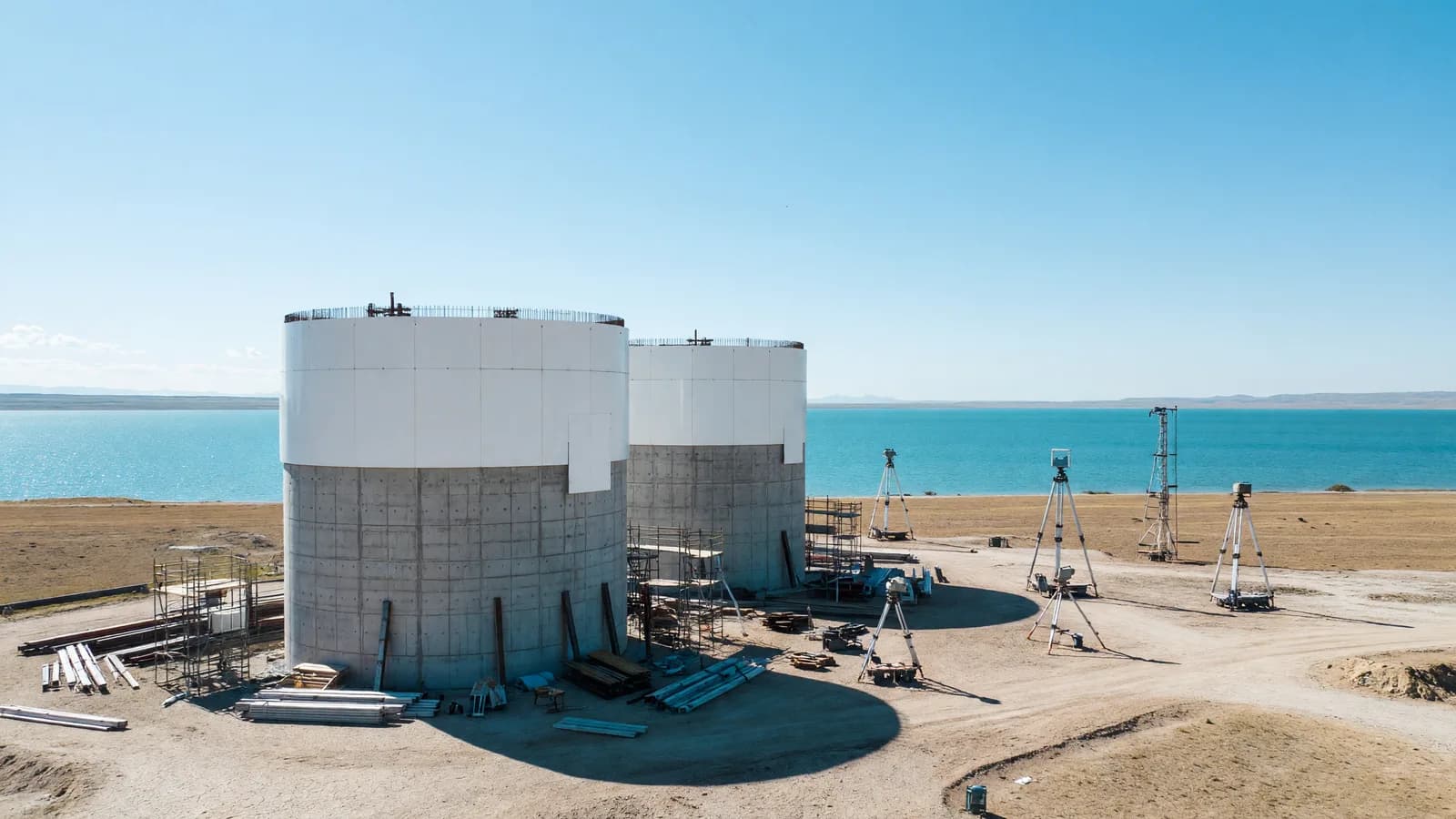
The plant itself will sit on the western shore of Lake Balkhash in the Zhambyl district of the Almaty region. Site preparation began in the summer of 2025 with geotechnical drilling; that work runs into next year and feeds directly into the permit-application documentation, World Nuclear News reports.
Why it matters
Kazakhstan is the world's leading uranium producer yet has operated no commercial nuclear power since the Soviet-built BN-350 sodium-cooled reactor near Aktau shut down in 1999 after 26 years of electricity, heat and desalination service. Closing that gap has been a stated national goal: in an October 2024 referendum, more than 70% of 7.8 million voters backed building a nuclear power plant.
The EPC signature converts that political mandate into contract engineering. It also locks in Russian supply for Central Asia's anchor new-build at a time when Rosatom is one of the few vendors with a bankable serial-construction record — its VVER-1200 is the same design being built in Belarus, China, Turkey, Bangladesh, Egypt and Hungary. The closest parallel in NNN's coverage is Akkuyu 2 in Turkey, where the first-of-a-kind VVER-1200 unit is now in commissioning-phase construction; Kazakhstan's project follows the same delivery playbook at larger geopolitical scale.
Financing is the tell. Most of the cost is expected to ride on a Russian state export loan under the intergovernmental agreement signed in May, replicating the export-credit model Rosatom has used to keep its international order book moving despite Western sanctions pressure. For context on the broader build-out, see NNN's tracking of Russia's domestic licensing wave at Kola and China's eight-reactor approval batch.
Background
The intergovernmental agreement — covering key project principles and export loan financing — was signed in May 2026 during Russian President Vladimir Putin's state visit to Kazakhstan. President Kassym-Jomart Tokayev called the Balkhash agreement "of exceptional significance" at the time. Detailed financing terms have not been published, but official news agency Kazinform reported the USD14.4 billion unit cost plus roughly USD2 billion for physical security and social infrastructure, with construction start targeted for 2027 and first-unit operation in 2034.
Kazakhstan is putting its own money in too. The draft 2027–2029 national budget earmarks 818.3 billion tenge — about USD1.7 billion — to increase the capital of Kazakhstan Nuclear Power Plants, spread across the three years. The state company, a subsidiary of the Samruk-Kazyna National Welfare Fund, was set up in 2014 to implement nuclear projects.
Rosatom's selection was no surprise. It ranked first among four international bidders — ahead of China's CNNC, France's EDF and South Korea's KHNP — when Kazakhstan chose its consortium leader in June 2025. And Balkhash is only the first act: CNNC is lined up to build a second plant adjacent to the Balkhash site, with preparations for a third underway. The government wants nuclear to supply 5% of national generation by 2035.
What's next
The near-term milestones are procedural. Survey work finishes next year, followed by preparation of permit-application documentation; Satkaliyev has said Rosatom should hold the site license in 2027, clearing construction start that year. The full build cycle is expected to take about a decade. Two open questions to watch: the final localization share for Kazakh companies in construction and equipment supply, and the detailed terms of the Russian export loan that will underwrite most of the USD16.4 billion price tag.
Questions
- Where will the Balkhash nuclear plant be built?
- Near the village of Ulken on the western shore of Lake Balkhash, in the Zhambyl district of the Almaty region, roughly 400 km from Almaty.
- How big will the plant be?
- Two VVER-1200 pressurized water reactors with a combined capacity of about 2.4 GW, equivalent to roughly 9% of Kazakhstan's installed generating capacity.
- Who is paying for it?
- Preliminary estimates put the cost at about USD16.4 billion, mostly financed through a Russian state export loan, plus 818.3 billion tenge in Kazakh state equity funding for 2027-2029.
- When will it be built?
- Rosatom is expected to obtain the site license in 2027, with construction starting the same year and the first unit targeted to come online in 2034.
Sources
- Kazakhstan Atomic Energy Agency announces EPC contract signing for Balkhash NPP — Government of Kazakhstan
- Rosatom signs EPC contract for Kazakhstan nuclear plant — World Nuclear News
- Kazakhstan And Russia Sign EPC Contract For Construction Of Balkhash Nuclear Power Station — NucNet
- Kazakhstan Nuclear Power Plant Contract Signed with Rosatom — The Times of Central Asia
About Nuclear News Network
Nuclear News Network (NNN) is an independent publication covering the global nuclear energy sector — reactor construction, SMRs, fuel supply, policy, operations and fusion. NNN publishes a daily brief, same-day analysis of major developments, and reference guides used across the industry. Articles are produced by the NNN Newsroom, an editorial automation system with human oversight, under the publication's editorial standards. Ruben Seoane is the founder and main editor of NNN.