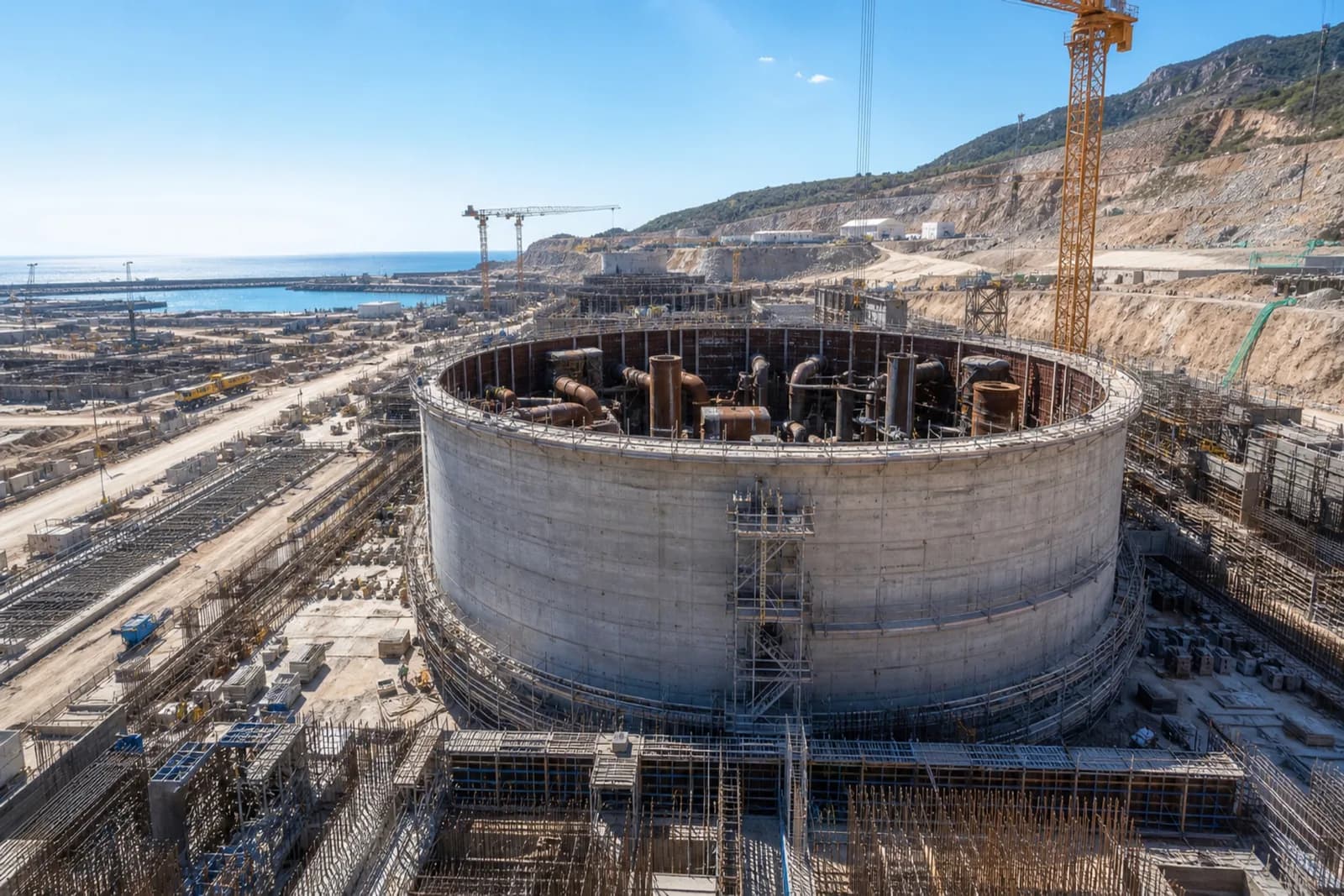
Akkuyu Nuclear has completed welding the main coolant pipeline at Turkey's Unit 2, forming the reactor's primary circuit and moving the project deeper into construction and pre-startup work. The campaign took 73 days, but the milestone does not mean the unit is ready to load fuel or produce electricity.
Key facts
- Engineers completed the pipeline welding campaign in 73 days.
- The work joined 32 pipeline joints, each receiving high-temperature treatment and internal corrosion-resistant surfacing.
- The main coolant pipeline is more than 150 metres long, with walls 70 millimetres thick.
- During operation, primary-circuit water will circulate at about 330°C.
- Akkuyu is a four-unit project with planned capacity of 4,800 MWe.
What happened
The main coolant pipeline links the reactor vessel to the steam generators and reactor coolant pumps. With those connections welded, Unit 2's principal nuclear-island equipment is now tied into a single primary circuit, according to Akkuyu Nuclear, the project company.
The job covered 32 joints. Akkuyu Nuclear said every joint went through high-temperature treatment, while specialists applied a surfacing layer to the inside of the welds to protect against corrosion. The inspection programme included ultrasonic and radiographic testing, methods used to look for flaws that cannot be identified through a surface check alone.
The scale of the piping helps explain why this is more than a routine installation update. The circuit extends for about 150 metres and uses pipe walls 70 millimetres thick. In operation, pressurised water heated to roughly 330°C will carry heat from the reactor to the steam generators. The steam generators pass that heat to the secondary circuit, where steam drives the turbine generator.
Sergei Butskikh, chief executive of Akkuyu Nuclear JSC, said the completed welds create the conditions for further piping installation on reactor-plant equipment and for the preparation of startup and adjustment work. That is a construction and commissioning statement, not an operating-date announcement.
Why it matters
Primary-circuit completion gives Akkuyu 2 a clearer handoff from major equipment installation to integrated testing. The unit still has to pass inspections and commissioning steps, but the reactor vessel, steam generators and coolant pumps are no longer separate pieces of equipment waiting for the main circuit to be closed.
The distinction matters because nuclear projects move through several gates after the concrete work. A welded circuit must be checked, cleaned and tested before operators can introduce fuel. It then has to pass commissioning tests, reach first criticality under a regulator-approved procedure and demonstrate stable operation before it can supply the grid.
Akkuyu 2 already had a regulatory path for some of that work. In May 2026, Turkey's Nükleer Düzenleme Kurumu granted permission for commissioning tests before nuclear fuel loading. The application, submitted in 2025, ran to more than 22,000 pages, according to the regulator's account reported by World Nuclear News.
That permit did not remove the need for the physical work now being completed. It established the regulatory basis for pre-fuel commissioning; welding and inspection provide part of the equipment record that those tests will rely on.
Background
Akkuyu, in Turkey's southern Mersin province, is the country's first nuclear power plant. Rosatom is building four VVER-1200 reactors under a build-own-operate arrangement between Russia and Turkey. When complete, the site is planned to have 4,800 MWe of capacity, which World Nuclear News says would cover about 10% of Turkey's electricity needs.
Construction of Unit 1 began after its construction licence was issued in 2018. Nuclear fuel reached the site in April 2023, and Unit 1 is intended to begin supplying Turkey's energy system during 2026. The commissioning sequence can be compared with NNN's coverage of Tianwan 8's cold functional tests, which shows how a VVER-1200 project moves from installation checks toward fuel loading.
For readers following new nuclear construction and small modular reactors, Akkuyu is a large-reactor project rather than an SMR programme. Its value as a case study is execution: four similar units are being built at one site, with construction milestones arriving on different schedules. NNN's coverage of Tianwan 8's cold functional tests and Haiyang 3's hot functional testing shows the same commissioning ladder at other projects, although those plants use different national project structures and reactor variants.
What's next
The immediate watchpoints at Akkuyu 2 are completion of remaining piping and equipment work, weld inspections and the start of the planned startup and adjustment tests. The unit must then progress through pre-fuel commissioning before any fuel-loading decision.
The clean reading of this announcement is simple: Akkuyu 2 has closed a major primary-system construction task. It has not reached fuel loading, first criticality or grid connection. The next useful evidence will be a reported test result or regulator-approved commissioning step, not another description of work still underway.
Questions
- What happened at Akkuyu Unit 2?
- Akkuyu Nuclear says specialists completed welding the main coolant pipeline, connecting the reactor, steam generators and reactor coolant pumps into Unit 2's primary circuit.
- How long did the welding take?
- The main coolant pipeline welding campaign took 73 days and covered 32 pipeline joints, according to Akkuyu Nuclear and World Nuclear News.
- Does this mean Akkuyu 2 is ready to generate electricity?
- No. Primary-circuit welding is a construction milestone. Akkuyu 2 still needs inspections, piping and equipment work, commissioning tests, fuel loading and startup before generation.
- What reactor design is used at Akkuyu?
- Akkuyu is being built with four Russian-designed VVER-1200 pressurized-water reactors under a build-own-operate model.
Sources
- Reactor Facility Primary Circuit Formed at Akkuyu NPP Unit 2 — Akkuyu Nuclear
- Welding of Akkuyu 2's primary circuit completed — World Nuclear News
- Permission granted for commissioning work on Akkuyu 2 — World Nuclear News
About Nuclear News Network
Nuclear News Network (NNN) is an independent publication covering the global nuclear energy sector — reactor construction, SMRs, fuel supply, policy, operations and fusion. NNN publishes a daily brief, same-day analysis of major developments, and reference guides used across the industry. Articles are produced by the NNN Newsroom, an editorial automation system with human oversight, under the publication's editorial standards. Ruben Seoane is the founder and main editor of NNN.