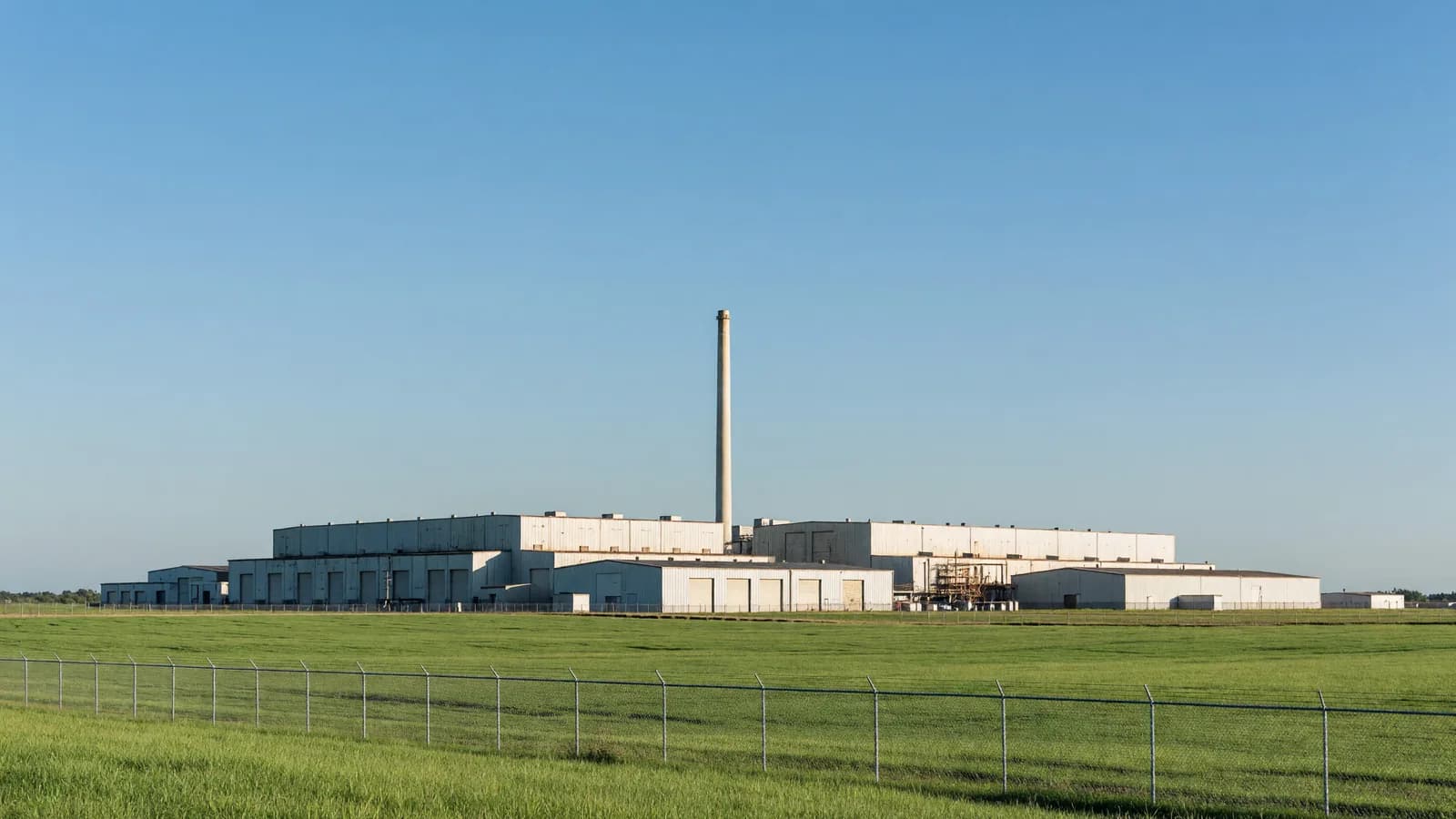
Cameco will buy every pound of future output from the planned Paducah Laser Enrichment Facility in Kentucky under an exclusive offtake signed with Global Laser Enrichment (GLE), giving Silex Systems' laser-enrichment technology its first complete commercial demand anchor ahead of a final investment decision.
Key facts
- The offtake agreement, announced September 14, 2026 on the Australian Securities Exchange, covers all future Paducah production — natural UF6, low-enriched uranium (LEU), LEU+ and, if that market develops, high-assay LEU (HALEU) for advanced reactors.
- Pricing is tied to Cameco's average realised long-term contract price, net of selling costs, sparing GLE the cost of building its own sales and marketing organisation.
- GLE is 51% owned by Silex Systems and 49% by Cameco; Cameco holds an option to raise its stake to a 75% majority.
- The plant's feedstock is secured by a 40-year U.S. Department of Energy agreement, signed in November 2016, for roughly 300,000 metric ton units of high-assay depleted uranium hexafluoride tails.
- The Paducah Laser Enrichment Facility is planned for up to 6 million separative work units per year from 2030; a pilot-scale technology demonstration is targeted to reach Technology Readiness Level 6 this year.
What happened
Global Laser Enrichment, the exclusive worldwide licensee of Silex Systems' Separation of Isotopes by Laser EXcitation (SILEX) technology, announced on September 14 that it has executed an exclusive Offtake Agreement with Cameco for the planned Paducah Laser Enrichment Facility (PLEF) in western Kentucky. Cameco — already GLE's 49% co-owner and, alongside Brookfield, a co-owner of Westinghouse — commits to purchase all of the plant's future nuclear fuel production.
The pricing mechanism is the notable structural choice: GLE will receive the equivalent of Cameco's average realised price, net of appropriate selling costs, achieved annually across Cameco's long-term contracting portfolio. That links a pre-revenue technology venture's revenue line to the contract book of one of the world's largest nuclear fuel merchants, and it lets GLE skip building a sales and marketing arm of its own.
Silex chief executive Michael Goldsworthy framed the deal as the demand-side pillar for a construction decision. "The Agreement with Cameco also provides a key commercial pillar to support a future final investment decision (FID) for the PLEF," he said in the ASX-filed announcement, adding that the contract carries "customary contractual terms to protect the interests of GLE and Silex."
Why it matters
Until now, the Paducah laser-enrichment story has been a technology and feedstock story: a promising third-generation enrichment process with a locked-up supply of U.S. government tails, but no named buyer for what the plant would produce. An exclusive, take-all-output contract with the sector's most commercially muscular fuel supplier removes the demand question in one move — and it does so without GLE having to pre-commit to spot-market exposure.
The timing fits a broader pattern. Western enrichment capacity is the binding constraint on the advanced-reactor and AI-baseload buildout that runs through NNN's fuel-supply-chain coverage: Urenco USA broke ground on its Eunice expansion, and days ago Centrus priced a $500 million stock-and-warrant offering to fund Piketon and Oak Ridge capacity — the same week GLE locked in a buyer. If PLEF reaches its planned up to 6 million SWU per year, it would stand alongside those projects as cornerstones of non-Russian enrichment supply.
For Cameco, the deal deepens a strategy it has been assembling for years: stakes in GLE and Westinghouse on top of its uranium mining and conversion business, positioning it across nearly every stage of the Western fuel cycle.
Background
Paducah's enrichment history runs in three technological generations. The site hosted a gaseous diffusion plant — one of the last of its kind in the United States — whose depleted-uranium tails are now the raw material for the laser plant. GLE was selected by the DOE in 2013 to negotiate re-enriching that inventory, and in November 2016 the two signed a 40-year sale-and-purchase agreement for approximately 300,000 metric ton units of high-assay tails. Under GLE's plan, the material would be re-enriched to natural-grade UF6 — more than 200,000 metric tons of uranium — with the residual low-assay tails returned to the DOE.
The venture has been through its share of restructuring. The SILEX technology began inside GE Hitachi; when GE and Hitachi sought to exit, Silex moved to 51% ownership, and the NRC's licensing history for GLE shows a Wilmington, North Carolina commercial plant license issued in 2012 that was placed on hold amid weak uranium markets — a license that predates today's fuel-hungry market by more than a decade. World Nuclear News reported at the time that re-enrichment would yield around 100,000 tonnes of natural-grade uranium over 40 years, with annual output regulated at roughly 2,000 tonnes of uranium — equivalent to a mine producing about 5 million pounds of U3O8 per year.
What the plant can make depends on how far the technology is pushed: natural UF6 from tails re-enrichment is the base case, with LEU and LEU+ above it and HALEU — the fuel most advanced reactor designs require — possible if that market matures. Our HALEU explainer covers why enrichment above the traditional 5% assay line is the bottleneck for reactors like Natrium and the Xe-100.
What's next
The critical path runs through technology demonstration, not demand. Cameco says GLE has accelerated its pilot program and is working to demonstrate TRL-6 — large-scale system performance under relevant conditions — this year, with a second full-scale laser module already installed at the U.S. pilot facility. A successful demonstration unlocks the case for government and industry support funding.
After that comes a feasibility assessment and, if conditions line up, a final investment decision. Commercial deployment under the DOE agreement is targeted for western Kentucky no later than 2030. The NRC, which lists the PLEF license application as still on hold, would need an application, review and issuance before construction. Watch for the TRL-6 result, any DOE loan-guarantee or funding moves tied to it, and the first signs of an NRC filing for Paducah.
Questions
- What did GLE and Cameco sign?
- On September 14, 2026, Global Laser Enrichment (GLE) and Cameco executed an exclusive Offtake Agreement under which Cameco will buy all future production from GLE's planned Paducah Laser Enrichment Facility, covering natural UF6 and enriched uranium products.
- How is the Paducah output priced?
- GLE receives pricing equivalent to Cameco's average realised price, net of selling costs, across its long-term contract portfolio each year — and avoids building its own sales and marketing organisation.
- What is the Paducah Laser Enrichment Facility?
- PLEF is GLE's proposed commercial plant in Kentucky that would re-enrich over 200,000 metric tons of U.S. DOE depleted-uranium tails into natural-grade UF6 and produce LEU, LEU+ and potentially HALEU, at up to 6 million SWU per year from 2030.
- Does the offtake mean Paducah is fully financed?
- No. The deal is a commercial pillar for a future final investment decision, which still depends on technology maturation, market conditions, regulatory approvals and government support.
Sources
- GLE and Cameco execute exclusive Offtake Agreement for future GLE nuclear fuel production — Silex Systems (ASX announcement)
- Global Laser Enrichment — Cameco
- Global Laser Enrichment Facility Licensing — U.S. Nuclear Regulatory Commission
- US DOE sells depleted uranium for laser enrichment — World Nuclear News
- US Nuclear Fuel Cycle — World Nuclear Association
- Global Laser Enrichment business: Paducah Laser Enrichment Facility — Global Laser Enrichment
- Centrus Announces Pricing of $500 Million Underwritten Public Offering of Class A Common Stock and Warrants — Centrus Energy
About Nuclear News Network
Nuclear News Network (NNN) is an independent publication covering the global nuclear energy sector — reactor construction, SMRs, fuel supply, policy, operations and fusion. NNN publishes a daily brief, same-day analysis of major developments, and reference guides used across the industry. Articles are produced by the NNN Newsroom, an editorial automation system with human oversight, under the publication's editorial standards. Ruben Seoane is the founder and main editor of NNN.