Tennessee has issued the first fusion-specific license granted by any US state. The Tennessee Department of Environment & Conservation approved a byproduct material license for Type One Energy on August 31, clearing the stellarator developer to break ground at TVA's retired Bull Run coal site in Clinton — first a fusion R&D campus, then a planned 400 MWe Infinity Two power plant.
Key facts
- TDEC issued the license August 31, 2026 — the first granted under a state fusion-specific licensing framework, per Type One and the governor's office
- The license covers Project Infinity at TVA's Bull Run Energy Complex, a coal site retired in December 2023
- Groundbreaking is expected in 2026, with the Infinity One prototype targeted for commissioning in 2029
- The follow-on Infinity Two plant is forecast at 400 MWe with full startup projected by 2034
- Type One initiated the application on January 30, 2026 — a seven-month regulatory turnaround
What happened
TDEC's approval converts the application Knoxville-based Type One Energy filed on January 30 into the state's — and the nation's — first fusion-specific byproduct material license. Governor Bill Lee's office announced the decision alongside TDEC, framing Tennessee as the first state to license a commercial fusion project under its own fusion framework.
The license authorizes the first phase of Project Infinity: a fusion development campus at Bull Run built in collaboration with Oak Ridge National Laboratory, TVA and the University of Tennessee. Type One CEO Christofer Mowry called the process itself the product: "for the first time, a fusion power plant-specific licensing process has been developed and then used to grant a fusion-specific license", positioning Tennessee's process as an international benchmark for fusion "safety by design."
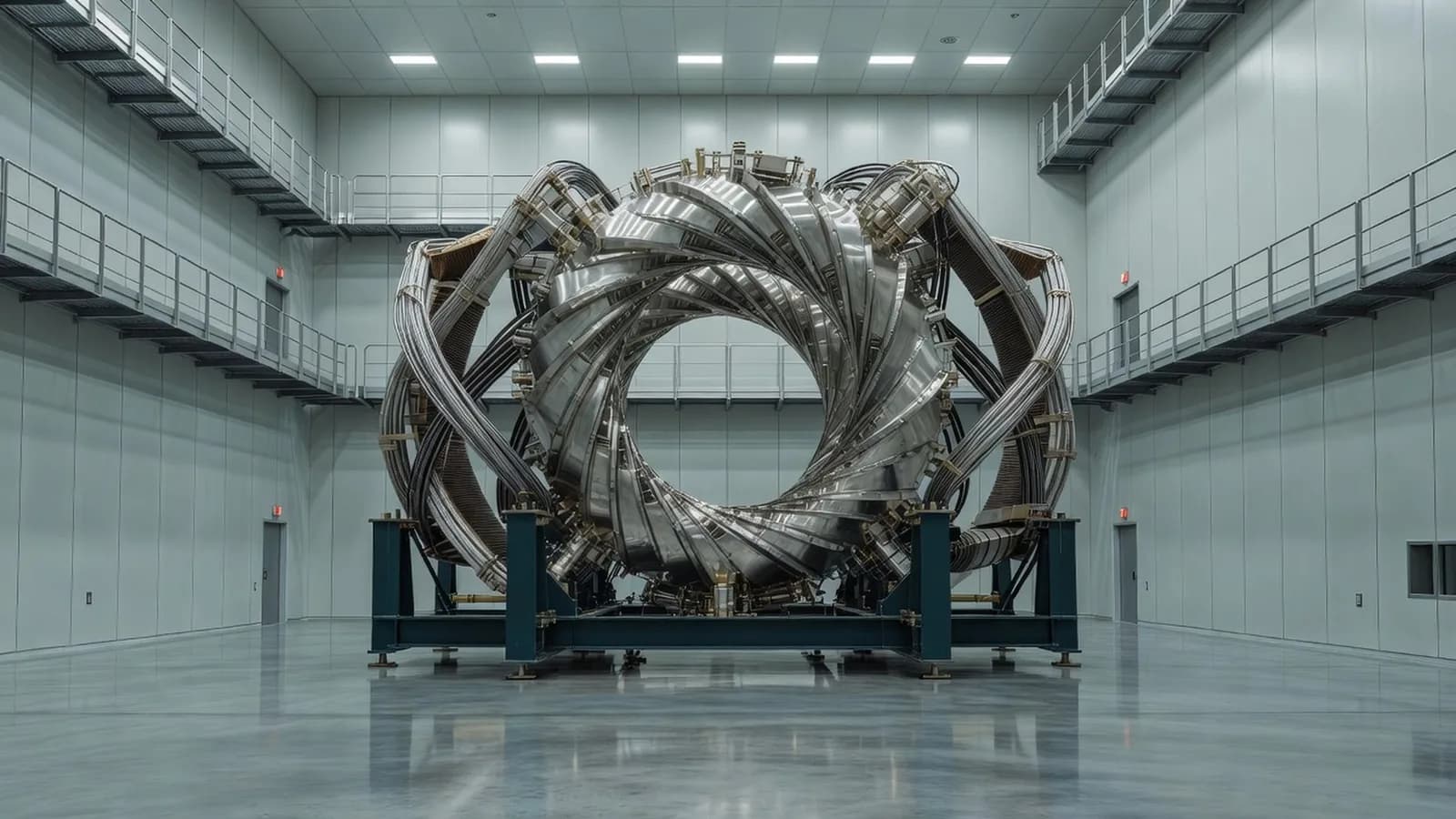
The machines are stellarators — the twisted-coil cousin of the tokamak. Infinity One, the engineering prototype, targets commissioning and startup in 2029; Infinity Two, the ~400 MWe power plant, would follow on the same site, with construction potentially starting as early as 2028 and full startup projected by 2034.
Why it matters
The milestone is regulatory, not technical — and that is exactly why it matters. Since the NRC's 2023 decision to regulate fusion under the byproduct materials framework rather than as fission reactors, the open question has been whether Agreement States could turn that framework into a workable plant-scale licensing process. Tennessee just answered it in seven months, start to finish — a timeline fission developers navigating the NRC's Part 50/52 tracks can only envy (see NNN's reactor licensing explainer).
It also sharpens the race among fusion's front-runners to be first to a licensed, grid-connected plant. Helion began construction of its Orion plant in Washington under existing permitting routes, and Commonwealth Fusion Systems has applied to connect its ARC plant to PJM. Type One now holds a distinction neither can claim: a license issued through a process written specifically for fusion power plants. For a field still without a single watt of grid electricity, regulatory proof-of-concept is a real asset — the argument NNN made when CFS raised its latest billion.
Background
Type One Energy spun out of the University of Wisconsin–Madison's stellarator program and relocated to Knoxville to sit beside Oak Ridge. Its bet is that the stellarator's steady-state stability — no driven plasma current, no disruptions — outweighs its manufacturing complexity, a case strengthened by Wendelstein 7-X's recent long-pulse records covered in NNN's fusion explainer.
Bull Run itself is a symbol TVA has leaned into: an 865 MW coal plant retired in December 2023 being repurposed for the technology that might one day replace baseload coal for good. The project's final investment decisions still run through the TVA board and least-cost planning, and state legislators have already raised waste and cost questions — a reminder that a license is a beginning, not a guarantee.
What's next
Watch for the Bull Run groundbreaking before year-end 2026, subsequent license submissions covering later project phases, Infinity One commissioning in 2029, and a TVA board decision on Infinity Two's construction start, potentially as early as 2028. The scoreboard question — first fusion electricity on a US grid — now has at least three credible entrants racing on three different confinement concepts.
Questions
- What license did Type One Energy receive?
- A byproduct material license issued by the Tennessee Department of Environment & Conservation on August 31, 2026 — the first granted under any US state's fusion-specific licensing framework. It clears groundbreaking on the fusion development campus at TVA's Bull Run site.
- Why does a state, not the NRC, license a fusion plant?
- In 2023 the NRC decided fusion machines will be regulated under the byproduct materials framework rather than as fission reactors. Tennessee is an NRC Agreement State, so it administers that framework itself — and built a fusion-specific process on top of it.
- When would the Bull Run fusion plant deliver power?
- Type One targets commissioning its Infinity One prototype in 2029 and a roughly 400 MWe Infinity Two power plant at Bull Run with full startup projected by 2034, subject to further approvals and TVA decisions.
- Is this the first licensed fusion plant in the US?
- It is the first license issued under a fusion-specific state licensing process, per Type One and TDEC. Helion began building its Orion plant in Washington state this year under existing permitting routes rather than a fusion-specific framework.
Sources
- A Regulatory Breakthrough for Fusion: The Bull Run Energy Complex — Type One Energy
- Tennessee approves license for nuclear fusion facility in Clinton, Bull Run Energy Complex — Tennessee Lookout
- Governor Bill Lee, TDEC Announce 1st License For Commercial Fusion — Chattanoogan
- Type One Energy initiates licensing of fusion power plant — World Nuclear News
About Nuclear News Network
Nuclear News Network (NNN) is an independent publication covering the global nuclear energy sector — reactor construction, SMRs, fuel supply, policy, operations and fusion. NNN publishes a daily brief, same-day analysis of major developments, and reference guides used across the industry. Articles are produced by the NNN Newsroom, an editorial automation system with human oversight, under the publication's editorial standards. Ruben Seoane is the founder and main editor of NNN.