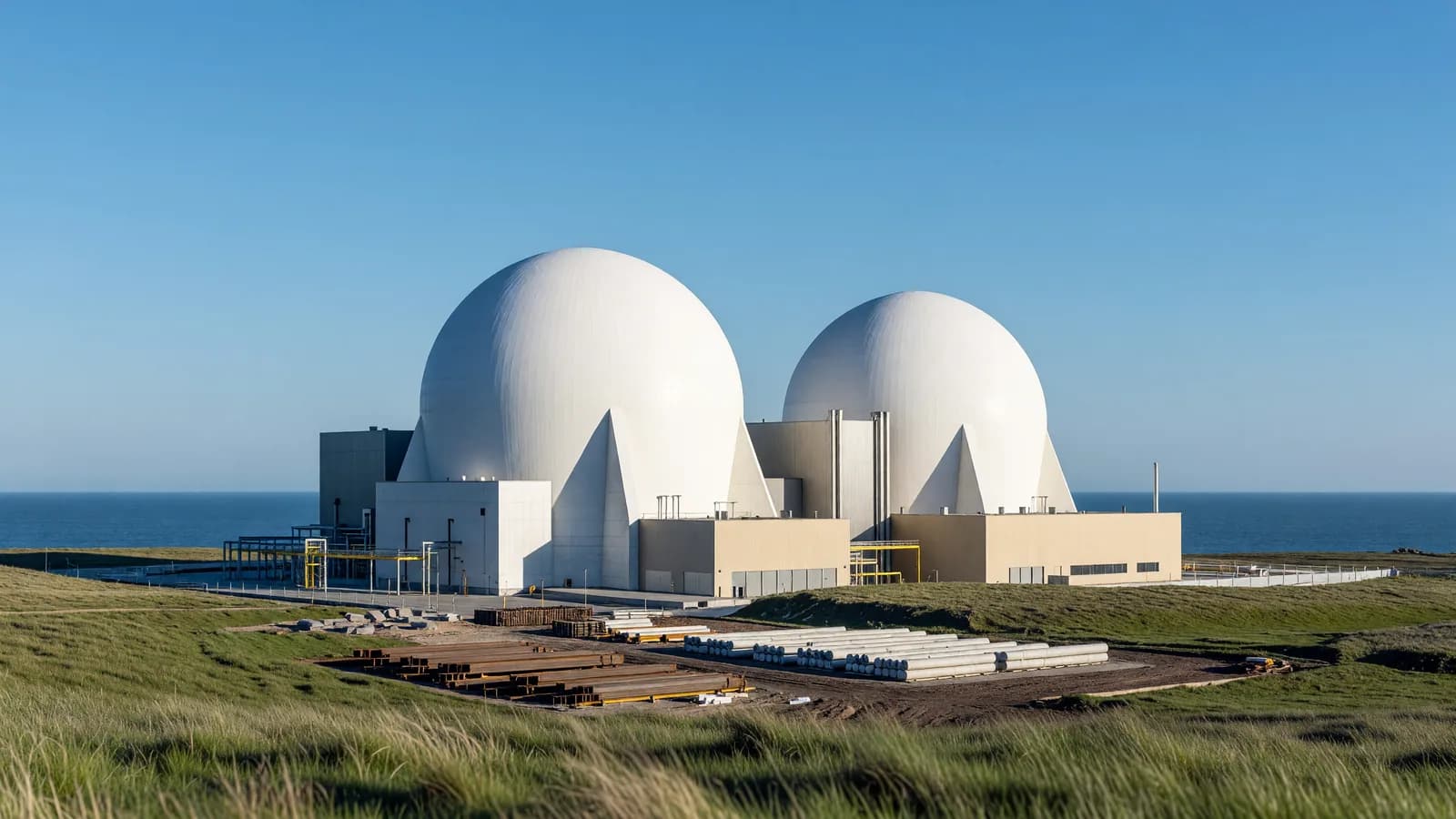
The United Kingdom has formally opened the Generic Design Assessment of X-energy's Xe-100 high-temperature gas-cooled reactor, the first HTGR to enter the country's modern design-review pipeline. The move, directed by the Department for Energy Security and Net Zero on 15 September, underpins a planned Centrica-backed fleet of up to 6 GW with EDF's Hartlepool site as the preferred first location.
Key facts
- The Generic Design Assessment of the Xe-100 will run about three years, with completion targeted for the end of 2029.
- X-energy and Centrica are pursuing up to 6 GW of Xe-100 capacity across the UK under a joint development agreement signed in September 2025.
- Each Xe-100 unit produces 80 MWe or 200 MWt; a standard four-pack totals 320 MWe, and sites can scale to 12 units.
- Hartlepool, the preferred first site, hosts an operating AGR plant scheduled to close in 2030.
- The design uses TRISO particle fuel, which retains integrity at temperatures well beyond those the reactor can reach.
- The NRC has been in pre-application engagement with X-energy since September 2018, feeding the cross-licensing path the UK review will use.
What happened
The Department for Energy Security and Net Zero (DESNZ) directed UK regulators to begin the Generic Design Assessment of the Xe-100 after completing reviews of X-energy UK Holdings Ltd's application, World Nuclear News reported on 15 September. X-energy had submitted the application on 2 June 2026, so the acceptance phase ran just over three months.
The timing lands exactly one year after Centrica and X-energy Reactor signed their Joint Development Agreement to deploy the Xe-100 in Britain. The companies have identified the Hartlepool site in north-east England — operated by EDF and Centrica — as the preferred first location for the planned fleet.
GDA is a voluntary process run by the Office for Nuclear Regulation, the Environment Agency and Natural Resources Wales, assessing the safety, security and environmental implications of a design separately from any decision to build it at a specific site. Successful completion brings a Design Acceptance Confirmation from the ONR and a Statement of Design Acceptability from the Environment Agency. The ONR said the assessment will begin "once the necessary arrangements around timescales and resources have been put in place," and noted that X-energy UK is already engaging with regulators through a Tier 3 Preliminary Design Review on selected Xe-100 topics.
X-energy said the review will benefit from expanded ONR-NRC collaboration, which allows NRC-reviewed design documentation and safety analyses to carry directly into UK design reviews. The partners have also submitted a proposal for entry into the UK Government's Advanced Nuclear Pipeline, a register of privately led advanced nuclear projects the government judges sufficiently mature to deliver; the companies said results of that submission are imminent.
Why it matters
This is the clearest licensing path yet for a non-light-water reactor in a Western regulator's formal process. Every SMR that has completed the modern GDA so far has been a light-water design; the Xe-100's high-temperature, TRISO-fueled architecture is a different regulatory problem, and how the ONR and Environment Agency handle it will set precedent for every HTGR, sodium-cooled and molten-salt design behind it.
The milestone also tightens the link between UK policy and X-energy's balance sheet. X-energy went public on Nasdaq in 2025 and is simultaneously building its first US Xe-100 plant with Dow on the Texas Gulf Coast and developing a second project with Energy Northwest and Amazon for up to 12 units in Washington state. UK acceptance adds a third front, with Centrica — one of Britain's largest energy suppliers — as the counterparty. The companies estimate the UK program carries a minimum of £40 billion in lifetime economic value, including £12 billion from the first project, figures X-energy bases on its 2024 Future Nuclear Enabling Fund studies.
For the UK, the GDA start is the regulatory half of a build program that is already showing up in employment data. Nuclear sector jobs passed 100,000 for the first time this year, driven by Sizewell C construction, and a Hartlepool Xe-100 plant would anchor the next wave in the north-east. See our policy-regulation coverage for the regulatory arc and top-smr-developers-2026 for where X-energy ranks in the global SMR race.
Background
The UK has deeper experience with gas-cooled reactors than any other country: eight Advanced Gas-Cooled Reactors remain in operation, a technological predecessor to X-energy's HTGR line. That history cuts both ways for the GDA. The regulator understands gas-cooled physics, but it also knows where the AGR fleet's ageing-plant problems came from, and the Xe-100's pebble-bed TRISO core is a distinct design from the AGR's graphite-moderated fuel elements.
The GDA process itself has been modernized under the government's Nuclear Regulatory Review push to accelerate deployment, and the ONR-NRC memorandum formalized in 2025 is the practical lever: it lets applicants reuse work already done for the US regulator rather than re-deriving it. X-energy has been in early engagement with UK authorities since 2024, and its US pre-application dialogue with the NRC dates to September 2018.
The fuel question runs parallel. The Xe-100 needs HALEU-class TRISO fuel, and X-energy's own TRISO-X facility plus its supply agreement with Centrus cover the near term; the UK program will eventually need its own fuel-logistics answer, one of the items the Future Nuclear Enabling Fund studies examined.
What's next
The ONR must finalize timescales and resources before formal assessment steps begin; X-energy is targeting a GDA conclusion by end-2029. Watch for the Advanced Nuclear Pipeline decision, which the companies say is imminent, and for Hartlepool-specific milestones: site studies, planning and consenting work, and progress at the Nuclear and Electrical Trades Academy launched with local bodies to build the workforce. EDF's Hartlepool AGR is scheduled to close in 2030, so the gap between that shutdown and a first Xe-100 unit on the same site is the number that matters for the town.
Questions
- What is the Xe-100 and why did it enter UK assessment?
- The Xe-100 is X-energy's 80 MWe high-temperature gas-cooled reactor using TRISO particle fuel. The UK directed regulators to begin its Generic Design Assessment on 15 September 2026 after reviewing the application X-energy submitted in June — the first HTGR to enter the modern GDA pipeline.
- How big could the UK Xe-100 fleet be?
- X-energy and Centrica are pursuing up to 6 GW of Xe-100 capacity nationwide under a joint development agreement signed in September 2025. Hartlepool, where EDF operates an AGR plant scheduled to close in 2030, is the preferred first site for a 12-unit, 960 MWe plant.
- How long does Generic Design Assessment take?
- GDA is expected to take about three years, with X-energy targeting completion by the end of 2029. It ends with a Design Acceptance Confirmation from the Office for Nuclear Regulation and a Statement of Design Acceptability from the Environment Agency, separate from site-specific licensing.
- Why does US-UK regulatory collaboration matter here?
- Expanded ONR-NRC cooperation lets UK reviewers use NRC-reviewed Xe-100 design documentation and safety analyses directly, which X-energy says creates efficiency gains. The NRC has been in pre-application engagement with X-energy since September 2018.
Sources
- UK regulators to begin Xe-100 design assessment — World Nuclear News
- X-energy Submits Xe-100 HTGR for UK Generic Design Assessment — X-energy
- Generic Design Assessment (GDA) of new nuclear power stations — Office for Nuclear Regulation
- NRC-ONR collaboration on advanced reactor licensing (news release 25-056) — US Nuclear Regulatory Commission
- UK nuclear jobs surpass 100,000 for first time, led by Sizewell C construction — NucNet
About Nuclear News Network
Nuclear News Network (NNN) is an independent publication covering the global nuclear energy sector — reactor construction, SMRs, fuel supply, policy, operations and fusion. NNN publishes a daily brief, same-day analysis of major developments, and reference guides used across the industry. Articles are produced by the NNN Newsroom, an editorial automation system with human oversight, under the publication's editorial standards. Ruben Seoane is the founder and main editor of NNN.