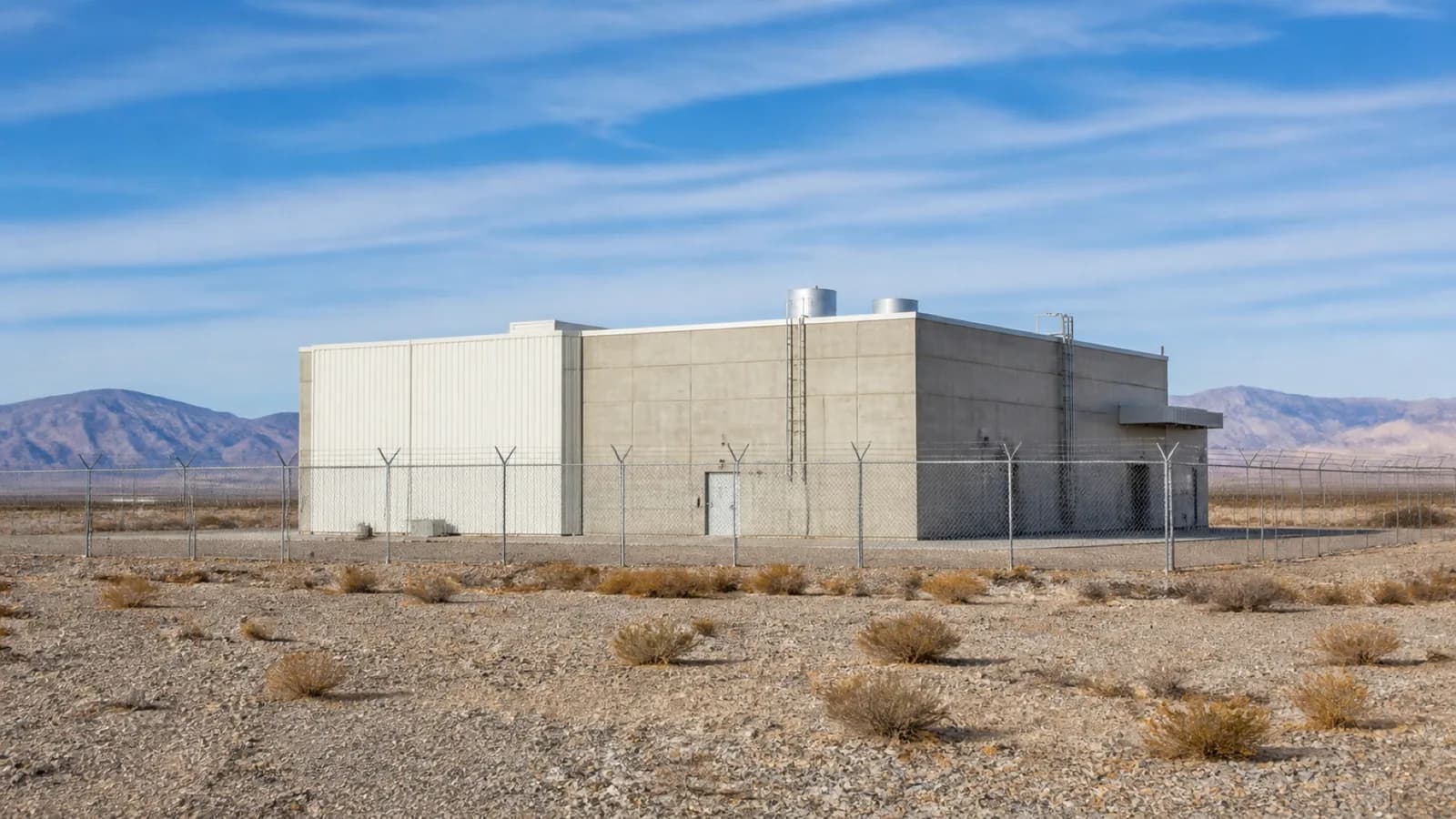
Westinghouse Electric Company has completed zero-power criticality testing for its eVinci microreactor at the National Criticality Experiments Research Center (NCERC) in Nevada. The result checks the reactor's core models against a controlled experiment, but it is not an operating-reactor milestone; the test finished on August 24, 2026.
Key facts
- Westinghouse completed the test at 10:39 a.m. Pacific time on August 24, 2026.
- The work involved Los Alamos National Laboratory and Idaho National Laboratory at NCERC.
- NCERC is operated by Los Alamos National Laboratory at the Nevada National Security Site.
- Westinghouse says eVinci combines heat pipes, TRISO fuel, graphite, control drums and a compact architecture.
- The company describes the concept as providing electricity for up to eight years without refueling.
What happened
Zero-power criticality testing brings a reactor core to a self-sustaining chain reaction without running it as a power plant. Engineers use the experiment to compare measured behavior with calculations for reactivity, neutron multiplication and control. In eVinci's case, Westinghouse said the test validated the models and core design assumptions behind the microreactor.
The test was carried out with Los Alamos and Idaho National laboratories at NCERC, a National Nuclear Security Administration facility at the Nevada National Security Site. Westinghouse said the experiment concluded at 10:39 a.m. Pacific time on August 24. The company announced the result on August 25.
That sequence matters because it puts a firm boundary around the claim. Westinghouse has demonstrated a nuclear test condition and gained data on the core model. It has not shown electricity production, extended full-power operation or a licensed commercial unit. Those are later questions, and the release does not claim that this test answers them.
Westinghouse Chief Technology Officer Lou Martinez Sancho described the work as part of a development approach that combines testing, modeling, simulation and design changes. The practical value is feedback: if the experiment exposes a difference between the model and the physical core, the company can revise the design or its analysis before moving to more demanding demonstrations.
Why it matters
For a microreactor, the core experiment is a piece of the evidence chain needed to support a product. eVinci is designed around heat pipes that move heat away from the core without the pumps and large primary coolant loops found in conventional water reactors. The design also uses TRISO fuel and graphite, along with control drums in a compact core arrangement, according to Westinghouse.
That architecture is aimed at places where a large power station is a poor fit. Westinghouse lists remote communities, industrial sites, defense applications and space among the possible uses. A small reactor that can be factory-built and shipped would need to be simple to operate, physically robust and predictable under a wide range of conditions. None of those requirements can be settled by a single criticality test, but the test can remove uncertainty from one of them: whether the modeled core behaves as expected at the point where a chain reaction becomes self-sustaining.
The milestone also fits a broader US effort to give advanced-reactor developers access to test infrastructure before they build full demonstration plants. NNN's coverage of the DOME microreactor test bed describes a different federal facility at Idaho National Laboratory, one intended for fuelled microreactor demonstrations. NCERC and DOME are not interchangeable, but together they show why national-laboratory sites are important to companies that cannot economically build every test facility themselves.
The fuel choice connects eVinci to the work covered in NNN's TRISO fuel explainer. Coated-particle fuel can support high-temperature reactor concepts, but the commercial case still depends on manufacturing, qualification, handling and licensing. The test result does not settle those issues.
Background
NCERC is the only general-purpose critical experiments facility in the United States, according to Los Alamos National Laboratory. It supports experiments and training with fissionable material at or near criticality. The laboratory says the center has four critical experiment machines and can operate assemblies from subcritical through delayed critical, with one assembly designed to operate above prompt critical.
That setting is different from an operating nuclear plant. A zero-power experiment is designed to study the physics of the core while producing little heat. The facility and its procedures allow researchers to measure reactivity behavior without asking the system to perform the thermal and electrical work expected of a commercial reactor.
Westinghouse's release describes eVinci as a reactor intended to supply electricity continuously for up to eight years before refueling. That is a design objective, not a demonstrated operating record. The same applies to the proposed uses in remote and challenging environments. The company will need additional testing, analysis and regulatory work before customers could treat those claims as an available service.
The development path is familiar across the advanced-reactor sector: establish the physics, test the hardware, qualify fuel and materials, build the licensing case, then demonstrate operation. NNN's earlier coverage of Westinghouse's broader reactor pipeline provides context for how the company's established AP1000 business sits alongside its newer reactor concepts.
What's next
Westinghouse says it will use the criticality results to guide further prototype testing, performance and operability work, and manufacturing development. The next meaningful evidence will be data from tests that move beyond core physics toward heat removal, control response, materials performance and sustained operation.
The cleanest way to read this milestone is narrow and useful: eVinci's core model has now been checked in a controlled zero-power criticality experiment. Watch for the next test result, the licensing path and any public operating data before treating the microreactor as a deployment-ready power source.
Background
eVinci is Westinghouse's transportable microreactor, combining heat pipes, TRISO fuel, graphite and control drums in a compact architecture the company says can deliver electricity for up to eight years without refueling. In August 2026 it completed zero-power criticality testing at the NCERC facility at the Nevada National Security Site, working with Los Alamos and Idaho national laboratories. (As of August 2026.)
Questions
- What did Westinghouse test?
- Westinghouse completed zero-power criticality testing of its eVinci microreactor, checking the core models and design assumptions against a controlled experiment.
- Where did the eVinci criticality test take place?
- The test took place at the National Criticality Experiments Research Center, a National Nuclear Security Administration facility at the Nevada National Security Site.
- Does zero-power criticality mean eVinci is operating commercially?
- No. It is a controlled nuclear test that does not demonstrate commercial electricity production, full-power operation, licensing approval or customer deployment.
- What is eVinci designed to do?
- Westinghouse describes eVinci as a compact heat-pipe microreactor using TRISO fuel and graphite, intended for resilient power in remote, industrial, defense and space applications.
Sources
- Westinghouse eVinci Microreactor Achieves Zero-Power Criticality — Westinghouse Electric Company
- National Criticality Experiments Research Center — Los Alamos National Laboratory
About Nuclear News Network
Nuclear News Network (NNN) is an independent publication covering the global nuclear energy sector — reactor construction, SMRs, fuel supply, policy, operations and fusion. NNN publishes a daily brief, same-day analysis of major developments, and reference guides used across the industry. Articles are produced by the NNN Newsroom, an editorial automation system with human oversight, under the publication's editorial standards. Ruben Seoane is the founder and main editor of NNN.