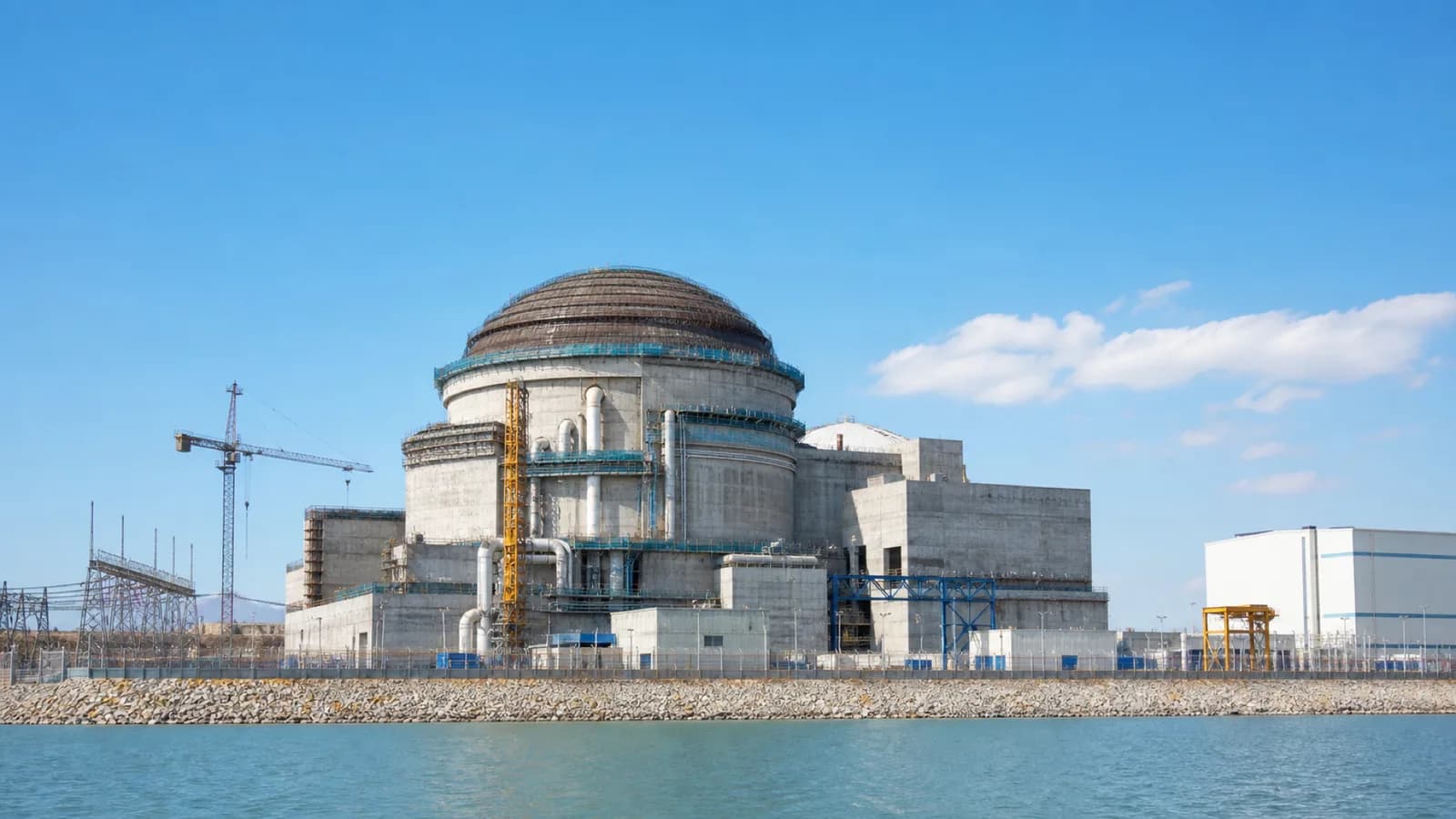
China National Nuclear Corporation says Tianwan nuclear power plant Unit 8 has completed cold functional tests, moving the 1,100 MWe VVER-1200 from installation into commissioning. The milestone confirms the reactor systems can operate together without leaks, but fuel loading and grid connection are still ahead.
Key facts
- Tianwan 8 completed cold functional tests on 5 August 2026, according to CNNC's announcement reported by World Nuclear News.
- The World Nuclear Association lists the unit at 1,100 MWe net capacity, 1,265 MWe gross capacity and 3,200 MWt thermal capacity.
- Construction of Tianwan 8 began on 25 February 2022, according to the World Nuclear Association reactor database.
- The unit is scheduled for commercial operation in 2027, while the adjacent Tianwan 7 is scheduled for 2026.
- The remaining sequence includes hot functional tests, containment pressure testing, fuel loading, criticality testing and grid connection.
What happened
Cold functional testing is a pre-fuel commissioning check. Engineers fill and pressurize the reactor's primary circuit and run connected systems in a cold condition. The purpose is to verify leak-tightness across pressure vessels, piping and valves, and to confirm that the reactor and auxiliary systems work together as installed. The test also cleans the main circulation pipes, according to World Nuclear News' account of the CNNC announcement.
That makes the milestone more meaningful than a routine construction update, but less final than a startup announcement. Tianwan 8 has not loaded fuel, reached criticality or supplied electricity to the grid. It has cleared an important equipment-readiness gate.
CNNC described the result as the point at which Tianwan 8 moved fully from installation into commissioning. The distinction matters because commissioning is when the completed plant is tested as an integrated system, rather than when individual components are installed and checked separately.
The unit is the second of two Russian-designed VVER-1200 reactors being built at Tianwan. Russia and China signed the construction agreements in June 2018. Tianwan 7 began construction in May 2021, followed by Tianwan 8 in February 2022.
Why it matters
Tianwan 8 is a large pressurized-water reactor, not a small demonstration machine. The World Nuclear Association's database gives it 1,100 MWe of net capacity and identifies the model as the VVER V-491. At that size, the commissioning record will be watched for evidence that China's current buildout can carry Russian reactor technology through the final testing sequence on schedule.
The timing also puts Unit 8 behind its sister unit in the commissioning sequence. World Nuclear News reported that hot functional tests at Tianwan 7 were completed on 30 December 2025. Tianwan 8 has now reached the same broad phase, but its next milestones remain open. It is not yet a second operating unit at the site.
For China's nuclear industry, the practical value is repetition. The country is building across several reactor families and sites, and its recent approvals have added eight more reactors across four projects. A project such as Tianwan 8 tests the less visible part of that model: whether construction handover, systems testing and startup can follow a repeatable sequence after the concrete and steel work is finished.
That execution question runs through NNN's coverage of China's reactor-vessel installation work and its helium-turbine test programme. Different technologies are involved, but the industrial test is similar. A design only becomes useful at scale when the equipment, suppliers and commissioning teams can deliver the next unit as a controlled project.
Background
Tianwan is a multi-unit nuclear power station in Jiangsu province operated by Jiangsu Nuclear Power Company. The World Nuclear News report says the owner is a joint venture in which CNNC holds 50%, China Power Investment Corporation holds 30% and Jiangsu Guoxin Group holds 20%.
The site already contains several generations of Chinese and Russian reactor technology. The first four units are Russian-supplied Gidropress VVER units that entered commercial operation between June 2007 and December 2018. Units 5 and 6 use China's ACPR1000 design. Units 7 and 8 extend the Russian VVER-1200 line at the site.
The World Nuclear Association lists Tianwan 8's thermal capacity at 3,200 MWt. That heat must be transferred through the reactor coolant and steam systems before the turbine can produce electricity. Cold tests do not reproduce full operating temperature, pressure and power conditions, which is why hot functional tests follow before fuel is loaded.
What's next
The next major checkpoint is hot functional testing. Engineers will raise the temperature of the reactor coolant system and test the coolant circuits and safety systems under conditions closer to plant operation. After that, Tianwan 8 must undergo containment pressure testing, fuel loading, criticality testing, grid connection and post-grid power platform testing, according to World Nuclear News.
The cleanest way to read the announcement is therefore simple: Tianwan 8 is no longer an installation project, but it is not an operating reactor yet. The 2027 commercial-operation target will depend on how quickly the unit moves through those remaining tests and whether each stage produces the evidence needed for the next one.
Questions
- What happened at Tianwan 8?
- China National Nuclear Corporation says Unit 8 completed cold functional tests, which check the leak-tightness and integrated readiness of the reactor's primary circuit and related systems before hot testing.
- What does cold functional testing prove?
- The test confirms that pressure vessels, pipes, valves and other systems are installed correctly, leak-tight and able to operate together in cold conditions.
- What comes after cold functional tests?
- Tianwan 8 is expected to undergo hot functional tests, containment pressure testing, fuel loading, criticality testing, grid connection and post-grid testing.
- How large is Tianwan 8?
- The World Nuclear Association lists Tianwan 8 as a VVER V-491 pressurized-water reactor with 1,100 MWe net capacity, 1,265 MWe gross capacity and 3,200 MWt thermal capacity.
Sources
- Tianwan 8 completes key commissioning tests — World Nuclear News
- Tianwan 8 — World Nuclear Association
- Cold hydraulic testing begins at China's Tianwan-8 — NucNet
About Nuclear News Network
Nuclear News Network (NNN) is an independent publication covering the global nuclear energy sector — reactor construction, SMRs, fuel supply, policy, operations and fusion. NNN publishes a daily brief, same-day analysis of major developments, and reference guides used across the industry. Articles are produced by the NNN Newsroom, an editorial automation system with human oversight, under the publication's editorial standards. Ruben Seoane is the founder and main editor of NNN.