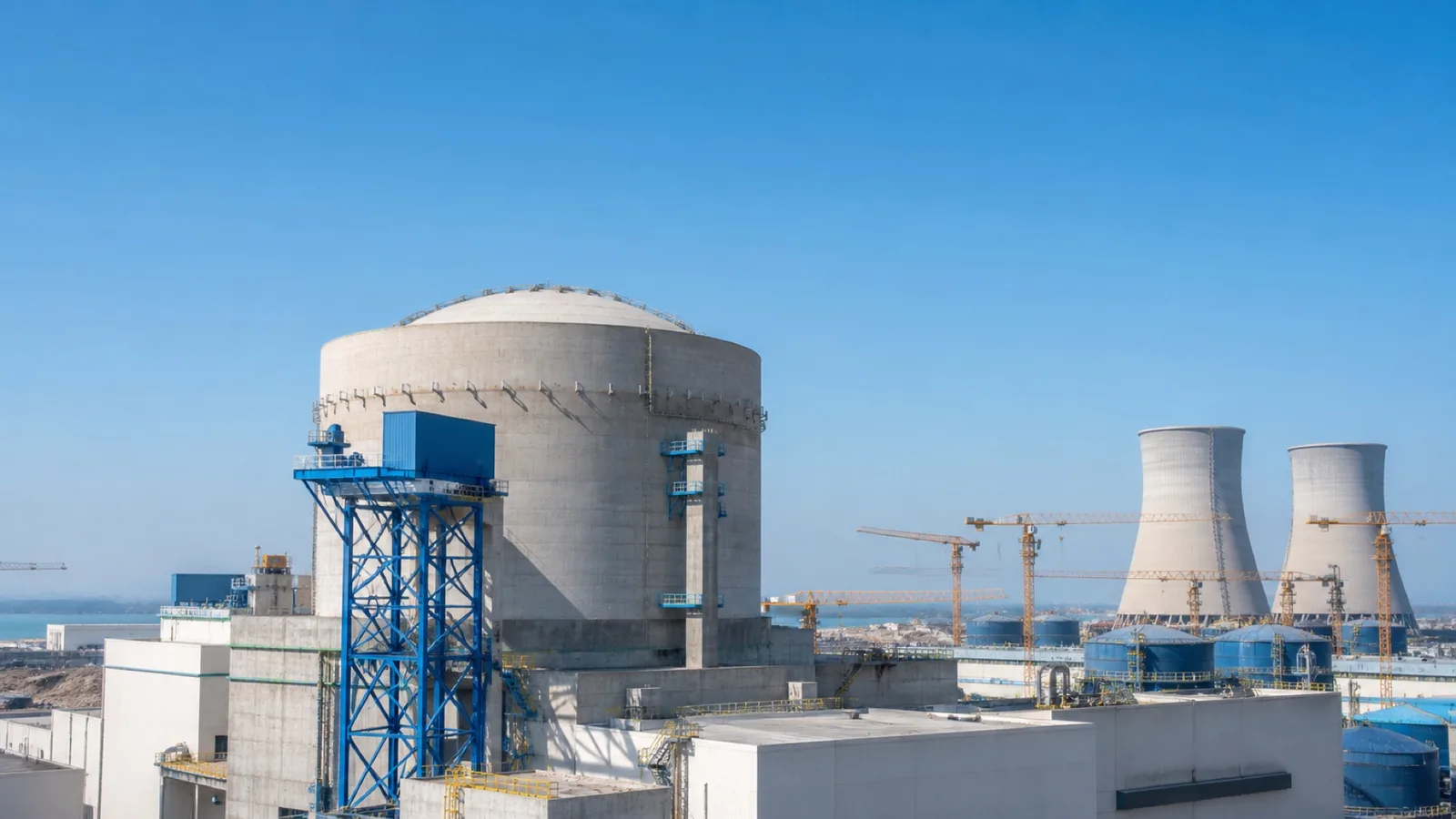
State Power Investment Corporation (SPIC) has completed hot functional tests at Haiyang Unit 3 in China’s Shandong province. The milestone clears a major pre-fuel commissioning gate for the CAP1000 reactor, with SPIC targeting fuel loading and first grid connection within 2026.
Key facts
- Haiyang-3 completed hot tests on August 13, 2026.
- The campaign covered 53 commissioning procedures, 308 test chapters and 30 periodic tests.
- Testing used 11 temperature rise and fall platforms.
- Haiyang-3 and Haiyang-4 are CAP1000 reactors, China’s version of the Westinghouse AP1000.
- SPIC said fuel loading and first grid connection are targeted within 2026.
What happened
Hot functional testing heats the reactor coolant system and runs integrated tests at temperatures and pressures similar to those expected during normal operation. It is carried out before fuel loading, so operators can verify equipment and interfaces without introducing nuclear fuel into the reactor.
At Haiyang-3, the campaign used 11 temperature rise and fall test platforms. SPIC said the work included 53 commissioning procedures, 308 test chapters and 30 periodic tests. The unit also completed transient tests including a non-nuclear steam-turbine start-up and a main-pump coasting test, all on the first attempt, according to World Nuclear News.
The purpose is broader than checking one pump or one valve. Hot testing exercises the reactor systems together, including coolant circuits, safety systems and conventional equipment. It verifies that the interfaces fit, that thermal performance matches the design basis and that control systems respond as expected under operating conditions.
SPIC said the work laid a foundation for the next steps: fuel loading and first connection to the grid. The company said it aims to complete both within the year. That is a target, not a completed milestone, and it remains dependent on the remaining commissioning and regulatory steps.
Why it matters
Haiyang-3 is part of China’s repeat-build strategy. The site already hosts two AP1000 reactors, and Units 3 and 4 extend that design family with the Chinese CAP1000 configuration. The value of completing hot tests is therefore not only that one reactor has passed a gate. It is that the construction and commissioning sequence is being repeated at a site with operating nuclear units.
NNN’s coverage of Tianwan-7’s fuel loading shows the next, more irreversible commissioning stage at another Chinese site. Fuel loading means the plant is preparing for first criticality; hot testing is the integrated systems check that should come before it. NNN has also covered Tianwan-8’s cold functional tests, the lower-temperature predecessor to the Haiyang campaign.
The sequence matters because nuclear projects do not move from concrete to electricity in one step. Cold functional testing checks installation, leak-tightness and cleanliness of the primary circuit. Hot functional testing then exercises systems at operating temperatures and pressures. Fuel loading and first criticality follow, with grid connection and power ascension still ahead.
Background
China’s State Council approved construction of Haiyang Units 3 and 4 in April 2021. First safety-related concrete for Haiyang-3 was poured in July 2022; construction of Haiyang-4 began in April 2025, according to the WNN report. Both units are scheduled for full operation in 2027.
When all four units are operating, SPIC says the Haiyang site will generate 40 billion kilowatt-hours annually. That figure is a company estimate for the completed four-unit site, not the output of Unit 3 alone. The distinction matters when measuring what this week’s test actually adds: it advances one unit toward operation rather than instantly adding the full site’s planned generation.
The project is also part of a planned larger nuclear base. SPIC says the site is planned to have six 1,000-megawatt-class reactors, with space reserved for two future expansions. The immediate evidence, however, is the commissioning record at Unit 3.
That distinction is useful when reading construction headlines. A completed test campaign does not mean Haiyang-3 has reached commercial operation, but it does show that the unit has moved beyond installation checks and into integrated thermal commissioning. The remaining steps still have to demonstrate safe nuclear start-up and stable power production.
What’s next
The next watchpoints are fuel loading, first criticality, grid connection and power ascension. SPIC’s stated objective is to load fuel and connect Haiyang-3 within 2026. Haiyang-4 will continue its own construction and commissioning path, with both units targeted for full operation in 2027.
For Haiyang-3, the hot-test result is a strong pre-fuel milestone. The decisive confirmation will come when the unit moves through nuclear commissioning and begins sending electricity to the grid.
Questions
- What are hot functional tests?
- They heat and pressurize the reactor coolant system and test nuclear-island and conventional systems together under conditions that simulate normal operation, before fuel is loaded.
- How many tests were completed at Haiyang-3?
- SPIC reported 53 commissioning test procedures, 308 test chapters and 30 periodic tests across 11 temperature rise and fall platforms.
- What reactor is Haiyang-3?
- Haiyang-3 is a CAP1000 pressurized water reactor, the Chinese version of the Westinghouse AP1000 design.
Sources
- Hot tests completed at third Haiyang unit — World Nuclear News
- Nuclear Power in China — World Nuclear Association
About Nuclear News Network
Nuclear News Network (NNN) is an independent publication covering the global nuclear energy sector — reactor construction, SMRs, fuel supply, policy, operations and fusion. NNN publishes a daily brief, same-day analysis of major developments, and reference guides used across the industry. Articles are produced by the NNN Newsroom, an editorial automation system with human oversight, under the publication's editorial standards. Ruben Seoane is the founder and main editor of NNN.