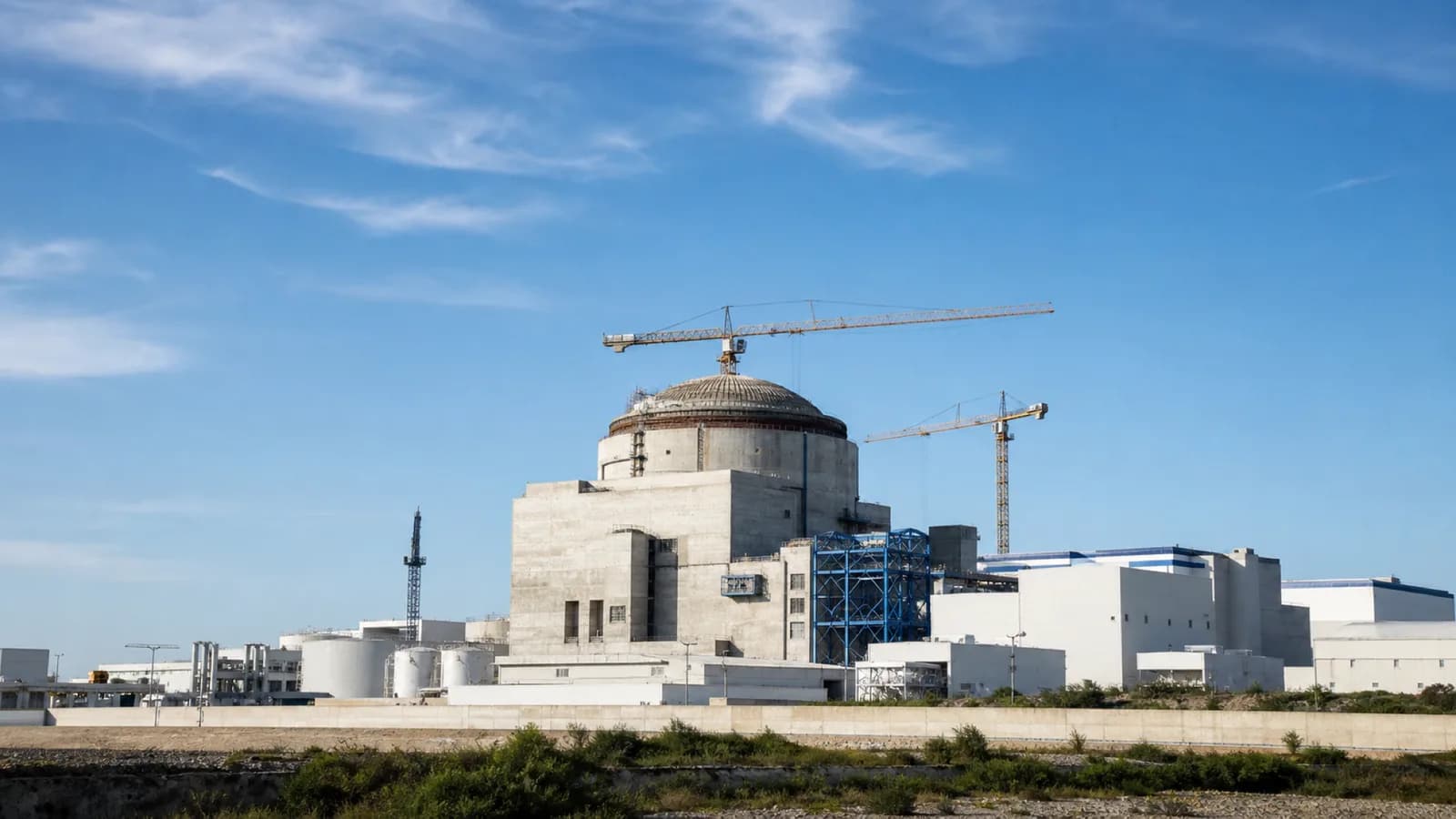
China National Nuclear Corporation has begun loading fuel into Tianwan nuclear power plant Unit 7 in Jiangsu province, moving the Russian-designed VVER-1200 into its final commissioning sequence. The first of 163 fuel assemblies entered the reactor core on 12 August, with commercial operation planned for 2026.
Key facts
- Fuel loading began on 12 August 2026, according to CNNC.
- Tianwan 7 will receive 163 fuel assemblies in its initial core loading.
- The unit is the first Russian-supplied Generation III+ VVER-1200 to reach fuel loading in China.
- Construction began in May 2021; Unit 8 followed in February 2022.
- Commercial operation is scheduled for 2026, while Tianwan 8 is planned for 2027.
What happened
Fuel loading is the point when a completed reactor begins to carry nuclear fuel, but it is not the same as startup. Operators still need to verify the loaded core, withdraw control rods in a controlled test programme, reach first criticality and check the plant at low power before the unit can generate electricity for the grid.
CNNC said the first assembly was loaded into Tianwan 7 on 12 August. The fuel was supplied by Russian state nuclear corporation Rosatom and manufactured at the Novosibirsk Chemical Concentrates Plant. The assemblies are part of the supply contract covering Tianwan Units 7 and 8, according to World Nuclear News.
NucNet reported that Jiangsu Nuclear Power Corporation owns the station. The company is a joint venture majority owned by CNNC. The two new units are Russian-designed VVER-1200 pressurized-water reactors, extending a China-Russia project first agreed in 2018.
The timing matters because Tianwan 7 is now ahead of its sister unit in the startup sequence. Tianwan 8 completed cold functional tests earlier this month, a systems-readiness milestone that comes before hot testing and fuel loading. NNN covered that step in Tianwan 8 completes cold functional tests.
Why it matters
Tianwan 7 is a concrete test of the last part of a large reactor project: moving from construction and system checks to a fuelled plant that can safely demonstrate its operating performance. A fuel-loading ceremony can look like the finish line in public announcements. It is closer to the start of the most closely watched testing phase.
That distinction is worth keeping in view as China continues to add reactors. NNN reported this month that Chinese authorities approved eight more reactors across four projects. Those approvals describe future capacity. Tianwan 7 shows what the delivery chain looks like several years later, when civil construction, equipment installation, fuel supply and commissioning have to line up in the same project.
The unit also carries a supply-chain story. China is operating several reactor designs, including Russian VVER units and domestically developed pressurized-water reactors. Tianwan 7 combines a Russian reactor design and initial fuel supply with construction and operation by Chinese companies. That arrangement gives both countries a live project through which to demonstrate equipment integration and fuel coordination, rather than relying only on an agreement or a reactor order.
The plant's scale adds weight to the milestone. Once all eight Tianwan units are operating, the station is expected to exceed 9 GWe of installed capacity and produce more than 70 TWh of electricity annually, according to project reporting. Those figures describe the completed site, not Tianwan 7 alone, and they should not be treated as current output.
Background
Tianwan is a multi-unit nuclear station in Jiangsu, on China's eastern coast. The first four units use Russian-supplied VVER designs and entered commercial operation between 2007 and 2018. Units 5 and 6 use China's ACPR1000 design. Units 7 and 8 return to the VVER family, this time with the VVER-1200 design supplied under the China-Russia agreement.
Construction on Unit 7 started in May 2021. Hot functional tests, which simulate the temperatures and pressures expected during normal operation without nuclear fuel in the core, were completed on 30 December 2025, according to CNNC's announcement as reported by World Nuclear News. Those tests prepared the unit for the fuel-loading step now under way.
Fuel loading does not prove that the reactor is ready for commercial service. It shows that the project has reached a controlled, fuelled commissioning phase. The plant's teams must still demonstrate that the reactor physics, cooling systems, turbine systems, electrical equipment and safety systems perform as required under progressively higher-power conditions.
What's next
The immediate watchpoint is completion of the 163-assembly loading campaign and the inspections that follow it. After that, Tianwan 7 is expected to move toward first criticality, a low-power physics test programme and grid connection. Commercial operation will come only after those tests and the post-grid commissioning work are complete.
The clean reading is simple: Tianwan 7 has crossed a major commissioning gate, but it has not started commercial generation. The next public milestone should show whether the unit can move from fuel loading to criticality and grid connection in time to meet its 2026 operating target.
Questions
- What happened at Tianwan 7?
- China National Nuclear Corporation began loading the first of 163 fuel assemblies into Unit 7 on 12 August 2026. The reactor is now in the fuelled commissioning phase, before criticality and grid connection.
- Is Tianwan 7 operating commercially?
- No. Fuel loading comes before first criticality, low-power testing, grid connection and post-grid testing. Commercial operation is scheduled for 2026, according to project reporting.
- Who supplied Tianwan 7's reactor and fuel?
- The reactor is a Russian-designed VVER-1200. Rosatom supplied the initial fuel, manufactured at the Novosibirsk Chemical Concentrates Plant, under the contract for Tianwan Units 7 and 8.
- What is the status of Tianwan 8?
- Tianwan 8, the sister VVER-1200, has completed cold functional tests but remains behind Unit 7 in the commissioning sequence. Its planned commercial operation date is 2027.
Sources
- First fuel loaded into Tianwan unit 7 — World Nuclear News
- Fuel Loading Begins At China’s Tianwan-7 Nuclear Power Plant — NucNet
- Tianwan 7 — World Nuclear Association
About Nuclear News Network
Nuclear News Network (NNN) is an independent publication covering the global nuclear energy sector — reactor construction, SMRs, fuel supply, policy, operations and fusion. NNN publishes a daily brief, same-day analysis of major developments, and reference guides used across the industry. Articles are produced by the NNN Newsroom, an editorial automation system with human oversight, under the publication's editorial standards. Ruben Seoane is the founder and main editor of NNN.