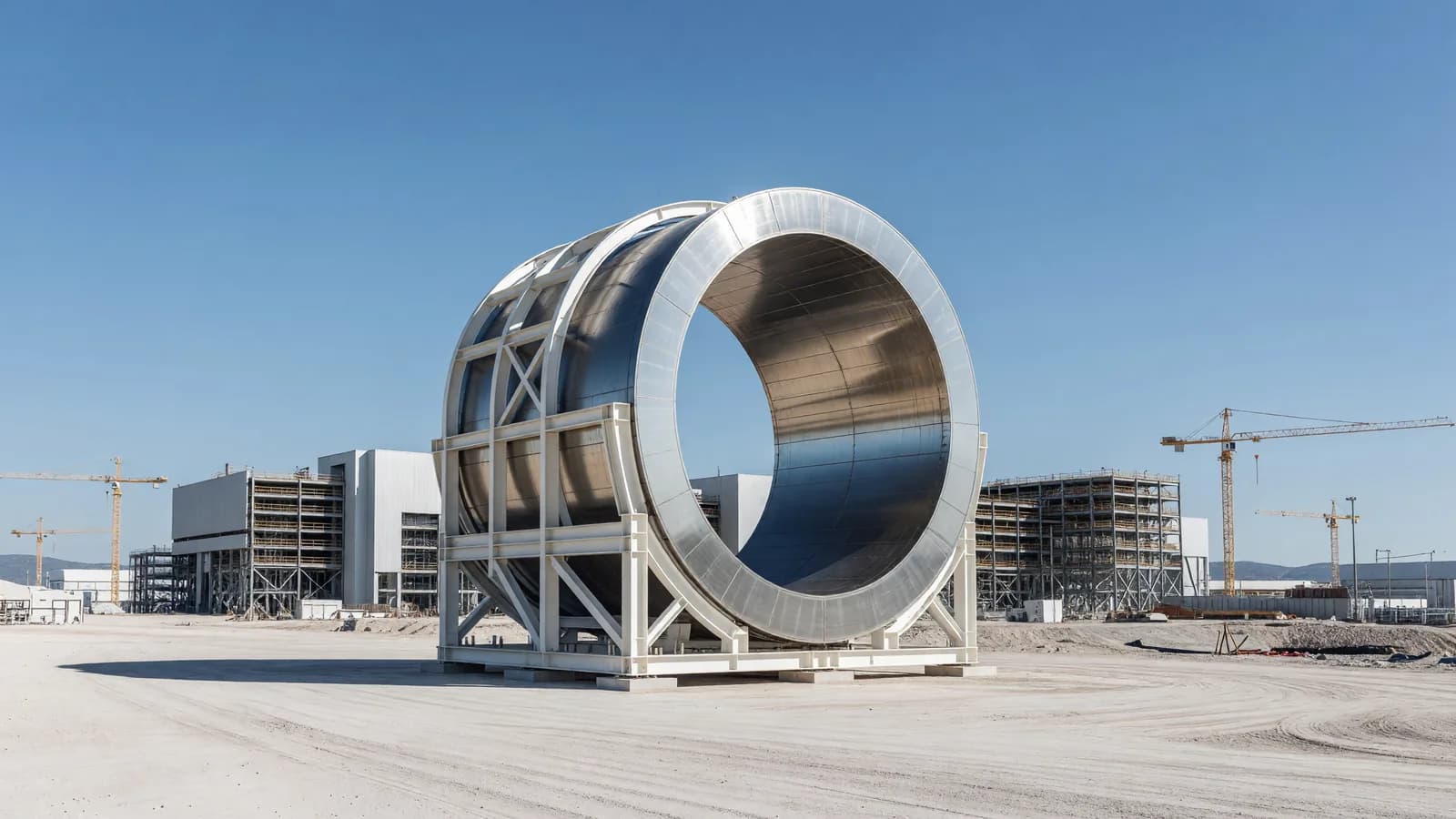
ITER received the ninth and final vacuum vessel sector for its tokamak on Oct. 2, bringing all major components needed for the fusion experiment’s core machine to the Cadarache site in southern France. The delivery closes a long procurement phase, but much assembly and commissioning work remains before ITER can begin research operations.
Key facts
- ITER received vacuum vessel sector #2, the ninth and final sector, on Oct. 2, 2026.
- The nine sectors will form a vessel 19.4 meters in diameter and 11.4 meters tall.
- The completed vessel is expected to weigh about 5,200 metric tons.
- ITER says all core-machine components are now on site, though in-vessel components and plant systems remain to be installed (ITER Organization).
What happened
The final piece was sector #2, a curved stainless-steel section of the vacuum vessel that will contain ITER’s plasma. It arrived at the project site on Friday, Oct. 2, and was unveiled from its protective housing during a gathering on Oct. 5, the ITER Organization reported. The project calls it the last large component of the machine and says its arrival puts the components needed for the core tokamak assembly on site.
ITER Director-General Pietro Barabaschi said the delivery would allow machine assembly activities to continue according to schedule. The component was procured by Fusion for Energy, the European domestic agency for ITER. It was manufactured by the AMW consortium, which includes Ansaldo Nucleare, Westinghouse Electric Company and Walter Tosto, with a broader supply chain of at least 15 companies, according to ITER.
Europe produced five of the nine vessel sectors; South Korea produced the other four. The European procurement program took more than 16 years and drew on knowledge from the Korean manufacturing program, ITER said. American Nuclear Society’s Nuclear Newswire reported that the final sector was made at a Westinghouse factory in Monfalcone, Italy, and transported to Cadarache by Daher.
This was a delivery milestone, not a completion announcement. ITER distinguishes the “core machine” from the full experimental facility. The core includes the cryostat, superconducting magnets and vacuum vessel with its thermal shield. Components inside the vessel, including the divertor and blanket, are outside that definition and still form part of the work ahead.
Why it matters
A tokamak vacuum vessel is the sealed chamber that holds the plasma and provides the structure around which the machine’s magnetic systems are assembled. ITER’s vessel is being built from nine sectors, joined into a single torus. Getting the final sector to the site removes a major procurement dependency; it does not remove the demanding precision work of positioning, welding and integrating those components.
The assembled vessel’s dimensions give a sense of that task: 19.4 meters in diameter and 11.4 meters high, with a mass of roughly 5,200 metric tons. These are plans for the finished vessel, not measurements of the delivered segment. Each sector must be positioned and joined within tight tolerances before the complete vacuum boundary can be used in the fusion experiment.
ITER is designed to study burning-plasma conditions and the integrated technologies needed for future fusion plants. The project says its tokamak is intended to produce 500 megawatts of fusion power from 50 megawatts of input heating power, a plasma-level performance objective. ITER will not convert that fusion power into electricity for the grid. The objective is to test physics and systems, not to sell power.
For the fusion sector, that distinction matters. ITER’s progress can demonstrate that large international supply chains can deliver complex hardware and that plasma experiments can probe reactor-relevant conditions. It cannot by itself establish the economics, reliability or electricity output of a commercial power station. NNN’s fusion explainer lays out those differences between experimental machines and proposed power plants.
Background
ITER is being built near Cadarache in southern France through a partnership of seven members: China, the European Union, India, Japan, South Korea, Russia and the United States. Its components are manufactured across member countries and brought together at the site for assembly. The distribution of work is part of the project’s technical and political design, but it also makes schedule coordination and quality control central to construction.
Machine assembly began in 2020, when the cryostat base was lowered into the tokamak pit, according to ITER. Six years later, the delivery of the last large core component closes a chapter in procurement. The vessel sector is not a reactor module that can operate on its own; it is one part of a machine that still needs in-vessel hardware, plant systems and extensive integration.
NNN has previously covered Commonwealth Fusion Systems’ $1 billion financing round and Tennessee’s first fusion-specific license type. Those stories concern private development and regulatory policy. ITER is a separate, multinational research project, and its purpose is to test fusion science and integrated technologies rather than provide commercial electricity.
What's next
The next work is inside the assembly process: teams must integrate the sectors with ITER’s other major systems, then continue installation of in-vessel components and plant equipment. ITER says the final delivery allows assembly activities to proceed according to schedule, but the organization’s statement does not mean the vessel or machine is complete.
ITER’s stated operational goals, as reported by the American Nuclear Society, are research operations in 2034, full magnetic energy in 2036 and deuterium-tritium operations in 2039. Those are project milestones still ahead; the October delivery neither changes them nor proves they will be met. The useful measure to watch now is progress on sector installation and integration, followed by commissioning of the systems needed for the first experimental program.
Questions
- What did ITER receive in October 2026?
- ITER received vacuum vessel sector #2, the ninth and final sector, at its Cadarache site on Oct. 2, 2026.
- Does the delivery mean ITER is ready to produce fusion power?
- No. The sector is a major assembly component. ITER still must assemble the machine, install other equipment and commission its systems before research operations.
- How large will ITER's assembled vacuum vessel be?
- The assembled vessel is planned to measure 19.4 meters across and 11.4 meters high, with a mass of about 5,200 metric tons.
Sources
- A remarkable chapter draws to a close — ITER Organization
- ITER Project Progress in Milestones — ITER Organization
- What will ITER do? — ITER Organization
- ITER welcomes last major component needed for core machine assembly — American Nuclear Society
About Nuclear News Network
Nuclear News Network (NNN) is an independent publication covering the global nuclear energy sector — reactor construction, SMRs, fuel supply, policy, operations and fusion. NNN publishes a daily brief, same-day analysis of major developments, and reference guides used across the industry. Articles are produced by the NNN Newsroom, an editorial automation system with human oversight, under the publication's editorial standards. Ruben Seoane is the founder and main editor of NNN.