Singapore's nuclear-energy strategy is a programme to build the expertise needed to decide whether to adopt nuclear power, not an approved power-plant project. With about 95% of its electricity produced from imported natural gas, the city-state is exploring a different energy-security model—and building an investment and engineering ecosystem that could matter even without a domestic reactor.
Key facts
- Deployment remains undecided. Singapore's official policy is to assess advanced nuclear technologies against safety, reliability, affordability and environmental sustainability. It has not announced a domestic reactor project, selected site or operating date.
- The next major public checkpoint is an international readiness assessment. The government schedules the IAEA's INIR Phase 1 mission tentatively for 2027, with its final report tentatively in 2027–2028. That review is not permission to build a plant.
- Nuclear capability building has a real funding history. MTI reports more than S$150 million invested since 2014. A separately announced S$66 million grant supports the next phase of nuclear-safety research; the figures should not be added without reconciling their coverage.
- The safety regulator is commissioning substantive preparatory work. The National Environment Agency announced three studies covering nuclear safety standards, environmental standards and environmental considerations.
- Singapore already participates in fusion's industrial supply chain. A*STAR and Commonwealth Fusion Systems announced a five-year research partnership, building on component work involving ST Engineering. This is distinct from the assessment of a domestic fission power plant.
- Overseas investment is not a domestic construction budget. Temasek is an early CFS investor, but the company's US$4 billion cumulative fundraising disclosed in July 2026 is a global company total—not Temasek's investment amount and not money allocated to a Singapore reactor.
Policy and investment status checked on 22 September 2026. This guide distinguishes operating capabilities, funded research, commercial investments and proposals. S$ means Singapore dollars; US$ means US dollars.
Why Singapore is taking nuclear energy seriously
The underlying problem is unusually concrete. Singapore needs electricity for homes, cooling, water infrastructure, manufacturing and a digital economy, but it has limited room to produce low-carbon energy. Importing fuel has supported an exceptionally reliable power system. It also leaves the country exposed to decisions, prices and disruptions elsewhere.
Nuclear power is attractive because it might change the balance of that dependence. A nuclear station would still require imported fuel and specialist services. However, fuel can be purchased and stored differently from a continuous flow of pipeline gas or regular liquefied-natural-gas deliveries. A domestic reactor could turn a relatively compact fuel inventory into a long-duration source of electricity.
That is a diversification argument, not a claim of complete energy independence. Conversion, enrichment, fuel fabrication, replacement parts and vendor support would remain international dependencies. Some advanced designs would also expose Singapore to specialised fuel supply chains that are less mature than those serving conventional reactors.
The renewable constraint is physical, not ideological
In its official explanation of the nuclear review, the government says even maximum solar deployment would meet less than a tenth of projected electricity demand at mid-century. Solar is worth expanding, but a rooftop panel and firm electricity supplied throughout the night solve different system problems.
Singapore is also pursuing regional electricity imports, low-carbon hydrogen and ammonia, geothermal resources, and carbon capture. In his energy-policy speech to Parliament, Tan See Leng raised the solar target to 3 gigawatt-peak by 2030 and described roughly 8.4 gigawatts of conditional electricity-import approvals, of which 3 gigawatts had reached conditional licences.
Those numbers describe different things. Solar nameplate capacity is not round-the-clock output. Conditional import approvals are not operating interconnectors. Neither can be read directly as a substitute for an equivalent amount of firm nuclear capacity.
The comparison Singapore ultimately needs is between complete electricity systems: generation, connections, reserves, storage, fuel logistics, security and the cost of keeping supply available when something goes wrong.
Carbon costs and industrial competitiveness are converging
Singapore's carbon tax is S$45 per tonne of carbon-dioxide equivalent in 2026 and 2027, with a stated trajectory towards S$50–80 by 2030. The current rate and the future policy range should not be confused: the latter is not a promise that every future year will carry a predetermined price.
For electricity-intensive industries, decarbonisation is becoming a question about operating costs and investment location. A low-carbon power source could help Singapore retain manufacturing and digital infrastructure. But nuclear would have to be competitive on delivered electricity cost, not just carbon intensity. High construction costs, financing charges or poor utilisation could outweigh savings on fuel and carbon tax.
AI adds urgency without shortening the nuclear timetable
Prime Minister Lawrence Wong explicitly connected rising electricity demand, artificial intelligence and data centres with renewed international interest in nuclear power in his EMA anniversary address.
That does not mean a proposed Singapore data centre can assume nuclear electricity will arrive in time for its opening. Procurement, licensing, workforce development and construction all have their own clocks. Near-term demand still has to be served by the existing system and nearer-term additions.
The more useful conclusion for investors is that Singapore has a structural reason to examine firm low-carbon power. That interest can support advisory mandates, research, supply-chain investment and power-market reform long before it produces a reactor order.
From an unsuitable technology to an option worth preparing for
Singapore's position has evolved through capability building rather than a sudden reversal of a nuclear ban.
The foundational parliamentary reply on the pre-feasibility study said the technologies then available were not suitable for the country's small, densely populated setting. It also recommended continuing to monitor new designs, build expertise and strengthen emergency preparedness.
That distinction matters. The government did not say physics made nuclear power permanently impossible. It said the contemporary balance of risk and benefit did not justify deployment.
| Milestone | What it established | What it did not establish |
|---|---|---|
| 2012 pre-feasibility conclusion | Available technologies were judged unsuitable; research and preparedness should continue | A perpetual statutory prohibition on nuclear generation |
| SNRSI established in 2014 | A domestic centre for nuclear science, safety and technical assessment | A power-reactor operator |
| US civil nuclear agreement signed in July 2024 and effective in December | A framework for deeper peaceful nuclear cooperation | Selection of a US reactor or authorisation of a site |
| SNRSI upgraded in July 2025 | A full research institute, expanded facilities and a new research grant | An operational nuclear power programme |
| Mott MacDonald appointment announced on 2 September 2025 | Technical, safety and commercial-readiness evaluation | A published procurement shortlist or construction tender |
| KHNP cooperation agreement signed on 1 March 2026 | Joint SMR studies, training and technical information sharing | Selection of a Korean reactor |
| NEA safety studies announced in March 2026 | Preparatory work on regulation and environmental protection | Enactment of a commercial-reactor licensing code |
| IAEA review announced in May 2026 | A structured external assessment of national readiness to decide | A decision to deploy nuclear energy |
| A*STAR–CFS partnership announced in May 2026 | A route into fusion research and component supply | A Singapore fusion plant |
The most recent ministerial position reviewed for this guide remains consistent with that progression. In Singapore's national statement to the IAEA in September 2026, Grace Fu explicitly included public confidence, economic viability and international obligations alongside nuclear safety, security, safeguards and environmental sustainability. She reaffirmed the planned review while making clear that it is not a commitment to adopt nuclear energy.
There is momentum. There is not yet a deployment decision.
The political and institutional map: who can move the decision?
Singapore's nuclear ecosystem does not revolve around a single legislator sponsoring a reactor subsidy. Executive policy, fiscal decisions, technical agencies, Parliament and international cooperation interact. Treating every official who discusses nuclear power as a pro-nuclear campaigner obscures those different responsibilities.
Policy leadership and parliamentary scrutiny
| Person or institution | Documented role in the nuclear discussion | How to interpret the role |
|---|---|---|
| Lawrence Wong, Prime Minister and Minister for Finance | Set out the national energy-security case and announced the IAEA review | Political sponsorship of rigorous assessment; expressly leaves open a decision against deployment |
| Tan See Leng, Minister-in-charge of Energy and Science & Technology | Leads the energy portfolio's capability-building and international-partnership agenda | The central ministerial advocate for keeping advanced nuclear in the option set |
| Ministry of Trade and Industry (MTI) | Owns the energy-policy assessment, with EMA carrying out technical and market work | The ministry where energy security and industrial competitiveness meet |
| Grace Fu and the Ministry of Sustainability and the Environment (MSE) | Bring environmental protection, safety capability and international nuclear governance into the assessment | A separate safety and environmental policy responsibility, not a reactor sales function |
| Vivian Balakrishnan, Minister for Foreign Affairs | Signed the US-Singapore civil nuclear cooperation agreement | Diplomatic and treaty architecture enabling cooperation |
| Poh Li San, Ang Wei Neng and Choo Pei Ling, Members of Parliament | Asked specific questions about sites, timelines, publication of risks, staffing and public participation | Documented scrutiny; asking a question is not evidence of unconditional support |
| Parliament's Estimates Committee, chaired by Patrick Tay | Examines public expenditure, efficiency and administrative arrangements | A fiscal-accountability channel relevant to the Future Energy Fund, not an investment promoter |
The questions MPs have already raised are useful guides to where future debate will concentrate. Who assesses the risks? Will findings be published? How many qualified people are needed? Will the public have a meaningful role before choices become difficult to reverse?
The government's reply on the Mott MacDonald study is particularly important: the study does not focus on potential sites or deployment timelines. A consultancy appointment cannot therefore be used as evidence that an island, industrial estate or offshore location has been chosen.
Agencies and expert institutions
The Energy Market Authority (EMA) studies the energy-system case and the suitability of technologies. Its Nuclear Energy Office includes branches covering technology and safety, policy and planning, and the nuclear ecosystem. The government directory lists Eugene Toh as the responsible assistant chief executive. EMA's announcement of its EDF partnership identified Darryl Chan as the office's director at the signing.
The National Environment Agency (NEA) has a different function. Its Radiation Protection and Nuclear Science Group administers radiation law, licenses relevant activities, monitors exposure, controls radioactive-waste disposal, implements nuclear conventions and works with the Singapore Civil Defence Force on radiological emergencies. Building an effective nuclear-safety regulator requires much more than knowing how to assess a reactor's advertised features.
NEA's Nuclear Safety Advisory Panel adds a notable layer of external expertise. It is chaired by Laurence Williams, a former UK chief inspector of nuclear installations, and includes Allison Macfarlane, a former US Nuclear Regulatory Commission chair; Olli Heinonen, a former IAEA safeguards chief; and Tan Peng Yam, a former chief executive of Singapore's Defence Science and Technology Agency.
Their inclusion is evidence of an effort to strengthen assessment. It is not a certification that a particular reactor is safe for Singapore. Especially for investors, the distinction between independent scrutiny and endorsement must remain explicit.
At the National University of Singapore (NUS), the Singapore Nuclear Research and Safety Institute (SNRSI) develops the scientific base that makes independent assessment possible. Its research expansion covers reactor safety, radionuclide dispersion, radiobiology, radiochemistry and nuclear policy. Director Chung Keng Yeow leads the institute; Heng Swee Keat, then identified as National Research Foundation chairman, inaugurated its new facility. NEA's Koh Li-Na described the value of co-locating radiation-monitoring laboratories with the institute.
SNRSI's stated ambition is to grow from about 50 experts at the announcement to 100 by 2030. That is a research-capability goal, not a complete staffing plan for operating and regulating a commercial reactor fleet.
What the law already does—and what remains to be designed
Singapore is not starting from a legal vacuum. It already regulates radioactive materials and electrical generation. What it does not yet present in the sources reviewed is a complete, project-specific route from a commercial reactor proposal to an operating licence.
The existing legal foundation
| Legal layer | What is already established | Why it matters for a possible nuclear programme |
|---|---|---|
| Radiation Protection Act 2007 | Controls radioactive materials and irradiating apparatus; provides for licensing, safeguards, inspections, waste and nuclear-material security offences | An existing statutory foundation, but not evidence that a commercial reactor has been authorised |
| Radiation Protection (Ionising Radiation) Regulations 2023 | Requirements for radiation workers, licensees, exposure control, monitoring, waste and emergency arrangements | Existing operational protection that any future programme would have to accommodate and develop |
| Electricity-market regulation | EMA licensing and market rules govern generation, system operation and grid participation, as summarised in the power-sector legal guide | Nuclear electricity would need a workable market and connection framework as well as nuclear-safety approval |
| EMA Act, including the Future Energy Fund provisions | Authority to finance eligible low-carbon infrastructure and preparatory work, subject to statutory limits | A possible public financing instrument, not an automatic nuclear appropriation |
| Carbon-pricing framework | A rising price signal for covered greenhouse-gas emissions | Changes the economics of alternatives without selecting a reactor technology |
| International safeguards and cooperation arrangements | Peaceful-use, non-proliferation and cooperation obligations and mechanisms | Enables technical relationships; does not replace domestic licensing |
The Radiation Protection Act's long title expressly addresses nuclear safeguards and implementation of the Convention on the Physical Protection of Nuclear Material. It would be wrong to describe Singapore as having no nuclear-related law. It would be equally wrong to suggest that a licence appropriate for a radioactive source in medicine or industry settles the requirements for a power station.
The regulatory work actually announced
NEA's announced studies examine reactor design and operating safety, accident prevention, environmental standards and regulatory frameworks, and environmental considerations for Singapore and its region.
These are inputs to policy and regulation. They are not enacted standards, and they should not be described as a bill already before Parliament. The official bills register and the policy sources reviewed for this guide did not establish a published, comprehensive commercial-nuclear licensing bill or a committed date for introducing one.
That is a bounded finding, not a claim that no drafting work exists inside government. The publicly evidenced programme is preparation and assessment. Predicting the eventual name, passage date or content of legislation would go beyond the available record.
The decisions a deployment framework would have to settle
The following are requirements and policy questions, not announced Singapore legislative commitments:
- Regulatory authority and independence. Who grants permission to construct, commission and operate? How is the safety decision insulated from pressure to meet electricity-supply or investment targets?
- A staged licensing process. What evidence is required for the site, reactor design, construction quality, fuel loading, commissioning and continued operation? How would Singapore use foreign assessments while retaining responsibility for local conditions?
- Operator competence. Who owns the plant, who operates it, and who has the technical capacity and financial resources to remain accountable throughout its life?
- Liability and financial protection. How would an accident compensation regime allocate liability, provide insurance or other financial security, and address cross-border claims?
- Waste and decommissioning. Who owns spent fuel, who funds disposal, and how are funds protected against changes in ownership or corporate failure?
- Emergency planning and public participation. What protective actions would be credible in a dense city-state, what information would be public, and how would neighbours participate in preparations?
- Security, safeguards and supply-chain control. What requirements would govern nuclear materials, cyber protection, physical protection, transport and specialist suppliers?
Singapore's description of the IAEA Milestones Approach explicitly includes the legal framework, regulatory framework, funding, procurement, safeguards, waste, siting and stakeholder involvement. The reactor is only part of the national undertaking.
For comparison, NNN's reactor-licensing explainer shows how extensive that undertaking becomes in an established nuclear jurisdiction. The US framework is useful background, not a template Singapore has adopted.
What the IAEA review will—and will not—tell us
The International Atomic Energy Agency's Integrated Nuclear Infrastructure Review, usually shortened to INIR, is an independent peer review of national preparedness. It is not a product certification for a vendor and not an international construction permit.
Singapore's published process starts with a self-evaluation against 19 infrastructure areas. The main mission is tentatively scheduled for 2027; finalisation of the mission report is tentatively placed in 2027–2028. The report would inform a national action plan identifying further work needed to reach the first milestone.
The distinction between undergoing the review and reaching the milestone is important. A review can identify gaps. Completing the mission does not mean every gap has been closed, and it does not oblige a country to continue.
The wider progression is from readiness to make a knowledgeable commitment, to readiness to invite bids or negotiate a contract, and eventually to readiness to commission and operate a plant. Singapore is preparing for the first of those stages.
The IAEA framework also distinguishes the government's coordinating role, a competent and independent regulatory body, and a competent owner/operator. Its second phase includes establishing the key organisations and legal and regulatory frameworks after a decision to launch a programme. Singapore's current preparation should therefore not be mistaken for a claim that every institution and law needed to operate a plant is already complete.
On duration, the IAEA gives about 10–15 years from initial national consideration to first-plant operation as an experience-based indication; Wong cautioned that preparation and infrastructure development can take well over 15 years. These are differently framed descriptions, not a Singapore delivery schedule. Neither justifies counting forward from the review date—or retrospectively from the country's first study—to announce a commissioning year.
The most consequential commitment may be transparency: the prime minister said the review's findings, including risks and challenges, would be shared publicly. The IAEA's own publication policy says mission reports are published 90 days after delivery to the member state unless it requests otherwise in writing. Singapore's disclosure commitment matters in addition to that default. A decision not to proceed would still leave it with capabilities useful for monitoring nuclear development elsewhere in Southeast Asia.
International partners: technology access without vendor selection
Singapore is building a network that covers operators, laboratories, safety regulators and waste specialists. These categories should remain separate: an operator knows how to run a fleet; a regulator decides whether an activity is acceptable; a vendor wants to sell equipment.
| Partner | Verified connection | Commercial implication |
|---|---|---|
| United States: civil nuclear cooperation and FIRST | The 123 Agreement and capability-building initiatives deepen peaceful-use cooperation | Enables relationships and learning; does not award a US supplier a contract |
| Sandia National Laboratories | EMA's cooperative research and development relationship is described in the government background paper | Access to technical assessment expertise |
| France and EDF | EMA announced an EDF memorandum of understanding, building on bilateral civil nuclear cooperation | A capability relationship, not selection of a French reactor |
| French ASNR, Finland's STUK and the US NRC | Regulatory partnerships and exchanges are documented in the background paper | Supports Singapore's own capacity to scrutinise technology and safety cases |
| UK Office for Nuclear Regulation (ONR) | ONR lists a nuclear-safety cooperation memorandum with NEA | Extends the regulator-to-regulator network |
| Korea Hydro & Nuclear Power (KHNP) | EMA's agreement with the Korean fleet operator covers joint SMR studies, workforce development and technical exchanges | Operational experience and assessment capability; no Korean technology award |
| Emirates Nuclear Energy Corporation (ENEC) | EMA's cooperation is described in the government background paper | Lessons from building a newcomer programme and operating a fleet |
| Sweden's SKB International | The company confirms a Singapore spent-fuel and radioactive-waste disposal assessment | A concrete specialist-services relationship, not an agreement to export Singapore's waste to Sweden |
| IAEA and ASEAN partners | The Country Programme Framework and regional preparedness work support technical cooperation | Benefits extend to radiation protection and neighbouring programmes, even if Singapore never builds a plant |
The IAEA cooperation framework for 2026–2031 is broader than electricity: it covers safety and security, the environment, food safety, human health, energy and industrial applications. Equating the whole framework with nuclear power-station development would overstate its purpose.
EMA's own KHNP announcement identifies Puah Kok Keong, its chief executive, and Daewook Chun, KHNP's acting president and chief executive at the signing, as the signatories. These are identifiable institutional relationships and defined workstreams, rather than a general expression of vendor interest.
The technology and industrial map
The visible commercial ecosystem has several distinct layers. Some organisations have paid assessment work or announced partnerships. Others have capabilities that might become useful. Only the former should be described as participants in a documented Singapore nuclear activity.
Assessment and engineering: the nearest-term market
Mott MacDonald leads EMA's advanced nuclear-technology study. The consultancy says it has engaged Hyundai Engineering & Construction as a subconsultant. Its announcement names David Boyland, managing director for Asia, and Ming Tan, global nuclear practice leader, and describes assessment work spanning safety, regulatory support, technology maturity and integration into energy systems.
EMA's appointment notice traces the tender to December 2024 and confirms the appointment in September 2025. Its assessment criteria explicitly include safety features, technology maturity and commercial readiness: evidence of progress outside the laboratory is part of the brief.
This is a more concrete commercial signal than a vendor declaring that Singapore would be a good market. There is an identifiable client, a defined task and a delivery organisation. It is nevertheless a study, not an engineering, procurement and construction award.
SKB International provides another example. Waste planning is a real workstream rather than a hypothetical problem deferred until after technology selection. Specialist opportunities also exist around reactor simulation, environmental sampling, radiation monitoring, materials characterisation, legal analysis and training—but a market opportunity is not evidence that a particular firm has won a contract.
Reactor vendors: a technology landscape, not a shortlist
Singapore's background paper discusses or illustrates technologies from GE Vernova Hitachi, NuScale, Rolls-Royce and X-energy, alongside China's high-temperature reactor experience. Such examples explain the international technological landscape. They do not establish that those companies are approved bidders or preferred suppliers for Singapore.
There is, however, a real technical screening process. EMA's account of its assessment work, featuring Nuclear Energy Office engineers David Toh and Tiang Zi Hua, says the process includes shortlisting suitable reactor designs, detailed technical and safety studies, and validation with international partners. A technical shortlist used to focus assessment is different from a published procurement shortlist. The account does not name shortlisted designs or announce a contract competition.
The industrial distinction is equally important. Hyundai Engineering & Construction's role in the assessment does not mean KHNP has been selected as operator. Cooperation with EDF does not imply an EDF construction contract. Familiarity with a design does not create a procurement decision.
NNN's SMR explainer and developer comparison provide the broader context. For Singapore, the decisive questions would include independently demonstrated safety, operational experience, fuel availability, grid suitability, delivered cost and the credibility of the long-term supplier.
Existing power companies: relevant, but not appointed nuclear operators
Singapore's established power and infrastructure sector includes SP Group, Keppel, Sembcorp Industries, YTL PowerSeraya, PacificLight Power, Senoko Energy and Tuas Power. The power-sector legal and market overview provides the context for the national grid, electricity generation, retail and import arrangements.
These organisations matter because a future nuclear project would have to connect to an existing electricity system, sell into an established market and coexist with other investments. SP Group's grid expertise, developers' project experience, and large customers' willingness to sign long-term contracts could all become relevant.
However, the public material reviewed does not appoint these companies to own or operate a Singapore reactor. Existing gas, renewables, interconnection or data-centre investments should not be relabelled nuclear projects. Singapore GasCo's gas procurement role and Singapore Energy Interconnections' regional-grid role similarly belong to the broader energy transition, rather than constituting nuclear mandates.
The clearest manufacturing connection is already in fusion
The Agency for Science, Technology and Research (A*STAR), ST Engineering and US-based Commonwealth Fusion Systems (CFS) offer a more tangible industrial story.
Their joint research announcement says earlier collaboration involved production of components for CFS's SPARC demonstration machine. The expanded partnership focuses on technologies for commercial fusion plants, including CFS's ARC design, drawing on advanced materials, precision manufacturing, materials testing and plasma diagnostics.
Lim Keng Hui, assistant chief executive of A*STAR's Science and Engineering Research Council, framed the opportunity as translating research into real fusion systems. Bob Mumgaard, CFS's chief executive and co-founder, pointed to Singapore's manufacturing and materials capabilities.
This can generate work in Singapore even if the eventual electricity is generated abroad. It also means the commercial ecosystem cannot be mapped simply by asking where power plants might be built. A component supplier, a laboratory and a technology investor can all be active in nuclear without operating a reactor.
Following the money: government, sovereign capital, venture and banks
There is no single Singapore nuclear investment pot. Public capability funding, a general energy-transition fund, overseas equity investments and potential future project finance have different purposes and risk profiles.
Public research money is already being committed
MTI's more-than-S$150-million capability-building figure describes investment associated with developing nuclear expertise. The S$66 million grant announced at SNRSI's upgrade supports a further research phase.
A careful capital map records the figures with their dates and purposes, without adding them into a supposed construction budget. The public descriptions do not provide the reconciliation needed to treat them as wholly separate, additive allocations.
This spending buys the ability to make and supervise a decision. It can produce useful research and regional safety capability even if the final answer on domestic deployment is no.
The Future Energy Fund is a possible instrument, not a reactor cheque
The Future Energy Fund (FEF) is the financing mechanism most easily misinterpreted. Its initial S$5 billion injection was explained when the enabling legislation was debated. Paragraph 63 of the original Budget 2025 statement announces a further S$5 billion top-up, explicitly in the context of electricity imports, hydrogen and nuclear. Parliament's subsequent committee release confirms the S$10 billion total.
The controlling detail is in sections 19 and 19A of the EMA Act. The fund can support eligible low-carbon infrastructure and related preparatory studies. The legislation also explicitly excludes expenditure on fuel for electricity generation, recurrent project costs and government land reclamation.
In its release of 12 August 2026, Parliament confirmed that no expenditure had yet been made from the fund. The Estimates Committee called for intermediate milestones and review points, rigorous application of normal government infrastructure governance and procurement, and reporting of project outcomes through EMA's financial statements and other appropriate channels. It also urged safeguards for national interests where cross-border joint ventures or private capital are involved.
Those recommendations are a meaningful part of the political map: Parliament is pressing for accountable deployment of energy-transition capital, rather than simply encouraging a larger fund. They are committee recommendations and reported assurances, not a new nuclear subsidy law.
The more specific explanation of potential nuclear eligibility remains attributed to CNA's account of MOF's evidence: the fund could support nuclear infrastructure if Singapore chose deployment, while the first-phase IAEA assessment would not be paid for from it.
The conclusion is narrower than a headline about billions flowing into nuclear: Singapore has created an instrument that could help finance a future decision. It has not earmarked the entire fund for nuclear, announced a reactor construction appropriation or eliminated the need to establish a bankable project.
Temasek: documented exposure to overseas fusion
Temasek's connection is direct and verifiable. The A*STAR–CFS announcement identifies it as an early investor in CFS and a lead investor in one of the company's Series A rounds.
Temasek also led General Fusion's US$65 million Series E financing announced in December 2019, according to fellow investor Gimv. That amount is the total round, not Temasek's disclosed cheque. The historical financing establishes a relationship; it does not by itself establish today's ownership percentage, valuation or capital available for future milestones.
CFS subsequently announced US$1 billion of additional equity financing in July 2026, taking cumulative capital raised to US$4 billion. The company described a wider institutional investor base but did not assign that entire round to Temasek or disclose that every existing investor participated.
These investments make Singapore part of the commercial fusion story. They do not demonstrate a sovereign decision to deploy fusion at home. Technology-company equity is also a different exposure from lending to a power station backed by a long-term electricity contract.
TRIREC: a private-capital connection beyond Temasek
Singapore-based TRIREC lists Type One Energy, a stellarator-fusion developer, in its portfolio. That is a documented investment relationship, not merely an expression of interest in clean energy.
The firm's Southeast Asia nuclear investment perspective also looks beyond owning reactor technology. Its central question is where early-stage investors can participate in a region that would need capabilities across the nuclear value chain.
That helps explain why a Singapore-based investor might follow nuclear news about another country. Investable businesses could serve regional or global customers: inspection, software, specialist manufacturing, waste services, testing or technical training. Such categories are opportunities to investigate, not a claim that TRIREC has already invested in each of them.
Banks: distinguish research from lending commitments
DBS has publicly promoted a nuclear investment thesis through its CIO report, The Nuclear Renaissance. The report's foreword is signed by chief investment officer Hou Wey Fook. It discusses exposure through uranium, mining, utilities, reactor manufacturers and private technology companies.
OCBC's Singapore nuclear-energy research examines the energy-security case, technological developments, public acceptance and international cooperation.
Those publications demonstrate analytical and client-facing interest. They are not commitments by DBS or OCBC to underwrite a Singapore reactor, and they do not substitute for either bank's transaction-level credit, environmental and risk review.
UOB, GIC, Clifford Capital, GenZero, infrastructure funds and family offices belong on a financial-sector watchlist, but this research did not establish a named domestic nuclear financing commitment from them. That is not proof that they have no nuclear exposure anywhere. It is a reason not to populate a Singapore reactor-financing table with unsupported assumptions.
International banks and private equity: an available network, not a local consortium
The global financial-sector statement supporting nuclear expansion names institutions including Bank of America, Barclays, BNP Paribas, Citi, Crédit Agricole CIB, Goldman Sachs, Morgan Stanley and Société Générale, as well as alternative-asset managers Ares Management and Brookfield.
This matters to a financial centre such as Singapore because nuclear expertise and capital can be assembled internationally. It does not make those institutions members of a Singapore nuclear consortium. A general statement of support carries far less commercial weight than an identified borrower, a signed facility, an equity subscription or a financial close.
For private equity and infrastructure investors, the important distinction is the stage of risk. Venture funding may tolerate uncertain physics or an immature product. Infrastructure capital ordinarily needs a much clearer route to construction completion and contracted revenues. A country building its nuclear institutions is not automatically ready for the latter.
Startups, advisers and the wider commercial ecosystem
The public record supports a stronger story about Singapore-linked participation than about an established cluster of homegrown reactor manufacturers.
| Organisation | What can be established | What should not be inferred |
|---|---|---|
| Commonwealth Fusion Systems | Temasek investment, A*STAR research and ST Engineering component collaboration through the joint announcement | It is a Singapore-headquartered startup or has a Singapore plant order |
| General Fusion | A historical Temasek-led financing documented by Gimv | Current ownership, valuation or a domestic deployment mandate |
| Type One Energy | Inclusion in TRIREC's investment portfolio | Singapore selection of its stellarator technology |
| Helical Fusion | Participation in a Singapore fusion dialogue organised with Leave a Nest and Hatch | An offtake agreement, local reactor site or government endorsement |
| HY and Matthew Chew | Participation in that technical and commercial dialogue | Appointment as the government's nuclear adviser or project developer |
| CapitaLand and Aylwin Tan | An end-user perspective in the same dialogue on predictable energy costs | A signed nuclear electricity purchase |
| Nuclear Business Platform | An advisory, market-development and events business linking nuclear suppliers and prospective markets | Independent confirmation of every market forecast it publishes |
Helical Fusion's Takaya Taguchi is an example of a technology entrepreneur engaging with the Singapore ecosystem. The organiser's account also identifies A*STAR's Andrew Ngo, HY's Matthew Chew and CapitaLand's Aylwin Tan. Their participation indicates networks forming across science, engineering and customers. It does not place every participant behind the same investment proposal.
Law firms, insurers, export-credit agencies, training providers and quality-assurance businesses would also be important to an eventual programme. The current, demonstrable opportunity is to build expertise and client relationships. Naming a law firm that publishes an analysis as though it were a retained government adviser would misrepresent the evidence.
Nor should Singapore's shipbuilding and offshore-engineering strengths be mistaken for existing nuclear capability. Seatrium and the wider maritime cluster are plausible participants in future marine-nuclear supply chains, but this research did not verify a Singapore floating-reactor construction award. Nuclear-grade traceability, specialist materials, quality assurance, security and liability arrangements cannot be assumed from experience with conventional offshore structures.
Why small modular reactors are attractive—and not a shortcut
Small modular reactors are central to Singapore's assessment because modularity and smaller units may fit a constrained electricity system better than very large reactors. Some designs also incorporate passive safety systems that rely on natural circulation or gravity rather than continuous external power and operator intervention.
But small, modular, advanced and safe for a particular location are not interchangeable labels.
A compact reactor building is not the same as a compact licensed site. Cooling equipment, security boundaries, fuel handling, maintenance, transport access, emergency arrangements and eventual decommissioning all require space and planning. A vendor's drawing of a small nuclear island cannot establish the land requirement of an entire project.
Similarly, a smaller reactor may reduce the amount of capacity lost in a single trip, but Singapore would still need to assess reserves and grid stability. A modular fleet creates questions about common equipment, shared systems and common-cause failures. Multiple units do not automatically provide independent reliability.
The economics are also conditional. Factory manufacture could reduce construction uncertainty if designs are stable and enough repeat orders exist. Early projects still carry first-of-a-kind engineering, licensing and supply-chain risk. Singapore would need to decide whether to become an early customer or wait for operating evidence elsewhere.
This is why the government's stated criteria include reliability and affordability alongside safety. The attraction is not that SMRs remove hard choices. It is that some designs might eventually produce a better answer to Singapore's particular combination of constraints.
Floating, offshore and underground concepts remain options to assess
Offshore siting can move equipment away from dense urban development. It also introduces marine collision, security, weather, corrosion, cooling, cable, access and jurisdictional questions. A floating plant does not make the waste disappear or remove the need for an accountable operator and regulator.
Underground siting can change protection and containment characteristics, but it creates excavation, ventilation, groundwater, access and maintenance considerations. Each concept requires its own evidence.
The practical reporting rule is straightforward: identify these as concepts unless an authority has publicly selected a location or programme. Singapore's published answer on the current feasibility study gives no basis for calling any such location an approved nuclear site.
Waste, emergency planning and public confidence
Waste is not a footnote to Singapore's nuclear decision. It is one of the clearest tests of whether the country is preparing for an entire industrial lifecycle rather than only electricity production.
SKB International confirms that it investigated the potential for spent-fuel and radioactive-waste disposal in Singapore. Its account of the subsequent Swedish state visit describes geological conditions as promising, while explicitly calling for complementary bedrock studies such as drilling.
The Straits Times later reported EMA's explanation of the work: it was a desktop assessment using available information, not a substitute for site investigations. An absence of an identified technical showstopper at that stage is not proof that a repository can be licensed at a particular site.
Three separate questions must therefore remain separate. Can a technically credible disposal concept be developed? Can a specific site demonstrate long-term safety? Can the project obtain legal permission, financing and durable public acceptance?
The answer also depends on the reactor and fuel eventually considered. Waste volume alone is an inadequate comparison: heat output, radioactivity, chemical form, handling requirements and disposal compatibility matter. Smaller reactors do not automatically produce less difficult waste per unit of electricity.
Nor do cooperation agreements establish that another country will accept Singapore's spent fuel. A take-back arrangement would require its own legally and commercially credible basis. Learning from Sweden is not outsourcing responsibility to Sweden.
Regional preparedness has value regardless of deployment
NEA's published functions already include radiological emergency response with the Singapore Civil Defence Force. The government background paper describes radiation monitoring and cooperation with ASEAN partners.
This is not an argument that neighbouring nuclear projects make accidents inevitable. It is an argument that Singapore needs enough technical capacity to understand them, evaluate information and coordinate protective actions if necessary.
Public confidence will depend on whether uncertainties are addressed in that same practical way. Household questions about safety, electricity bills, waste ownership and emergency arrangements deserve evidence rather than slogans. A favourable national energy strategy cannot substitute for a credible local safety case.
Fusion is a separate opportunity with a separate timetable
Fission splits heavy atomic nuclei. Fusion combines light nuclei. The physics, fuel requirements, engineering challenges and regulatory questions differ; NNN's fusion explainer explains the main approaches.
Singapore's domestic power assessment and its fusion investment relationships should therefore be analysed separately. A*STAR's collaboration can strengthen manufacturing and scientific capabilities while commercial fusion remains under development. Temasek and TRIREC can invest in overseas companies without Singapore selecting those technologies for its grid.
CFS targets electricity generation in the early 2030s. That is the developer's objective, not demonstrated commercial performance and not Singapore's timetable. The company still has to turn scientific and engineering progress into a functioning power plant with a viable maintenance, fuel and operating model.
The immediate Singapore opportunity is more grounded: components, materials, modelling and testing for customers abroad. Even that market carries risk if customers' financing or technical milestones slip. It should be valued as emerging industrial work, not a guaranteed stream of operating-plant revenue.
What would make a Singapore nuclear project financeable?
An eventual reactor would enter a competitive electricity system where established participants already make investment and procurement decisions. A project with high upfront capital costs cannot simply assume that future wholesale prices will cover its financing needs.
The International Energy Agency's regional financing discussion emphasises stable government commitments, risk allocation, export-credit support and the difference between large reactors and SMRs. Those issues apply directly to Singapore's potential decision, even though no financing model has been selected.
A prospective lender or infrastructure investor would need answers to several questions:
Who absorbs construction risk? A fixed-price contract is only as useful as the contractor's ability to honour it. Vendor guarantees, public support, contingencies and completion tests would need to be credible.
Who buys the electricity? A long-term power-purchase agreement, regulated revenue arrangement or other support mechanism could provide certainty. The government's preparation has not established a Singapore nuclear contract-for-difference or guaranteed tariff.
Who pays when the plant is unavailable? Outage risk, replacement electricity, reserve requirements and grid obligations affect the value of the power contract.
Who bears policy and licensing changes? Regulatory independence must remain intact, while investors need to understand the consequences if a project cannot satisfy the regulator.
Who funds the end of the plant's life? Waste and decommissioning obligations need protected financing rather than reliance on the balance sheet of a future owner.
What does the alternative cost? A fair comparison includes gas and carbon exposure, imported power and transmission, storage and reserves, and other low-carbon options. NNN's nuclear-versus-gas comparison explains the categories, although its US assumptions should not be imported unchanged into Singapore.
Possible structures include public ownership, a joint venture, long-term contracted revenues and various forms of public risk sharing. These are analytical possibilities—not announced policy. The useful question is not simply whether Singapore can mobilise capital, but whether it can allocate risks in a way that remains affordable and accountable.
The Southeast Asian dimension
Singapore has reasons to follow nuclear developments in neighbouring countries even before deciding whether to build domestically. Those developments affect emergency preparedness, diplomacy, electricity trade, professional services and the region's demand for equipment and capital.
In his energy-strategy address, Wong identified nuclear interest across Indonesia, Malaysia, the Philippines, Thailand and Vietnam. National ambitions should still be distinguished from construction starts, financed projects and operating plants.
There is also a specific diplomatic milestone. Singapore's September 2026 national statement says it will assume ASEAN's chairmanship in January 2027 and welcomes a proposed ASEAN–IAEA Strategic Partnership on Nuclear Energy, Safety and Governance. Fu identified emergency protocols, radiation-monitoring networks, information sharing and readiness exercises as areas for regional cooperation. The proposal broadens Singapore's potential convening role; it does not establish a regional reactor procurement programme or common licensing authority.
For Singapore's financial and professional-services sectors, an overseas project might create opportunities before a local one does. A Singapore-based adviser could work for a foreign regulator. A component manufacturer could supply a reactor elsewhere. A fund could invest in a supplier whose revenue is spread across countries.
Cross-border nuclear electricity is a separate possibility again. It would require a host-country project, an operating and liability framework, credible transmission arrangements and Singapore import approvals. Existing low-carbon electricity import targets should not be rewritten as nuclear import commitments.
The regional case also explains why domestic capability building need not be wasted if Singapore ultimately declines nuclear power. Radiation science, emergency coordination, technical due diligence and informed diplomacy remain useful.
The milestones that will separate preparation from deployment
The most informative signals will be decisions that change accountability, capital exposure or execution risk—not the number of conferences or memoranda signed.
| Signal to watch | Why it would matter | What would still remain unresolved |
|---|---|---|
| Publication of the INIR findings and national action plan | Reveals capability gaps and the government's response | Whether Singapore will choose deployment |
| A formal decision to proceed or not proceed | Establishes the national position | Technology, site, operator and financing details |
| Published nuclear licensing and liability proposals | Lets industry and the public assess the rules | Passage, implementation and regulatory capacity |
| A defined site-assessment process | Moves beyond generic suitability arguments | Site-specific safety, environmental and public-acceptance outcomes |
| An identified owner and competent operator | Establishes who bears long-term responsibility | Financing, construction execution and operating performance |
| A procurement process with clear evidence requirements | Distinguishes a real commercial opportunity from market exploration | Contract award and financial close |
| A credible waste and decommissioning plan | Addresses obligations beyond the operating life | Detailed qualification, funding and implementation |
| Signed industrial supply contracts | Converts manufacturing potential into identifiable business | Customer technical milestones and execution risk |
The enduring conclusion is that Singapore's nuclear story is already larger than the question of a local power plant. It includes an emerging capability base, overseas technology investments, industrial collaboration and a regional market for expertise.
But those achievements should not be collapsed into a construction programme that has not been approved. The decisive test is whether the country can demonstrate a whole system—safe, financeable, governable and acceptable to the people expected to live with it.
Related reading
Start with how small modular reactors work, compare developers by construction progress, and examine how public buyers structure nuclear procurement. For the investment and manufacturing strand, read nuclear fusion, explained and NNN's coverage of CFS's latest major financing.
Photograph credit
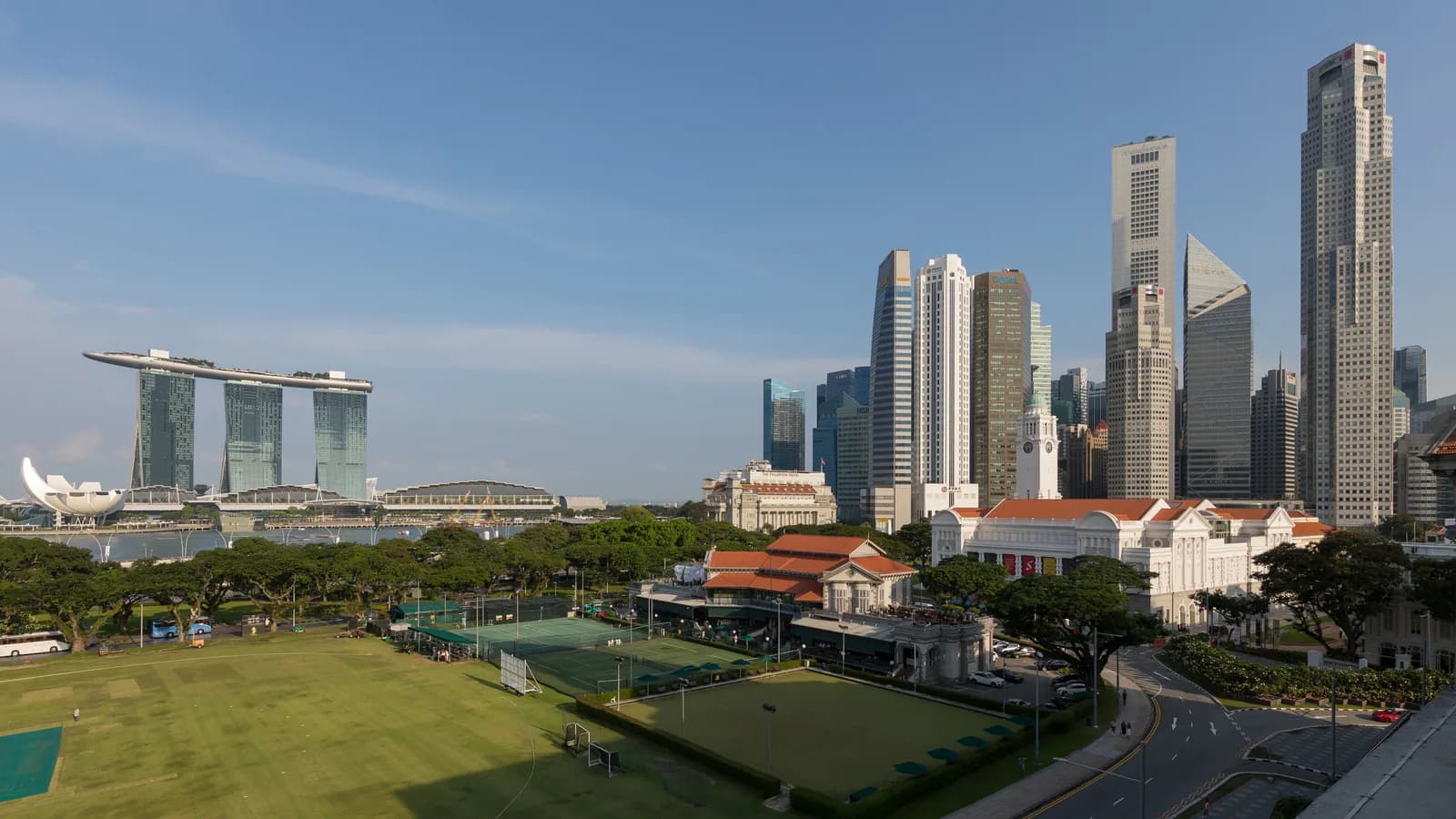
Marina Bays Sands Hotel and skyline of the Central Business District Singapore, photographed by Basile Morin, 8 June 2018. Original photograph and licence record on Wikimedia Commons, licensed CC BY-SA 4.0. The publication version is resized and converted to WebP by NNN's publishing pipeline; the photograph remains available under the same licence. This is an archival cityscape, not a proposed nuclear site.
Questions
- Does Singapore have a nuclear power plant?
- No. As of September 2026, Singapore has not decided to deploy nuclear power. It is building capabilities and preparing for an IAEA Phase 1 infrastructure review, tentatively in 2027. No domestic reactor project or operating date has been announced.
- Is nuclear power banned in Singapore?
- The 2012 finding that available nuclear technologies were unsuitable was a policy assessment, not a blanket statutory ban. Singapore already regulates radioactive materials; a commercial reactor would require a fully developed safety and licensing framework.
- Is Singapore spending S$10 billion on nuclear power?
- No. The S$10 billion Future Energy Fund supports the wider energy transition. It could support nuclear infrastructure if Singapore chooses that pathway, but it is not a dedicated nuclear allocation or an approved reactor construction budget.
- Which Singapore investors are involved in nuclear energy?
- Temasek has backed Commonwealth Fusion Systems and led General Fusion's 2019 financing. Singapore-based TRIREC lists Type One Energy in its portfolio. These are overseas fusion investments, not commitments to build a Singapore power plant.
- Could Singapore store nuclear waste underground?
- A desktop study explored disposal options, and SKB International described the conditions as promising. That is not a licensed repository or a site-specific safety finding. Geological investigations, regulation, financing and public engagement remain necessary.
Sources
- Nuclear Energy: Singapore's policy and capability building — Ministry of Trade and Industry
- Singapore to undertake an INIR Phase 1 mission, with detailed annexes — Ministry of Sustainability and the Environment
- PM Lawrence Wong at the EMA 25th Anniversary Gala Dinner, 19 May 2026 — Prime Minister's Office
- Tan See Leng: MTI Committee of Supply Debate 2026 — Ministry of Trade and Industry
- Parliamentary reply on the 2012 nuclear pre-feasibility study — Ministry of Trade and Industry
- Building Singapore's Capabilities to Assess Nuclear Energy, October 2025 — MTI, MSE, EMA and NEA
- Parliamentary reply on nuclear deployment capabilities, 6 November 2025 — Ministry of Trade and Industry
- NEA to commission studies on nuclear safety frameworks, 26 March 2026 — National Environment Agency
- Singapore signs fourth IAEA Country Programme Framework, 24 April 2026 — National Environment Agency
- Radiation Protection Act 2007, current consolidated legislation — Singapore Statutes Online
- Radiation Protection (Ionising Radiation) Regulations 2023: regulatory summary — National Environment Agency
- Energy Market Authority of Singapore Act: sections 19, 19A and 19B — Singapore Statutes Online
- Energy Transition Measures and Other Amendments Bill: second-reading speech — Ministry of Trade and Industry
- Singapore carbon tax: current rate and future trajectory — National Climate Change Secretariat
- Budget 2025 Statement: nuclear capability building and Future Energy Fund, paragraphs 61–63 — Ministry of Finance
- Parliament's release on the Estimates Committee report, 12 August 2026 — Parliament of Singapore
- Estimates Committee findings on the Future Energy Fund, August 2026 — CNA
- Estimates Committee remit and chairmanship — Parliament of Singapore
- Bills introduced in Parliament — Parliament of Singapore
- Radiation safety: the national authority and its functions — National Environment Agency
- NEA Nuclear Safety Advisory Panel — National Environment Agency
- EMA Nuclear Energy Office and branches — Singapore Government Directory
- SNRSI becomes a full institute with S$66 million research grant, July 2025 — National University of Singapore
- Mott MacDonald to lead EMA's advanced nuclear study — Mott MacDonald
- EMA appoints Mott MacDonald for advanced nuclear technology study, 2 September 2025 — Energy Market Authority
- How EMA is assessing advanced nuclear technologies, May 2026 — Energy Market Authority
- EMA–KHNP civil nuclear capability-building agreement, signed 1 March 2026 — Energy Market Authority
- Milestones Approach: phases, institutions and responsibilities — International Atomic Energy Agency
- Integrated Nuclear Infrastructure Review: scope and report publication policy — International Atomic Energy Agency
- US-Singapore 123 Agreement enters into force — Ministry of Trade and Industry
- Joint statement on signing the US-Singapore 123 Agreement — Ministry of Trade and Industry
- EMA statement on civil nuclear cooperation with EDF — Energy Market Authority
- ONR international agreements, including Singapore NEA — UK Office for Nuclear Regulation
- SKB International's Singapore study and state visit — SKB International
- Singapore waste-disposal desktop study: findings and limitations — The Straits Times, reporting EMA's response
- A*STAR and CFS sign fusion supply-chain research agreement, 20 May 2026 — Commonwealth Fusion Systems and A*STAR
- CFS raises another US$1 billion, 30 July 2026 — Commonwealth Fusion Systems
- General Fusion's US$65 million Series E led by Temasek, December 2019 — Gimv
- TRIREC portfolio, including Type One Energy — TRIREC
- Next Generation Nuclear in Southeast Asia — TRIREC
- The Nuclear Renaissance: CIO investment research — DBS
- The future of nuclear energy in Singapore, 20 March 2025 — OCBC
- Financial institutions supporting the global nuclear expansion declaration — Triple Nuclear Declaration, via PR Newswire
- Financing nuclear energy in Southeast Asia: investment needs, risks and pathways — International Energy Agency
- Nuclear fusion dialogue with Helical Fusion and Singapore partners — Leave a Nest / NEST Garage
- Nuclear Business Platform: advisory and market-development services — Nuclear Business Platform
- Singapore power-sector legal framework and participants, 2026 — Orrick, via Chambers Practice Guides
- Singapore's national statement to the 70th IAEA General Conference, September 2026 — Republic of Singapore, hosted by the IAEA
About Nuclear News Network
Nuclear News Network (NNN) is an independent publication covering the global nuclear energy sector — reactor construction, SMRs, fuel supply, policy, operations and fusion. NNN publishes a daily brief, same-day analysis of major developments, and reference guides used across the industry. Articles are produced by the NNN Newsroom, an editorial automation system with human oversight, under the publication's editorial standards. Ruben Seoane is the founder and main editor of NNN.