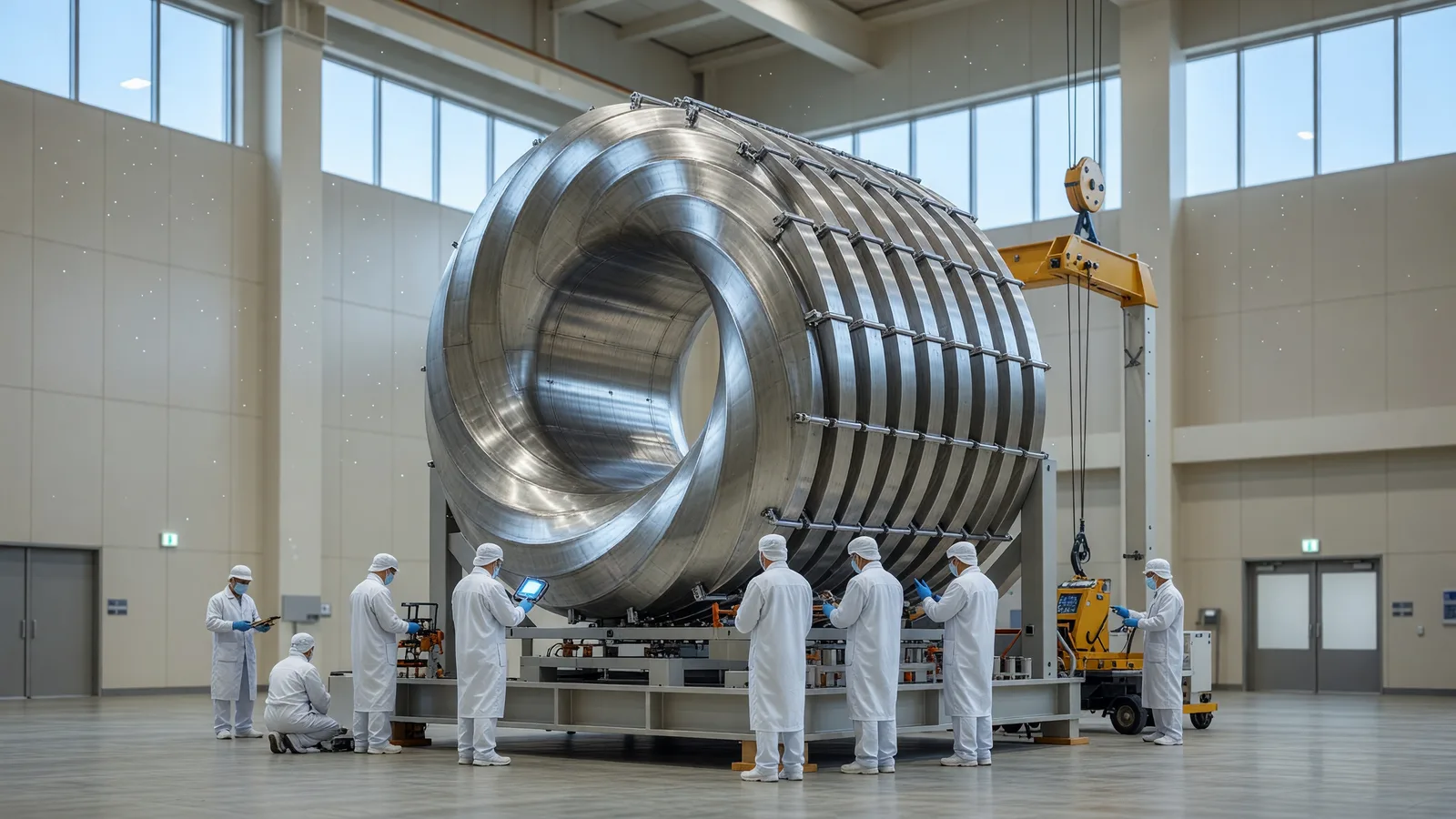
Japan's Ministry of Economy, Trade and Industry has conditionally selected Tokyo-based Helical Fusion for a milestone-based grant program backing private developers targeting fusion power demonstrations in the 2030s. The stellarator startup is one of four finalists sharing an anticipated JPY 60 billion (USD 370 million) subsidy pool, with individual grant amounts still to be set.
Key facts
- METI announced four conditionally selected operators on August 31, 2026: EX-Fusion, Helical Fusion, LINEA Innovation and Starlight Engine
- The FY2025 Supplementary Grant anticipates about JPY 60 billion (USD 370 million) in total subsidies for all selected operators through February 2029
- Helical Fusion was founded in October 2021 as a spinout from the National Institute for Fusion Science, drawing on roughly 70 years of Japanese helical-system research
- Subsidy coverage is capped at two-thirds of project costs; formal selection follows once METI confirms each operator has met its adoption conditions
- The program runs under Japan's Basic Energy Plan and the Fusion Energy Innovation Strategy, which targets power demonstration in the 2030s
What happened
METI's Agency for Natural Resources and Energy published the conditional selection results on August 31, naming four project operators for the FY2025 Supplementary Grant for Promoting Fusion Energy Power Generation Demonstration. Six proposals were submitted; four were conditionally adopted. The selections are not yet final — each operator must satisfy the stated adoption conditions before the selection committee confirms formal adoption and sets grant amounts.
The grant backs technology development by startups and other private entities aiming to demonstrate fusion power generation in the 2030s. By the end of February 2029, the program expects to distribute roughly JPY 60 billion across all selected operators. Individual awards will be announced after formal decisions.
Helical Fusion confirmed its conditional selection the same day, saying the program is designed to determine which technologies are realistic for power plants. Chief executive Takaya Taguchi said the company selected and developed its helical-system technology against that criterion alone, expressing confidence that the design's plant-friendly traits — high generation efficiency, steady-state operation and maintainability — will become a Japanese strength in international fusion competition.
Why it matters
Japan is funding multiple fusion approaches in parallel rather than betting on one line. The METI program explicitly encourages tokamak, helical and laser approaches, and the four conditional selections reflect that diversity: EX-Fusion pursues laser fusion, LINEA Innovation works on a compact spherical tokamak, Starlight Engine — partnered with Kyoto Fusioneering — and Helical Fusion both work on stellarator-family designs. For readers tracking the global race, our nuclear fusion explained hub maps how these confinement concepts differ and why steady-state operation matters for a power plant that must run around the clock.
The selection also lands amid an intensifying licensing race. In the United States, Tennessee issued the first fusion-specific state license to Type One Energy at the end of August, while private capital continues to pour into the sector — Commonwealth Fusion Systems closed a USD 1 billion round earlier this year. Japan's answer is industrial policy: milestone-based subsidies tied to technical and commercialization goals, rather than open-ended research grants.
The milestone structure is the detail to watch. Operators must set clear goals for 2030s demonstrations and define the milestones to be reached by program end, with continuation judged on achievement. That makes the grants closer to staged project finance than science funding — a governance model other fusion-supporting governments are also weighing.
Background
Helical Fusion was founded in October 2021 by researchers from the National Institute for Fusion Science (NIFS) in Toki, Gifu Prefecture. NIFS operates the Large Helical Device, which has sustained plasmas for 3,268 seconds and exceeded 100 million degrees Celsius — the experimental record behind the company's claim that the helical stellarator can meet the three requirements of a commercial fusion reactor: steady-state operation, net electricity and maintainability.
The company's Helix Program sequences development through two enabling technologies — high-temperature superconducting magnets and an integrated blanket/divertor system — before combining them in the Helix HARUKA integrated demonstration device and then the Helix KANATA power-generating plant. Manufacturing and construction for the HARUKA magnet demonstration is already underway in a dedicated space on the NIFS site, with components sourced from more than 30 Japanese companies.
The physics case was laid out in a 2023 peer-reviewed paper in Physics of Plasmas describing the steady-state reactor design. Unlike a tokamak, which confines plasma in a symmetric torus and relies partly on plasma current, a stellarator twists the chamber itself into a figure-eight, shaping the confining magnetic field with external coils. That removes the current-driven instabilities that force tokamaks to run in pulses — the key argument for steady-state output — at the cost of far more complex magnet geometry.
What's next
Formal adoption and grant amounts for each operator will follow once METI's selection committee confirms the adoption conditions have been met. The program runs until February 28, 2029.
For Helical Fusion, the near-term milestones are the individual demonstrations of the high-temperature superconducting magnet and the blanket/divertor system, targeted for completion by the mid-2020s. The integrated HARUKA demonstration and the KANATA power plant sit in the 2030s, consistent with the national Fusion Energy Innovation Strategy's demonstration timeline.
Watch for three signals: the formal grant amounts when METI confirms adoption; progress on the HARUKA magnet build at the NIFS site; and how the four selected operators report against their milestones — the mechanism that will determine which Japanese fusion approaches continue to receive state support.
Questions
- What did METI select Helical Fusion for?
- METI conditionally selected Helical Fusion under its FY2025 Supplementary Grant for Promoting Fusion Energy Power Generation Demonstration, a milestone-based program funding private developers pursuing fusion power demonstrations in the 2030s.
- How much funding will Helical Fusion receive?
- The grant amount has not been set. The program anticipates about JPY 60 billion (USD 370 million) in total subsidies for all selected operators through February 2029, with individual amounts announced after formal selection.
- Why a stellarator instead of a tokamak?
- Helical Fusion's helical stellarator is designed for steady-state operation, net electricity output and maintainability. Stellarators confine plasma with external twisted coils rather than a plasma current, avoiding the pulse limits that constrain tokamaks.
Sources
- 令和7年度補正フュージョンエネルギー発電実証推進事業補助金 間接補助事業者の公募に係る審査状況の公表 — Agency for Natural Resources and Energy, METI
- Helical Fusion、経産省による核融合発電の社会実装支援事業「フュージョンエネルギー発電実証推進事業補助金」に条件付採択が決定 — Helical Fusion
- Helical selected for Japanese fusion demonstration project — World Nuclear News
About Nuclear News Network
Nuclear News Network (NNN) is an independent publication covering the global nuclear energy sector — reactor construction, SMRs, fuel supply, policy, operations and fusion. NNN publishes a daily brief, same-day analysis of major developments, and reference guides used across the industry. Articles are produced by the NNN Newsroom, an editorial automation system with human oversight, under the publication's editorial standards. Ruben Seoane is the founder and main editor of NNN.