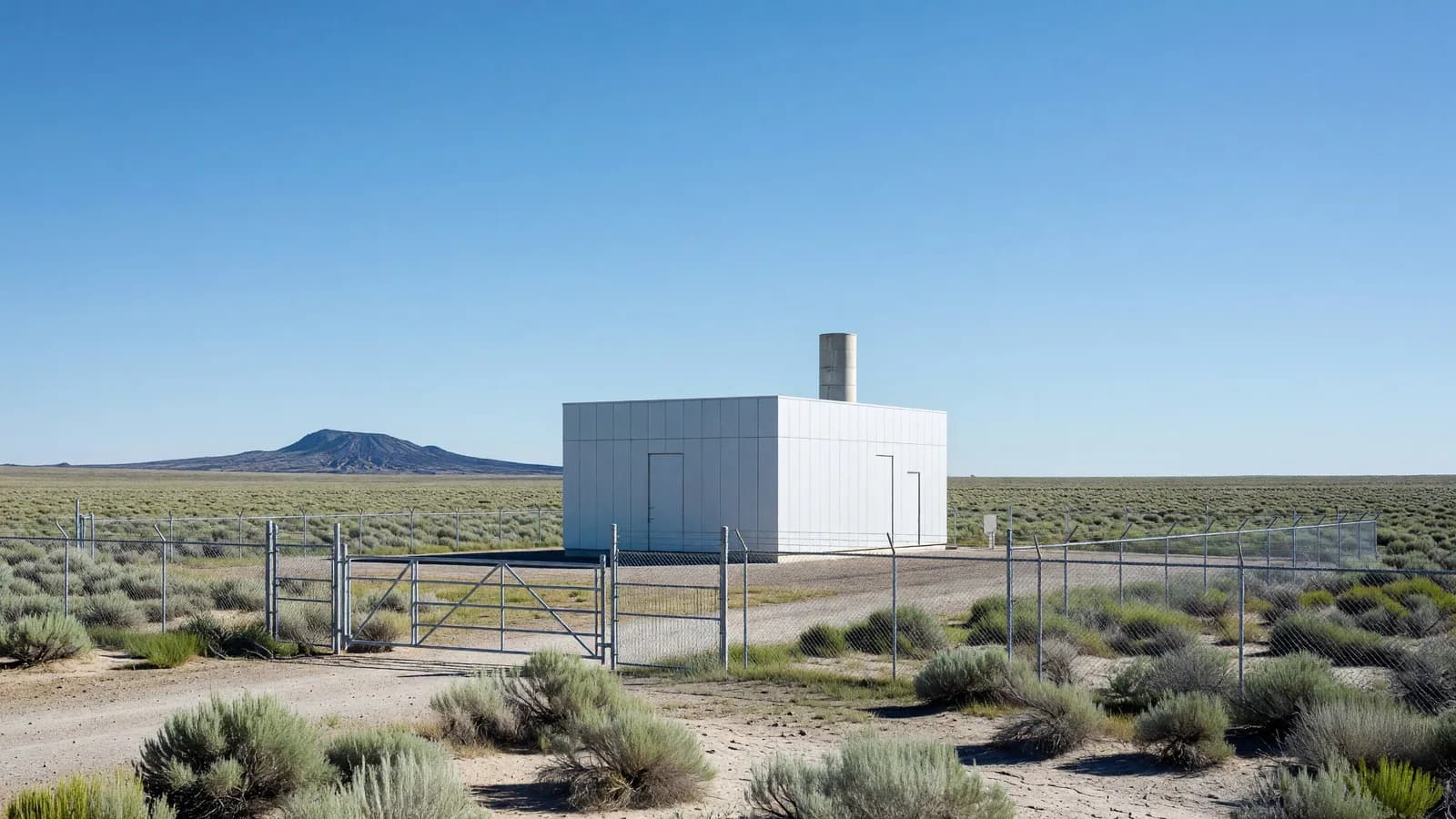
The Nuclear Energy Launch Pad is a U.S. Department of Energy initiative, managed by the National Reactor Innovation Center (NRIC) at Idaho National Laboratory, that lets privately funded companies build and operate advanced reactors and fuel-cycle facilities under DOE authorization instead of an initial Nuclear Regulatory Commission license — either on a roughly 2,000-acre parcel at INL or at sites across the country. DOE supplies land, lab expertise and a prioritized safety review. The developer supplies everything else, including the money. It matters because it is now the main door into the fastest deployment pathway in U.S. nuclear: the one that took five privately built test reactors to criticality between June and August 2026.
Key facts
- Established March 5, 2026 as the successor to DOE's Reactor Pilot Program (June 2025) and Fuel Line Pilot Program (2025); the request for applications opened April 29, 2026 and remains open on a rolling basis
- Two pathways: Launch Pad INL, "about 2,000 acres" near INL's Central Facilities Area divided into leasable plots, and Launch Pad USA, the same framework at other DOE sites, national labs or private land nationwide
- No DOE funding: participants pay for authorization reviews, NRIC program-manager support and site services; INL land is leased at fair-market value
- Applications are scored out of 100 across 11 criteria, and a zero in any category disqualifies the application
- DOE reviews of the three main safety submissions are to be completed within 45 days under DOE-STD-1271-2025; Deployable Energy's Unity reactor got its safety analysis approved in 106 days and reached criticality about 150 days after kickoff
- Two selection rounds so far: four projects on April 27, 2026 and 13 projects from 12 developers on Aug. 24 — 17 projects from 15 companies
How it works: the DOE authorization pathway
The Launch Pad is not a technology program; it is a contracting and authorization structure. A selected developer signs two agreements. The first is an Other Transaction Agreement (OTA) with DOE's Idaho Operations Office, executed under the department's other-transaction authority, in which the developer keeps design authority and DOE provides the regulatory framework. The second, for projects using lab land or staff, is a Strategic Partnership Project (SPP) agreement — or a CRADA — with Battelle Energy Alliance, the contractor that runs INL. The RFA says both "will almost always be necessary." NRIC assigns each project a Technical Program Manager; above that sits what the FAQ calls the Concierge team, "a group of senior leaders from INL and DOE" whose job is to "remove barriers" the program manager cannot.
Safety review runs on DOE-STD-1271-2025, "Authorization Pathway for Nuclear Facilities," a standard DOE issued in August 2025 to implement Executive Order 14301 and modeled, per the Nuclear Innovation Alliance, on the process used for the Pentagon's Project Pele microreactor. It replaces the NRC's construction-permit-then-operating-license sequence with four stage gates:
| Phase | What the developer submits | What DOE does |
|---|---|---|
| Agreements | OTA, SPP and a Nuclear Safety Design Agreement (NSDA) fixing design requirements, safety-analysis approach and code of record | Reviews the NSDA within 45 days; NQA-1 or a justified alternative (ISO 9001, ISO 19443) is set here |
| Preliminary design (~50%) | Preliminary Documented Safety Analysis (PDSA) | Reviews within 45 days; construction "may begin at the earliest point permitted by law" |
| Final design | Documented Safety Analysis (DSA) and Technical Safety Requirements (TSR) | Reviews within 45 days; approves the safety basis |
| Startup | DOE-approved commissioning and test plan; safeguards, security and material-control programs in place | Readiness activity (about three weeks per the Industry Day deck; Hazard Category 3 facilities skip the formal review), then a Joint Test Group oversees fuel receipt, startup and criticality |
Two structural details matter. Per the FAQ, "DOE-ID is the only DOE Site Office authorized to issue DOE Authorization for Launch Pad deployments," whether the facility is in Idaho or not. And authorization is site-specific: it "cannot be applied across multiple locations," so a developer planning a demonstration in Texas followed by a plant in Idaho needs two applications and two authorizations.
Launch Pad INL versus Launch Pad USA
| Launch Pad INL | Launch Pad USA | |
|---|---|---|
| Where | About 2,000 acres near INL's Central Facilities Area, parceled into plots; alternative INL land identified if needed | Other DOE sites, national laboratories, university campuses or privately owned land anywhere in the U.S. |
| Land | Leased from DOE at fair-market value; parcel allocated after selection based on power, water and acreage needs | Developer's responsibility; a county-level shortlist with a credible plan is acceptable at application |
| Infrastructure | Proximity to electrical interconnect, potable water and fiber; developer funds the connections, buildings, parking and access roads | Whatever the host site offers; DOE and NRIC help scope cost estimates |
| Security | INL provides physical security "up to the perimeter of the leased area"; the developer runs facility security inside it | Developer's responsibility |
| Site data | INL's existing seismic, biological, cultural and water-table characterization is available; NEPA tiering off site-wide documents "may be possible" | Case by case |
| Expertise | On-site access to INL staff and facilities on a cost-recovery basis | Remote or project-specific access to INL or other national-lab experts |
| Design authority | Developer, or optionally Battelle Energy Alliance under the OTA | Developer only; NRIC and INL "do not assume design authority" |
The FAQ makes the USA track's flexibility explicit: "a privately owned, non-federal site is eligible for Launch Pad USA, provided it meets siting, regulatory, and infrastructure requirements," and an applicant unsure of siting is "encouraged to apply to Launch Pad USA" and update the location later. What DOE will not do is pre-designate sites: it is "not currently developing a directory or inventory of preferred non-federal deployment sites," does not sign site-level framework OTAs with host institutions, and is "not currently pursuing" regional deployment hubs outside the lab system.
What it costs and who pays
Everything. The NRIC page answers the funding question with one word — "No" — and the FAQ elaborates: "all Launch Pad work is entirely privately funded and estimated on a case-by-case basis." Selected participants are billed for "NRIC Technical Program Manager Support, NRIC/INL/DOE expenses related to reviews, travel, and other expenses incurred, and site services," which at INL include "Safeguards & Security support, power, water, emergency services." INL does not publish flat fees or hourly rates ("business-sensitive") but provides an interface plan and service menu after selection. The developer also owns the back end: it is "solely responsible for handling and disposal" of wastes, must fund decommissioning and site restoration, and manages spent fuel until DOE negotiates a disposition contract "prior to initial nuclear fuel receipt" that defines "title, transport, interim storage, and ultimate disposition." At INL, any on-site dry-cask storage has to fit within the 1995 Settlement Agreement between Idaho, DOE and the Navy that restricts spent fuel at the site.
Private money can be leveraged. The FAQ confirms a Launch Pad project can simultaneously hold a DOE Title 17 loan guarantee and use its proceeds for project costs, and that a milestone-based investor commitment letter is acceptable evidence of funding, though "sufficient financial readiness, ideally with committed funding" is scored. Launch Pad also "does not provide feedstock": HALEU comes through DOE's separate HALEU Availability Program, which "prioritizes reactor deployment needs" and is evaluated on its own.
What DOE authorization lets you do — and what it does not
This is the part developers and investors most often blur. Under the Launch Pad, facilities "will serve research, development, and demonstration purposes" and "will not require initial NRC licensing," per the RFA. But the FAQ draws the commercial boundary hard:
- "Commercial sales of enriched product is not permitted under DOE Authorization." Any nuclear material produced for sale "is considered a commercial activity and must be licensed by the NRC."
- "Commercial activities including fuel supply, product sales, or services for third parties fall under NRC's jurisdiction."
- Delivering DOE-authorized fuel to an NRC-licensed facility "even one owned by the same developer" is a transfer "into the commercial regulatory framework" and outside the authorization's scope.
- Grid power sales require an NRC license; scaling an authorized line to commercial throughput "generally requires safety-basis updates and may require a new or amended authorization."
Transition is allowed and expected. A facility sited at INL "may later transition to an NRC license," and applicants must submit a long-term regulatory strategy showing how the DOE-authorized deployment supports future NRC licensing. But the NRC "independently determines what DOE-generated information is creditable," DOE-authorized quality-assurance records do "not automatically substitute for NRC QA requirements," and operating novel fuel under DOE authority "does not replace NRC requirements, including those associated with Lead Test Assemblies." The Launch Pad shortens the road to an operating demonstration. It does not shorten the NRC's road; at best it front-loads the evidence.
Who is in
| Round | Developer | Project | Pathway and site |
|---|---|---|---|
| April 2026 | Deployable Energy | 1-MWe Unity microreactor demonstration; criticality June 30, 2026 | Launch Pad INL, Materials and Fuels Complex |
| April 2026 | General Matter | HALEU enrichment facility | Launch Pad USA, former Paducah Gaseous Diffusion Plant site, Kentucky |
| April 2026 | NuCube Energy and Idaho State University | Advanced Research and Test (ART) microreactor | Launch Pad USA, ISU Pocatello campus |
| April 2026 | Radiant | Kaleidos microreactor test in the DOME test bed | Launch Pad INL |
| August 2026 | Antares Nuclear | Not disclosed (Mark-0 reached criticality at INL June 4 under the Reactor Pilot Program) | Not disclosed |
| August 2026 | Atlas Atomics | Not disclosed (heavy-water reactor concept) | Not disclosed |
| August 2026 | Deployable Energy (2 projects) | Full-power demonstration at INL; maritime demonstration, per POWER | Launch Pad INL; second site not disclosed |
| August 2026 | Forge Atomics | Not disclosed (Ember 25-MWe factory-built PWR) | Not disclosed |
| August 2026 | Hexium | Not disclosed (laser isotope separation) | Not disclosed |
| August 2026 | Lightbridge | Not disclosed (uranium-zirconium metallic fuel) | Not disclosed |
| August 2026 | Nusano | Not disclosed (isotopes; centrifuge-free HALEU process) | Not disclosed |
| August 2026 | Oklo | Not disclosed (fast reactors, fuel fabrication, recycling, isotopes) | Not disclosed |
| August 2026 | Raven-Flint Nuclear | Torch fluorine-free uranium conversion pilot plant, 500 tU/yr, per company | Launch Pad INL, per company |
| August 2026 | Scaled Atomics | MN-350 mobile microreactor, per company | Not disclosed |
| August 2026 | Sublime Nuclear | Not disclosed (modular uranium conversion) | Not disclosed |
| August 2026 | Valar Atomics | Not disclosed (Ward 250 HTGR critical in Utah June 18; TRISO fuel line under the Fuel Line Pilot Program) | Not disclosed |
First-round pathway and site details are from POWER's April 30 report. For the August round, NRIC's chief operating officer has said six projects are Idaho-bound — three reactor demonstrations, one enrichment project, one fuel fabricator and one converter — without naming them. NNN will update this table as agreements are signed.
What the Launch Pad is not
Not the Reactor Pilot Program. That program, created under Executive Order 14301 with the goal "of achieving criticality in each of the three reactors by July 4, 2026," selected 11 projects from 10 companies in August 2025. It and the Fuel Line Pilot Program stopped taking applications in April 2026; participants transfer into the Launch Pad with a written request, and NRIC says there "will not be any reset or setback" so long as scope and deliverables are unchanged. DOE's own program page now describes the Launch Pad as "the next evolution of DOE-authorized demonstration projects."
Not DOME. The Demonstration of Microreactor Experiments test bed at INL is a shared facility with its own standalone RFA; Radiant uses it as a Launch Pad INL participant, but DOME access and Launch Pad selection are separate decisions.
Not Project Prometheus. Prometheus is the INL-led Genesis Mission program applying AI to reactor design and licensing — software, data and models. The Launch Pad is land, agreements and safety authorization for physical builds. A company can be in both; Oklo is.
Not the Nuclear Lifecycle Innovation Campus. NLIC is DOE's competition to host state-level fuel-cycle campuses, with five finalist states named July 28, 2026. The FAQ calls the two "independent initiatives"; a developer may join both, and the Launch Pad application guide lets applicants ask to be connected with NLIC.
Not a source of fuel. See above: feedstock comes through the HALEU Availability Program or the developer's own supply agreements.
Common misconceptions
People assume selection is an award. It is a queue position with lab support attached: the developer still has to negotiate the OTA and SPP, clear a foreign-ownership (FOCI) review that "may take up to six months" if it has overseas investors, get a parcel allocated, and fund every step. The FAQ says access to resources "begins after selection and is dependent on successful execution" of both agreements.
People assume a DOE-authorized reactor is a licensed reactor. It is a demonstration operating on DOE's authority for DOE's purposes. Revenue-generating operation — power sales, fuel sales, third-party services — is an NRC matter, and DOE authorization does not carry over to it automatically.
People assume the Launch Pad means Idaho. Half of the first-round projects and at least seven of the August 13 are not at INL. Valar's Ward 250 went critical in Utah, Oklo's Groves in Texas, and General Matter's enrichment plant is planned for Kentucky; the framework travels, the authorizing office does not.
Current state (August 2026)
Seventeen projects from 15 companies are in the program after two rounds. One Launch Pad project (Deployable Energy's Unity) has reached criticality; three more Launch Pad companies (Antares, Valar, Oklo) did so under the predecessor Reactor Pilot Program; with Aalo Atomics, which is not in the Launch Pad, DOE's 2026 count stands at five. INL is grading roads and installing utilities on the 2,000-acre parcel — "similar to a subdivision," in NRIC's words — with NEPA actions scheduled to complete in summer 2026 per the Industry Day deck. The RFA is continuously open; NRIC says post-July applications will be reviewed "on a periodic basis" with no fixed cadence, and that notification could take longer than the six weeks of the first cycle. The first-round anticipated announcement date of Aug. 19 slipped to Aug. 24.
Related reading
For the news on the August round, see NRIC picks 13 projects for the Launch Pad's second round. The milestones the pilot programs produced are in DOE: four advanced reactors hit criticality in 2026 and Oklo's DOE startup authorization for Groves. The shared test bed Radiant is using is covered in DOME, a first-of-a-kind microreactor test bed. For the licensing road that begins where DOE authorization ends, read the NRC reactor licensing process, explained, and for the federal money that the Launch Pad pointedly does not include, DOE nuclear funding, explained. The AI program that is often confused with this one is in DOE's Genesis Mission and Project Prometheus. Reactor designs across the roster are tracked in the SMR hub.
Background
DOE's Nuclear Energy Launch Pad, established in March 2026 as the successor to the Reactor Pilot Program, lets private developers build reactors and fuel facilities under DOE authorization rather than an NRC license — on about 2,000 leasable acres at Idaho National Laboratory (Launch Pad INL) or at other sites nationwide (Launch Pad USA), with participants paying their own way. After two selection rounds in April and August 2026, 17 projects from 15 companies are in the program. (As of August 2026.)
Questions
- What is the Nuclear Energy Launch Pad?
- A DOE initiative managed by the National Reactor Innovation Center at Idaho National Laboratory that gives privately funded developers a prioritized path to DOE authorization for reactors and fuel-cycle facilities, plus lab expertise and, at INL, leased land on a roughly 2,000-acre site.
- Does DOE fund Launch Pad projects?
- No. NRIC's FAQ states that all Launch Pad work is entirely privately funded. Participants pay for DOE authorization reviews, NRIC program-manager support and INL site services; INL land is leased at fair-market value. Title 17 loan-guarantee proceeds may be used, subject to that program's rules.
- Is DOE authorization the same as an NRC license?
- No. DOE authorization under DOE-STD-1271 covers research, development and demonstration on DOE's authority. Selling grid power, enriched uranium or fuel, or serving third-party customers requires a separate NRC license, and the NRC decides case by case how much DOE-generated data it credits.
- What is the difference between Launch Pad INL and Launch Pad USA?
- Launch Pad INL leases parcels on a roughly 2,000-acre site near INL's Central Facilities Area, with lab utilities and on-site expertise. Launch Pad USA applies the same DOE authorization framework to other DOE sites, national labs or private land anywhere in the U.S.
- Who is in the Nuclear Energy Launch Pad?
- Seventeen projects from 15 companies: Deployable Energy, General Matter, NuCube/Idaho State University and Radiant (April 2026); then Antares, Atlas Atomics, Deployable (two more), Forge Atomics, Hexium, Lightbridge, Nusano, Oklo, Raven-Flint, Scaled Atomics, Sublime Nuclear and Valar (August 2026).
- How is the Launch Pad different from the Reactor Pilot Program?
- The Reactor Pilot Program and Fuel Line Pilot Program of 2025 covered reactors and fuel fabrication only and closed to applications in April 2026. The Launch Pad absorbed their participants, broadened eligibility to the whole fuel cycle and runs on a continuously open request for applications.
Sources
- Nuclear Energy Launch Pad at Idaho National Laboratory — National Reactor Innovation Center
- Launch Pad INL — National Reactor Innovation Center
- Launch Pad USA — National Reactor Innovation Center
- Nuclear Energy Launch Pad RFA — Frequently Asked Questions — National Reactor Innovation Center
- Launch Pad Industry Day Presentations (May 19, 2026) — National Reactor Innovation Center
- Request for Application: NRIC Nuclear Energy Launch Pad (INL-NRICRFA01) — SAM.gov
- NRIC Launch Pad to take national innovation to next level — Idaho National Laboratory
- National Reactor Innovation Center accepting Launch Pad applications — Idaho National Laboratory
- National Reactor Innovation Center announces first selections for Nuclear Energy Launch Pad — Idaho National Laboratory
- NRIC selects new Nuclear Energy Launch Pad participants to boost nuclear energy — Idaho National Laboratory
- America built nuclear power in Idaho first. Now it's doing it again. — Idaho National Laboratory
- U.S. Department of Energy Reactor Pilot Program — U.S. Department of Energy
- Energy Department Fuel Line Pilot Program — U.S. Department of Energy
- Executive Order 14301 — Reforming Nuclear Reactor Testing at the Department of Energy — Federal Register
- Review: Recent DOE updates to its reactor authorization process (DOE-STD-1271-2025) — Nuclear Innovation Alliance
- Nuclear Lifecycle Innovation Campuses contenders announced — U.S. Department of Energy
- 1995 Settlement Agreement — Idaho Department of Environmental Quality
- DOE opens Nuclear Energy Launch Pad and DOME test bed to industry applicants, sets July 8 deadline — POWER Magazine
- INL building up 2,000-acre Nuclear Energy Launch Pad in Idaho desert — Local News 8 (KIFI)
- Second round of Launch Pad selections includes eight newcomers — American Nuclear Society — Nuclear Newswire
About Nuclear News Network
Nuclear News Network (NNN) is an independent publication covering the global nuclear energy sector — reactor construction, SMRs, fuel supply, policy, operations and fusion. NNN publishes a daily brief, same-day analysis of major developments, and reference guides used across the industry. Articles are produced by the NNN Newsroom, an editorial automation system with human oversight, under the publication's editorial standards. Ruben Seoane is the founder and main editor of NNN.