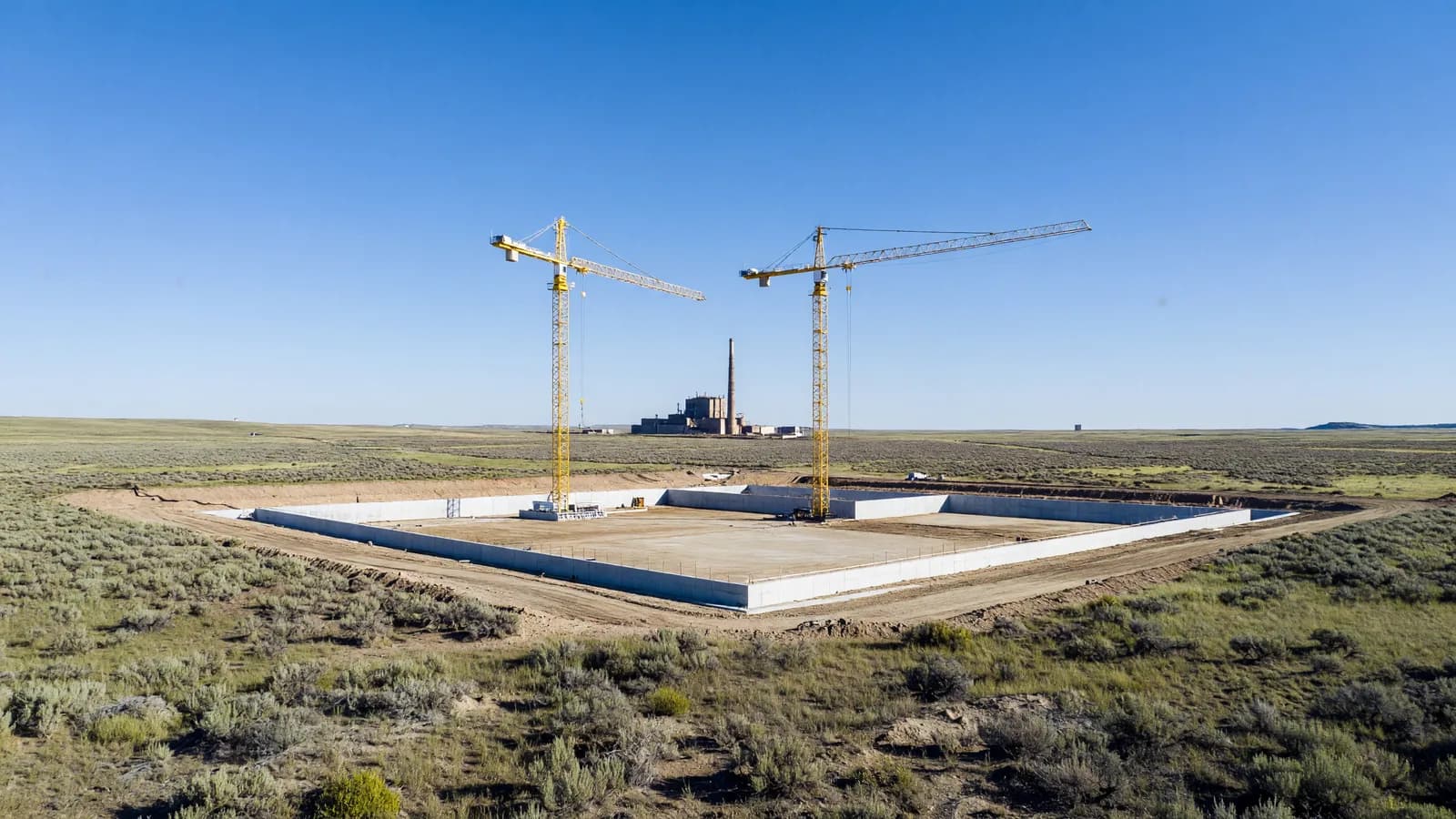
The Natrium project has moved from design announcement to nuclear construction in under six years — fast by nuclear standards, slow by the schedule TerraPower first published. This page is the dated record: every milestone, every slip, every pipeline commitment, with sources. It is updated as new milestones land; for how the technology works, see the Natrium explainer.
Key facts
- October 2020 ARDP selection to April 2026 nuclear construction start: 5.5 years
- The March 4, 2026 construction permit was the first for a commercial non-light-water US power reactor in more than 40 years
- Completion target slipped once — 2028 to 2030 — attributed primarily to HALEU fuel availability after the Russian supply route closed
- The owner's current expectation filed with the NRC: construction complete by February 2031
2020–2021: design to site
- September 2020 — TerraPower and GE Hitachi unveil the Natrium design: a 345 MWe sodium-cooled fast reactor with molten-salt storage.
- October 2020 — DOE selects Natrium as a flagship of the Advanced Reactor Demonstration Program, with $80 million in initial federal funding under a cost-share that grew to roughly $2 billion.
- June 2021 — TerraPower and Rocky Mountain Power announce a siting assessment across four retiring Wyoming coal plants.
- November 16, 2021 — Kemmerer, Wyoming is selected as the preferred site, next to the retiring Naughton coal plant.
2022–2023: money, fuel and the slip to 2030
- August 2022 — TerraPower closes a $750 million equity raise.
- October 2022 — GE Hitachi and TerraPower announce the Natrium Fuel Facility at Global Nuclear Fuel–Americas in Wilmington, North Carolina.
- 2022–2023 — The completion target moves from 2028 to 2030, attributed primarily to HALEU fuel availability after Russian supply became untenable.
- March 2023 — PacifiCorp forecasts two additional Natrium units beyond Kemmerer, online by 2033.
- April 2023 — KHNP and SK sign a strategic collaboration with TerraPower — the start of the Korean industrial axis that now runs through the project.
2024–2025: licensing and early works
- March 2024 — TerraPower submits the construction permit application for Kemmerer Unit 1.
- May 14, 2024 — The NRC formally dockets the application.
- June 2024 — Non-nuclear groundbreaking at Kemmerer; work starts on the energy-storage island, which sits outside NRC jurisdiction.
- December 2024 — Reactor-enclosure suppliers selected: ENSA (reactor head), Doosan (core barrel, guard vessel, internal supports), HD Hyundai (reactor vessel) and Marmen (rotating plug) — the package that became Doosan's August 2026 production contract.
- February 2025 — NRC completes the draft safety evaluation one month ahead of schedule.
- August–September 2025 — Utah and Kansas deployment agreements announced.
- October 2025 — TerraPower submits Natrium for the UK's Generic Design Assessment.
- December 2025 — NRC completes the final safety review — the technical review ran 18 months against a 27-month schedule.
2026: permit, construction, pipeline
- January 9, 2026 — Meta announces an agreement supporting up to eight Natrium plants for data-center load.
- February 2026 — The UK Office for Nuclear Regulation accepts Natrium into GDA.
- March 4, 2026 — The NRC issues the construction permit — the first for a commercial non-light-water US power reactor in more than 40 years.
- April 23, 2026 — Nuclear construction officially begins at Kemmerer.
- June 17, 2026 — The GDA process formally starts and TerraPower announces TerraPower UK, its first office outside the US.
- July 2026 — Crews begin excavation at the nuclear island; TerraPower becomes the first advanced-reactor company admitted to INPO.
- August 14, 2026 — Hyundai E&C named EPC contractor under a framework covering up to eight Natrium reactors, with completion, price and performance guarantees, plus an SK Innovation term sheet for Korea.
- August 21, 2026 — Doosan Enerbility signs the manufacturing contract for the core barrel, guard vessel and internal supports.
What's ahead
- Through 2030 — component manufacturing, nuclear-island civil works, and the operating-license process; HALEU deliveries remain the program's watch item.
- February 2031 — the owner's construction-completion expectation filed with the NRC.
- By 2033 — PacifiCorp's forecast for two further units.
Current state (August 2026)
Construction is underway at Kemmerer with the energy-storage island ahead of the nuclear island, component production contracted across a Spanish-Korean-French supply chain, and a commercial pipeline — Meta, PacifiCorp, Utah, Kansas, Korea, the UK — that makes Natrium the advanced design with the most credible path from one plant to many. This timeline is append-only: new milestones are added with dates and sources as they land, and the completion expectation stands at February 2031 until a primary source moves it.
Background
Natrium is TerraPower's advanced plant design: a 345 MWe sodium-cooled fast reactor coupled to molten-salt thermal storage that can boost output to 500 MWe for more than five hours. Its March 2026 NRC construction permit was the first for a commercial non-light-water US power reactor in more than 40 years, and construction of the first unit began in April 2026 at Kemmerer, Wyoming, on the site of a retiring coal plant, with completion expected by early 2031. The announced pipeline beyond Kemmerer includes agreements covering up to eight plants for Meta's data centers, further PacifiCorp units, and UK deployment through the Generic Design Assessment. (As of August 2026.) Read the Natrium explainer.
Questions
- When did the Natrium project start?
- TerraPower and GE Hitachi unveiled the Natrium design in September 2020, and the US Department of Energy selected it as an Advanced Reactor Demonstration Program flagship in October 2020, with $80 million in initial federal funding.
- When did Natrium construction start?
- Non-nuclear early works began at Kemmerer, Wyoming in June 2024. Nuclear construction officially began April 23, 2026, seven weeks after the NRC issued the construction permit on March 4, 2026.
- When will the Natrium reactor be complete?
- The owner has told the NRC it expects construction complete by February 2031, roughly five years from construction start.
- Why was Natrium delayed from 2028 to 2030?
- Fuel. The design needs HALEU (high-assay low-enriched uranium), and after the Russian supply route closed in 2022 TerraPower moved its completion target from 2028 to 2030 while a Western HALEU supply chain was contracted.
- How long did the Natrium construction permit take?
- TerraPower submitted the application in March 2024; the NRC docketed it on May 14, 2024, completed its technical review in 18 months against a 27-month schedule, and issued the permit on March 4, 2026 — the first for a commercial non-light-water US power reactor in more than 40 years.
- Which Natrium plants are planned beyond Kemmerer?
- A January 2026 Meta agreement covers up to eight plants for data centers; PacifiCorp has forecast two more units by 2033; Utah and Kansas deployment agreements were announced in 2025; Hyundai E&C holds an EPC framework for up to eight reactors; and the design entered the UK's Generic Design Assessment in 2026.
Sources
- TerraPower's Kemmerer 1 Enters Construction: Timeline of the Natrium Project's Road to First Power — POWER Magazine
- NRC Issues Construction Permit for TerraPower's Natrium Advanced Reactor — US Department of Energy
- TerraPower Commences Construction on America's First Utility-Scale Advanced Nuclear Power Plant — TerraPower
- NRC completes safety review for TerraPower's Kemmerer project — American Nuclear Society
- TerraPower's Natrium reactor begins UK GDA process — World Nuclear News
- TerraPower becomes first advanced reactor company to join INPO — American Nuclear Society
About Nuclear News Network
Nuclear News Network (NNN) is an independent publication covering the global nuclear energy sector — reactor construction, SMRs, fuel supply, policy, operations and fusion. NNN publishes a daily brief, same-day analysis of major developments, and reference guides used across the industry. Articles are produced by the NNN Newsroom, an editorial automation system with human oversight, under the publication's editorial standards. Ruben Seoane is the founder and main editor of NNN.