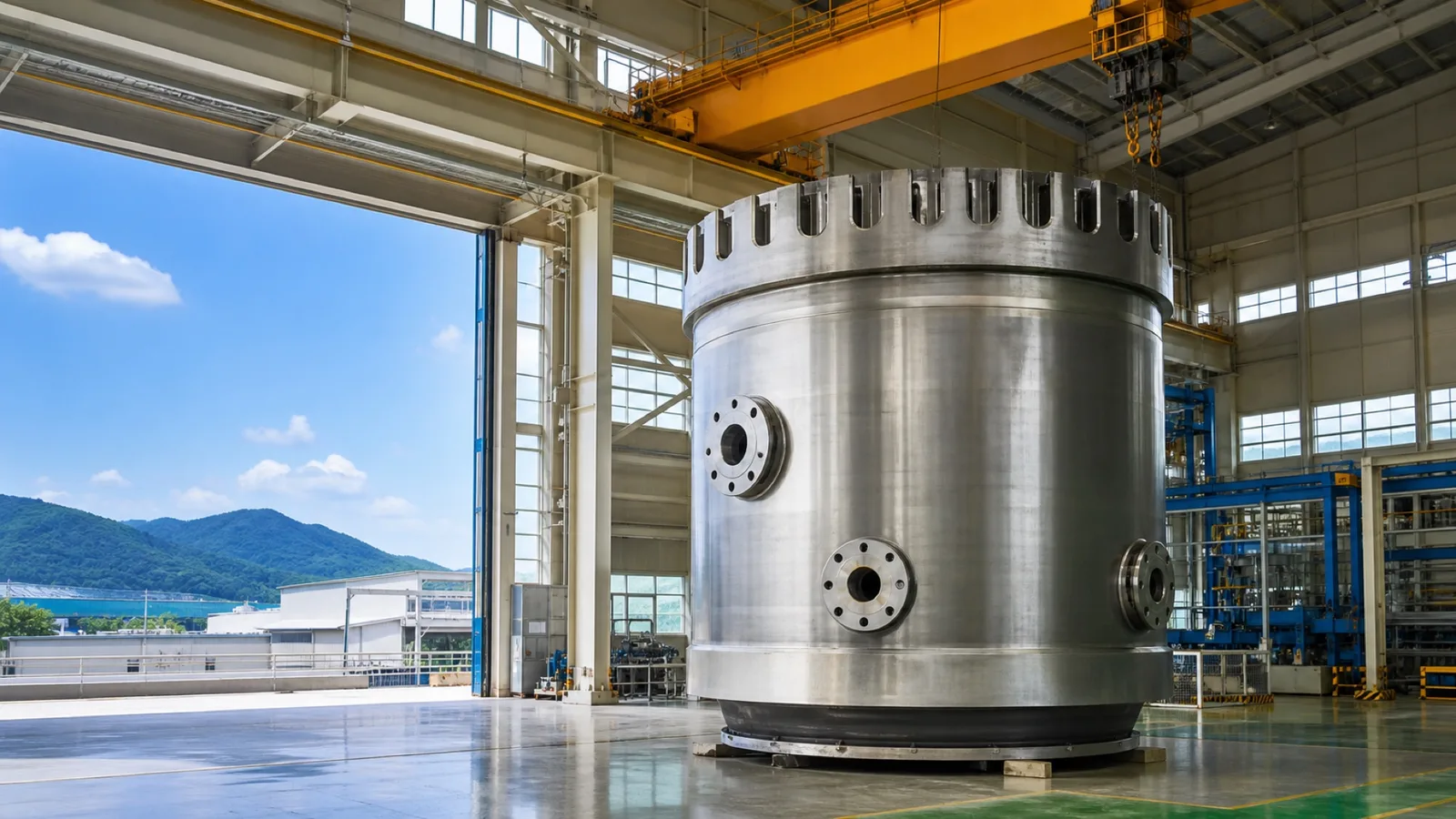
Doosan Enerbility has signed a manufacturing contract for key components of TerraPower’s first Natrium reactor in Kemmerer, Wyoming. The order matters because it moves the 345 MWe advanced reactor from supplier qualification into production work on equipment central to the nuclear island.
Key facts
- Doosan will supply the core barrel, guard vessel and internal supports for the first Natrium unit.
- Natrium is a 345 MWe sodium-cooled fast reactor with molten-salt storage that can temporarily lift output to 500 MWe.
- TerraPower expects the Kemmerer plant to be complete in 2030.
- Doosan’s contract follows a December 2024 manufacturability review for the same equipment package.
What happened
South Korea’s Doosan Enerbility said it had signed a contract to make three major pieces of the Natrium reactor enclosure system: the core barrel, guard vessel and internal supports. In the plant, these components sit inside and around the reactor vessel and help define the physical boundary and support structure for the reactor core and its internals.
The contract follows a longer engineering sequence rather than appearing as a first contact. TerraPower selected suppliers for the enclosure system in December 2024. Equipos Nucleares SA of Spain was selected for the reactor head, Doosan for the core barrel, guard vessel and supports, HD Hyundai for the reactor vessel, and Marmen of France for the rotating plug, according to World Nuclear News.
Doosan said it used the intervening period to complete a manufacturability review and implement design improvements. Its statement described the design as ready for manufacturing orders after that work. The practical meaning is important: large nuclear components are not interchangeable catalogue items. They must be designed so that the chosen forge shops, machining lines, inspection procedures and transport routes can actually produce them to the required tolerances.
The order is for TerraPower’s first Natrium plant, being built at Kemmerer in Wyoming. TerraPower says non-nuclear construction began there in June 2024 and expects the plant to be complete in 2030. The project is being developed through the US Department of Energy’s Advanced Reactor Demonstration Program.
Why it matters
The announcement is a supply-chain story as much as a reactor story. Advanced nuclear companies can announce a design, a site and a customer years before the heavy components are ready. Production contracts are the point at which design assumptions meet steel, welding, inspection and factory capacity.
For TerraPower, the Doosan order also strengthens the Korean manufacturing connection around Natrium. TerraPower recently named Hyundai Engineering & Construction as EPC contractor for a framework covering up to eight future Natrium reactors. NNN has covered that agreement’s completion, price and performance guarantees in its report on TerraPower and HDEC. Doosan’s component order shows a different layer of the same strategy: construction delivery depends on a repeatable industrial network, not only on a reactor designer.
The equipment is also tied to Natrium’s particular architecture. The design combines a sodium-cooled fast reactor with thermal storage. TerraPower describes the reactor as producing 345 MWe and the storage system as temporarily raising output to 500 MWe. That flexibility is meant to let the plant follow daily demand while retaining a nuclear source of firm energy.
Background
Natrium is one of the two flagship US advanced-reactor demonstrations selected under DOE’s cost-shared demonstration programme. The first unit is not a conventional light-water reactor, so the supply chain must support a sodium system, a new reactor enclosure arrangement and fuel requirements associated with a fast-spectrum design. NNN’s Natrium reactor explainer sets out how the technology differs from today’s fleet.
Kemmerer is also a useful test of whether a first-of-a-kind project can create a second-unit pipeline. TerraPower’s excavation milestone marked physical progress at the site; Doosan’s order marks progress in a factory several thousand miles away. Those milestones have to converge before 2030.
The supplier map is international by design. Spanish, Korean and French firms are contributing to the enclosure system while US contractors manage the site and project integration. That arrangement can bring specialist capacity to the build, but it also makes coordination, quality assurance and transport sequencing central execution risks.
The contract also gives TerraPower a more tangible manufacturing baseline for future units. A first component package can expose machining constraints, inspection hold points and delivery assumptions before the company attempts to repeat the design across a fleet. That learning curve is one of the main reasons advanced-reactor developers emphasize standardization: the second unit should not rediscover every problem solved by the first.
What’s next
The next watchpoint is component manufacturing and inspection, followed by delivery to Wyoming and installation into the reactor enclosure. TerraPower will also need to continue its licensing, nuclear construction and commissioning sequence. For the wider fleet, the test is whether this single order becomes a repeatable procurement package under the HDEC framework or remains specific to the demonstration unit.
The cleanest measure of progress will not be another partnership announcement. It will be completed forgings, accepted inspections and equipment arriving at Kemmerer on the schedule TerraPower has published.
Background
Natrium is TerraPower's advanced plant design: a 345 MWe sodium-cooled fast reactor coupled to molten-salt thermal storage that can boost output to 500 MWe for more than five hours. Its March 2026 NRC construction permit was the first for a commercial non-light-water US power reactor in more than 40 years, and construction of the first unit began in April 2026 at Kemmerer, Wyoming, on the site of a retiring coal plant, with completion expected by early 2031. The announced pipeline beyond Kemmerer includes agreements covering up to eight plants for Meta's data centers, further PacifiCorp units, and UK deployment through the Generic Design Assessment. (As of August 2026.) Read the Natrium explainer.
Questions
- What will Doosan Enerbility supply for Natrium?
- Doosan will supply the reactor core barrel, guard vessel and internal supports for TerraPower’s first Natrium plant in Kemmerer, Wyoming.
- What is the Natrium reactor’s output?
- TerraPower describes Natrium as a 345 MWe sodium-cooled fast reactor paired with molten-salt energy storage that can temporarily raise output to 500 MWe.
- When is the first Natrium plant expected to be complete?
- World Nuclear News reports TerraPower expects the Kemmerer plant to be complete in 2030, subject to the project’s licensing and construction milestones.
Sources
About Nuclear News Network
Nuclear News Network (NNN) is an independent publication covering the global nuclear energy sector — reactor construction, SMRs, fuel supply, policy, operations and fusion. NNN publishes a daily brief, same-day analysis of major developments, and reference guides used across the industry. Articles are produced by the NNN Newsroom, an editorial automation system with human oversight, under the publication's editorial standards. Ruben Seoane is the founder and main editor of NNN.