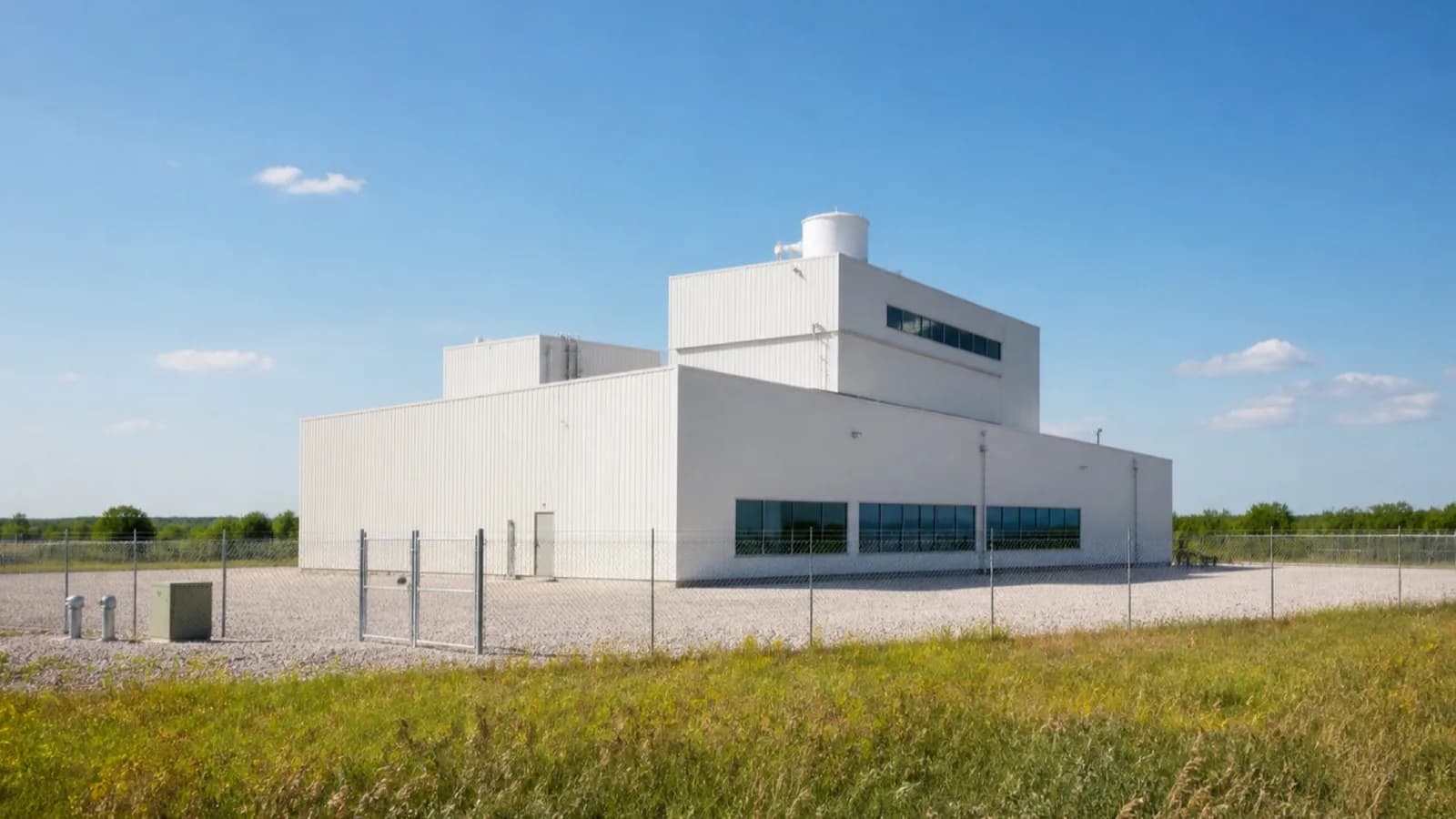
Oklo Inc. says its Groves Isotope Test Reactor near Lockhart, Texas, has reached first criticality, a controlled, self-sustaining chain reaction at low power. The milestone came less than a year after groundbreaking under the U.S. Department of Energy's Reactor Pilot Program, but it is not commercial power operation or proof that isotope production has begun.
Key facts
- Oklo says Groves reached first criticality less than a year after groundbreaking.
- The company describes Groves as the first Reactor Pilot Program reactor to reach criticality on private land.
- The reactor achieved a controlled, self-sustaining chain reaction at low power.
- Oklo says the facility creates an operational foundation for future commercial isotope production.
- The company says Groves was built on a greenfield site with fuel and components manufactured or commercially procured.
What happened
Oklo announced the milestone on Aug. 6, saying the Groves Isotope Test Reactor had reached first criticality after DOE authorization through the Reactor Pilot Program. In reactor terms, criticality means the fission chain reaction is sustaining itself. The release specifies that the achievement occurred at low power, which matters because it describes the start of controlled reactor operation rather than a plant delivering electricity to a grid.
The company says Groves is the first reactor in the pilot program to reach criticality on private land after being built from the ground up on a greenfield site. That is the part of the announcement that separates it from a laboratory experiment. Oklo says it completed civil excavation and construction, procured or manufactured the reactor's components and fuel, and developed its operating programs in-house.
The sequence follows the startup authorization Oklo announced in July. That earlier decision cleared fuel loading, startup testing and reactor operations. The new release confirms that the project has moved through those gates far enough to establish a controlled chain reaction. It does not provide a power rating, fuel assay, operating schedule or date for isotope output.
Oklo's immediate commercial objective is isotope production. The company says the Groves project is intended to build domestic capability for isotopes used in healthcare, industry, research, space and national security. It also says the work produced experience in engineering, construction, procurement, startup procedures, training and safety readiness that can be reused across later facilities.
Why it matters
Advanced-reactor developers have spent years trying to prove that a design can move beyond drawings, test loops and regulatory filings. Groves is a small but concrete answer to that problem: a privately sited reactor has reached an operating milestone under a federal pilot pathway. The schedule is the headline. Oklo says the project went from groundbreaking to first criticality in under a year, a pace that other developers will now be asked to explain or match.
That does not make the schedule a sector-wide benchmark yet. The project is a low-power test reactor, and Oklo has not published enough detail in this release to compare its scope, cost or staffing model with a commercial power plant. The company is also making a forward-looking case that lessons from Groves will reduce uncertainty for future isotope, power and fuel-cycle deployments. Those claims will be tested by the next project, not settled by this milestone.
The result still matters for the DOE Reactor Pilot Program. The program's operating premise is that engineering, construction, commissioning and operational preparation can advance alongside federal safety review and authorization. Groves is now an example of what that model looks like when it reaches first criticality on private land. Other participants will show whether the pathway is repeatable or whether Groves remains an unusually fast company-specific build.
For the wider U.S. advanced-reactor effort, the project complements rather than replaces shared test infrastructure. NNN previously covered the DOME microreactor test bed at Idaho National Laboratory, which is designed to give developers a federal venue for testing. We also covered TerraPower's excavation start at Kemmerer Unit 1, a commercial power project with a different scale and purpose. Groves sits between those categories: privately built, low power and aimed at creating an operating record that Oklo can carry into commercial work.
Background
Oklo is pursuing fast-fission power plants, fuel recycling and isotope production. Its earlier DOE startup authorization for Groves described the facility as a low-power test reactor near Lockhart and emphasized the private-land build. The first-criticality announcement is the next step in that same story, not a separate commercial reactor launch.
The company says the project was built with full-scale civil excavation and construction, commercially procured or internally manufactured components, and fuel obtained through its deployment effort. The release does not disclose the reactor's electrical output or the quantity and type of isotopes expected from the facility. Those omissions make it difficult to translate the milestone into a production forecast.
The distinction between criticality and commercial operation is especially important for readers tracking advanced reactors. A reactor can reach criticality at low power and still require additional testing, operating experience and regulatory or program decisions before it produces useful electricity or commercial products. In Groves' case, Oklo describes isotope production as a future capability supported by the facility, not as an output that has already started.
Fuel and supply-chain questions also remain open. NNN has tracked the broader U.S. fuel problem through Centrus' $900 million DOE HALEU task order. Oklo's release says Groves fuel and components were manufactured or commercially procured, but it does not identify the fuel supplier or publish enrichment details. Those details will matter as the company tries to reproduce the model in later facilities.
The milestone also lands alongside DOE's wider effort to shorten nuclear development cycles. NNN recently covered Prometheus, an Idaho National Laboratory-led project involving Oklo among its industry participants. Prometheus focuses on software and AI tools; Groves is a physical demonstration of construction, readiness and startup. The connection is practical: both efforts will be judged by whether they remove time and uncertainty from real deployments.
For design and deployment context, NNN's SMR explainer hub tracks the technologies and commercial pathways behind the current advanced-reactor buildout.
What's next
The next public markers are startup testing, sustained operation at the intended test conditions and any announcement that isotope production has begun. Oklo has not published dates for those steps in the first-criticality release, and it has not said when Groves will connect to a grid because the facility is described as a low-power test reactor rather than a commercial power plant.
The larger test is repeatability. Watch whether Oklo announces another private-land isotope or power project that uses the procedures, supplier relationships and operating programs developed at Groves. Watch the other DOE Reactor Pilot Program projects too. If they reach comparable milestones, the program will have evidence of a working pathway. If not, Groves will remain an important result, but a narrow one.
Background
Oklo's Groves Isotope Test Reactor is a low-power fast reactor built on private land in Texas under DOE's Reactor Pilot Program to demonstrate design, construction and operations for future commercial isotope-production facilities. Groves went from groundbreaking to DOE startup authorization in just over ten months and reached first criticality in under a year — the first Reactor Pilot Program reactor to do so on private land. (As of August 2026.)
Questions
- What happened at Oklo's Groves reactor?
- Oklo says its Groves Isotope Test Reactor reached first criticality, a controlled, self-sustaining nuclear chain reaction at low power, after DOE authorization under the Reactor Pilot Program.
- Does first criticality mean Groves is producing commercial power?
- No. Groves is a low-power test reactor. First criticality is an operating milestone, not grid connection, commercial power operation or proof that isotope production has begun.
- How quickly did Oklo build Groves?
- Oklo says the reactor reached first criticality less than a year after groundbreaking on a greenfield private site near Lockhart, Texas.
- Why does the private-land milestone matter?
- Oklo says Groves is the first Reactor Pilot Program reactor to reach criticality on private land after being built from the ground up, making it a test of a commercial deployment pathway outside a national-lab campus.
Sources
About Nuclear News Network
Nuclear News Network (NNN) is an independent publication covering the global nuclear energy sector — reactor construction, SMRs, fuel supply, policy, operations and fusion. NNN publishes a daily brief, same-day analysis of major developments, and reference guides used across the industry. Articles are produced by the NNN Newsroom, an editorial automation system with human oversight, under the publication's editorial standards. Ruben Seoane is the founder and main editor of NNN.