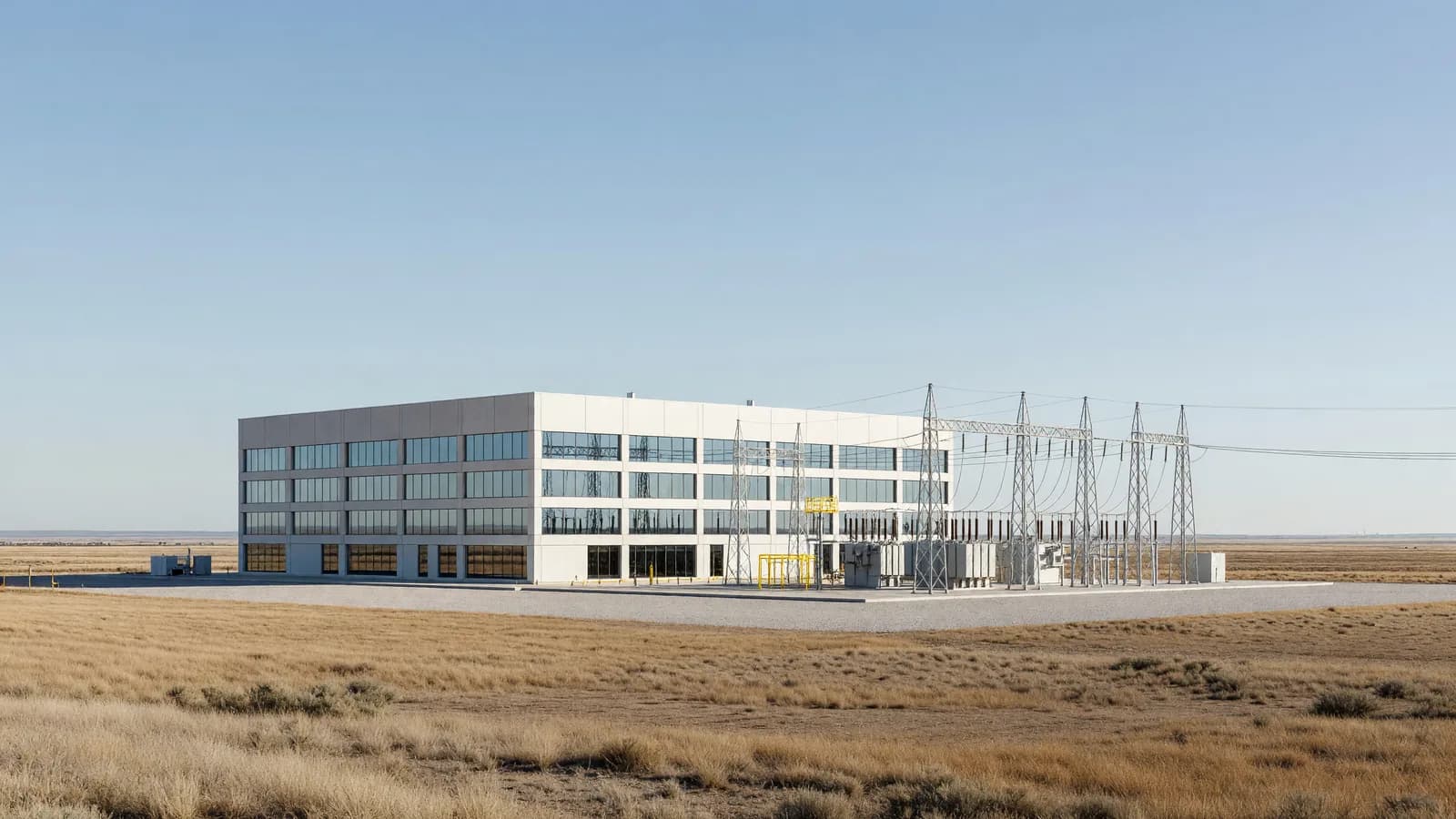
Nuclear power already supplies data centers, but almost entirely through contracts with reactors that were built decades ago. Amazon, Google, Meta and Microsoft have signed for roughly 8.5 GW of output from operating, restarting and uprated US reactors — an NNN tally of the deals in the table below — while the International Energy Agency counts 45 GW of conditional data-center agreements with small modular reactor projects. The gap between those two numbers is the story: the existing fleet is delivering now, and almost every new reactor promised to a data center is still a framework, an option or a licence application.
Key facts
- Data-center electricity demand rose 17% in 2025 and is set to double by 2030, with AI-focused data centers tripling, according to the IEA
- Amazon Web Services buys up to 1,920 MW from Talen's Susquehanna plant through 2042, the largest nuclear supply contract for data centers
- Microsoft's 835 MW Crane restart (formerly Three Mile Island Unit 1) is on track for 2027, Constellation says
- Meta's nuclear agreements support up to 6.6 GW of new and existing capacity by 2035 — the largest portfolio of any buyer
- Conditional data-center–SMR agreements grew from 25 GW at end-2024 to 45 GW; only Kairos Power's 50 MW Hermes 2 is under construction
How nuclear serves data centers
A data center is a large, persistent electricity load: servers, AI accelerators and cooling draw power day and night, and a single AI campus can need hundreds of megawatts. Nuclear plants run at high capacity factors around the clock, which is why buyers who want firm, low-carbon supply keep returning to them. There are four ways a data center gets nuclear power today:
- Contract an operating plant. A power purchase agreement (PPA) reserves a share of a reactor's output for 20 years or more, delivered through the grid. This is the only route delivering power at scale today, and the fastest to start — Meta's Clinton deal begins in June 2027, about two years after signing.
- Fund an uprate or life extension. The buyer's long contract pays for extra output from an existing plant or for another licence renewal. Uprates add new capacity to the grid instead of only reallocating what is there.
- Restart a closed plant. Crane in Pennsylvania and Duane Arnold in Iowa are being brought back under long contracts with Microsoft and Google. Restarts need NRC approvals, refurbishment and grid rights, and take several years.
- Build new reactors. SMRs, microreactors and large reactors contracted for data centers. None is operating; the first power is targeted for 2030.
How the power is delivered matters as much as who generates it. Front-of-the-meter deals move power through the grid like any other supply. Co-located or behind-the-meter arrangements take power directly from a neighbouring plant, which reduces grid charges but has drawn regulatory pushback over who pays for the shared network (see the grid rules section below).
The numbers
| Metric | Value | Context |
|---|---|---|
| Data-center electricity growth, 2025 | +17% | vs ~3% for global electricity demand |
| Data-center demand outlook | Doubles by 2030 | AI-focused data centers triple |
| Big-tech capital spending, 2025 | >$400 billion | five largest companies; set to rise another 75% in 2026 |
| Conditional data-center–SMR agreements | 45 GW | up from 25 GW at end-2024; not a construction tally |
| Existing-plant capacity contracted by hyperscalers (US) | ~8.5 GW | NNN tally of the signed deals below, excluding Google's undisclosed Duane Arnold share |
| Largest single contract | 1,920 MW | Amazon–Talen, Susquehanna, through 2042 |
| Largest buyer portfolio | Up to 6.6 GW by 2035 | Meta: Constellation, Vistra, TerraPower, Oklo |
| New reactors for data centers under construction | 1 | Kairos Hermes 2, 50 MW, Oak Ridge, Tennessee |
Existing plants: operating, restarting and uprating for data centers
These are signed contracts with reactors that exist today. Status is as of October 2026.
| Buyer | Plant (owner), location | Capacity | Deal | Status |
|---|---|---|---|---|
| Amazon (AWS) | Susquehanna 1–2 (Talen), Pennsylvania | up to 1,920 MW | PPA through 2042; began as a co-located campus purchase in 2024 | Delivering; moved to a front-of-the-meter contract in April 2026, full volume by 2032 at the latest |
| Microsoft | Crane, ex-Three Mile Island 1 (Constellation), Pennsylvania | 835 MW | Restart + 20-year PPA (Sept 2024) | Restart under way; NRC environmental review done; on track for 2027 |
| Meta | Clinton (Constellation), Illinois | 1,121 MW + 30 MW uprate | 20-year PPA + relicensing (June 2025) | Signed; deliveries from June 2027 |
| Meta | Perry and Davis-Besse, Ohio; uprates incl. Beaver Valley, Pennsylvania (Vistra) | 2,176 MW + 433 MW of uprates | 20-year PPAs + uprates (Jan 2026) | Signed; uprates online in the early 2030s |
| Amazon (AWS) | Comanche Peak (Vistra), Texas | 1,200 MW | 20-year PPA (Sept 2025); buyer named as AWS in 2026 | Signed; deliveries from Q4 2027 |
| Amazon | Calvert Cliffs (Constellation), Maryland | 690 MW incl. 190 MW uprate | 20-year PPA + uprate (Sept 30, 2026) | Signed; uprate online 2030–2032 |
| Duane Arnold (NextEra), Iowa | share of 615 MW plant; CIPCO takes the rest | Restart + 25-year PPA (Oct 2025) | $1.9B DOE loan closed Sept 2026; target Q1 2029 | |
| Vogtle and Hatch (Georgia Power), Georgia | ~96 MW of uprates | Tariff-backed uprate support (Sept 2026) | Awaiting Georgia PSC approval | |
| Loviisa (Fortum), Finland | up to 50% of output, 2030–2049 | 22-year PPA + life extension (Sept 2026) | Signed; deliveries start 2028 | |
| Data4 | EDF fleet, France | 40 MW | 12-year share of fleet output (Sept 2025) | Signed |
New reactors planned for data centers
Every project below is tied to a named data-center buyer or developer. "Binding" means a purchase or prepayment contract; "framework" means a master agreement, option or funding-plus-rights deal; MOU and LOI are non-binding.
| Buyer | Developer, design | Site | Capacity | Agreement | Status (Oct 2026) | First power |
|---|---|---|---|---|---|---|
| Google (via TVA) | Kairos Power, Hermes 2 (fluoride salt-cooled) | Oak Ridge, Tennessee | 50 MW | Binding TVA–Kairos PPA (Aug 2025) | Under construction since April 2026 | 2030 |
| Kairos Power, KP-FHR fleet | sites TBD | up to 500 MW | Framework (Oct 2024) | Hermes 2 is the first project | 2030–2035 | |
| Elementl Power, technology not chosen | three US sites | ≥600 MW each | Framework: development capital + offtake option (May 2025) | No sites public | — | |
| Meta | TerraPower, Natrium | sites TBD | up to 8 units, 2.8 GW | Framework: funds 2 units, rights to 6 more (Jan 2026) | No Meta site announced | as early as 2032; rest by 2035 |
| Meta | Oklo, Aurora | Pike County, Ohio | up to 1.2 GW | Binding prepayment + development funding (Jan 2026) | Pre-construction work slated for 2026 | 2030 first phase; full by 2034 |
| Amazon | X-energy, Xe-100; Energy Northwest (owner) | Cascade, near Columbia Generating Station, Washington | 320 MW, option to 960 MW | Framework: development funding (Oct 2024) | Construction expected to start by end of decade | 2030s |
| Amazon (with KHNP, Doosan) | X-energy, Xe-100 | US sites TBD | >5 GW by 2039 | Partnership (Aug 2025) | No further named sites | by 2039 |
| Amazon | Dominion Energy, SMR not selected | North Anna, Virginia | — | MOU to explore (Oct 2024) | Feasibility | 2030s |
| Crusoe | Blue Energy, up to 5 BWRX-300 | Port of Victoria, Texas | up to 1.5 GW | Partnership (Nov 2025) | NRC construction permit application, part 1, filed Sept 2026 | gas from 2028, nuclear by 2031 |
| Crusoe | Aalo Atomics, Aalo Pod / XMR | Crusoe sites | 50 MWe plants | Partnership (Jul 2026) | Proof-of-concept data center planned | 2027 pilot; end-2029 |
| Switch | Oklo, Aurora | sites TBD | 12 GW by 2044 | Non-binding master agreement (Dec 2024) | No binding PPAs yet | — |
| Equinix | Oklo; Radiant; ULC-Energy / Rolls-Royce SMR; Stellaria | US, Netherlands, Europe | 500 MW Oklo; 20 Radiant units; 250 MW ULC; 500 MW Stellaria | Pre-agreements, preorders and LOIs (2024–2025) | No binding PPAs found | — |
| Endeavour (Edged data centers) | Deep Fission, borehole reactor | sites TBD | 2 GW | Co-development partnership (Jan 2025) | Early development | 2029 target |
| Sabey Data Centers | TerraPower, Natrium | Rocky Mountains, Texas | — | MOU (Jan 2025) | Exploratory | — |
| Fermi America campus | Westinghouse, 4× AP1000 | Amarillo, Texas | 4 large units | Developer-owned; no nuclear offtaker signed | NRC accepted the COL application for review (Sept 2025) | — |
| GridMarket customers | Deployable Energy, microreactors | sites TBD | >3 GW through 2035 | Non-binding $22.5B pipeline (Jul 2026) | Pilot planned | 2030 |
| Standard Power | NuScale / ENTRA1, 24 × 77 MWe | Ohio, Pennsylvania | 1,848 MW | Technology selection (Oct 2023) | No visible progress | — |
| UK data-centre campus | Holtec + EDF UK, up to 4 SMR-300 | Cottam, Nottinghamshire | ~1.3 GW | MoU (Sept 2025), then JV heads of terms (Jun 2026) | Proposal to UK government | early 2030s |
Two fusion contracts sit alongside these: Microsoft's 50 MW PPA with Helion for the Orion plant in Malaga, Washington, targeting 2028, and Google's 200 MW offtake from Commonwealth Fusion Systems' first ARC plant in Chesterfield County, Virginia. Neither technology has yet put power on a grid — see nuclear fusion, explained.
Who is buying
| Company | Existing and restarted plants | New reactors | Headline commitment |
|---|---|---|---|
| Amazon | Susquehanna, Comanche Peak, Calvert Cliffs | X-energy / Energy Northwest; Dominion SMR study | >5 GW of new nuclear by 2039 with X-energy, KHNP and Doosan |
| Meta | Clinton; Perry, Davis-Besse, Beaver Valley | TerraPower Natrium; Oklo Aurora | Up to 6.6 GW by 2035 |
| Duane Arnold restart; Vogtle and Hatch uprates; Loviisa | Kairos Power; Elementl Power; CFS (fusion) | Up to 500 MW from Kairos by 2035 | |
| Microsoft | Crane restart | Helion (fusion) | 835 MW Crane PPA |
| Data-center developers | EDF (Data4) | Oklo (Switch, Equinix), Blue Energy and Aalo (Crusoe), Deep Fission (Endeavour) | 12 GW Switch framework, non-binding |
The pattern is consistent. Hyperscalers sign binding contracts for existing reactors, where power arrives on a known date, and take options, prepayments or development stakes in new ones, where they arrive only if the reactor is licensed, financed and built. Data-center developers without hyperscaler balance sheets lean on the start-up end of the market, where most agreements are non-binding.
The grid rules: co-location and FERC
Putting a data center beside a reactor and taking power directly looked like the obvious shortcut in 2024. Regulators slowed it. On November 1, 2024, the Federal Energy Regulatory Commission rejected, 2–1, an amended interconnection agreement that would have raised the behind-the-meter supply to Amazon's Susquehanna campus from 300 MW to 480 MW. Talen and Amazon then restructured the deal as a front-of-the-meter PPA, effective April 2026.
The broader rules followed. On December 18, 2025, FERC found PJM Interconnection's tariff unjust and unreasonable for lacking co-location provisions and ordered new transmission services for co-located load, including firm and non-firm contract-demand options. A June 18, 2026 rehearing order upheld that framework and required further tariff revisions. The practical effect: co-location is possible in the largest US grid region, but the data center pays for the grid services it still relies on — which narrows the cost advantage of plugging in next door. Restarts face grid limits too: FERC in 2026 let Constellation transfer 760 MW of interconnection rights to Crane, after PJM found that some transmission upgrades could run past 2030.
Common misconceptions
"Data centers are already running on small modular reactors." No SMR supplies a data center anywhere. The only operating SMRs are in China and Russia, and the first Western new-build tied to data centers, Hermes 2, targets 2030. See SMRs, explained.
"A 12 GW or 45 GW announcement means 12 GW or 45 GW is coming." The IEA's 45 GW is conditional offtake, and Switch's 12 GW with Oklo is explicitly non-binding. Binding capacity on the new-build side is a small fraction of the headlines.
"Buying existing nuclear output adds clean power to the grid." Only partly. A PPA with an operating plant reallocates output that was already on the grid unless it pays for an uprate, a restart or a licence extension that would not otherwise happen. That is why recent deals — Clinton, Vistra, Calvert Cliffs, Georgia Power, Loviisa — bundle uprates or relicensing into the contract.
"Nuclear-powered data centers leave the grid." Even co-located campuses depend on the grid for backup when the reactor refuels or trips, which is why FERC now requires co-located load in PJM to buy transmission services.
"New reactors can solve the AI power crunch this decade." A data center can be built in a few years; a first-of-a-kind reactor takes most of a decade. That mismatch is why projects like Blue Energy's Texas plant start with gas turbines and plan to switch to nuclear later.
Siting and public opinion
Power is only part of the local debate. Gallup found 71% of Americans oppose a data center in their area, compared with 53% for a nuclear plant — so the data center, not the reactor, is often the harder sell. Water use, land, transmission lines, noise and electricity bills all shape the response. A reactor on a data-center campus also brings emergency planning zones, security requirements and NRC siting review that a gas plant or a grid connection does not. Most announced new-build projects therefore pick existing energy sites: retired coal plants (Cottam), former federal land (Pike County, Ohio, at the former Portsmouth Gaseous Diffusion Plant) or existing nuclear stations (North Anna, and Cascade near Columbia Generating Station).
Current state (October 2026)
Nuclear for data centers has two speeds. The existing fleet is where the power is: roughly 8.5 GW of US reactor output is now contracted to Amazon, Meta, Google and Microsoft, and new deals increasingly pay for uprates and relicensing rather than plain output. The latest, Amazon's Calvert Cliffs agreement, was signed on September 30, 2026. Two restarts — Crane (2027) and Duane Arnold (Q1 2029) — are funded and under way.
New reactors remain a pipeline. One project tied to data centers is under construction (Hermes 2), one hyperscaler-linked SMR project has an NRC construction permit application in (Blue Energy–Crusoe, part 1), and one large-reactor campus is in NRC review (Fermi America). The largest volumes — Meta–TerraPower, Amazon–X-energy, Switch–Oklo — depend on sites, licences and first-of-a-kind cost performance still to come.
What to watch: Crane's return to service in 2027, the first deliveries under Meta's Clinton and Amazon's Comanche Peak contracts (both 2027), site announcements for Meta's Natrium units, the NRC's review of Blue Energy's application, and whether PJM's new co-location services revive direct-connection deals.
Latest NNN coverage
- Google buys Loviisa nuclear power: 22-year PPA with Fortum to 2050 — September 2026
- Blue Energy files NRC application for Texas gas-to-nuclear plant — September 2026
- DOE closes $1.9B loan to restart NextEra's Duane Arnold plant — September 2026
- Nature Outlook puts SMRs at center of AI power debate — August 2026
- Gallup: 71% oppose local AI data centers, vs. 53% for nuclear — August 2026
- Blue Energy and GVH advance 2.5 GW gas-plus-nuclear plant in Texas — August 2026
- TerraPower names Hyundai E&C as EPC for up to eight Natrium reactors — August 2026
- IEA says data-center SMR deals hit 45 GW — July 2026
- GridMarket, Deployable Energy announce $22.5B data-center nuclear deal — July 2026
Related reading
For the reactors behind the new-build deals, start with SMRs, explained and top SMR developers in 2026, then the design pages for Natrium and the BWRX-300. The licence path every new project still has to walk is NRC reactor licensing, explained; the federal money behind restarts like Duane Arnold is in DOE nuclear funding, explained. For why buyers choose nuclear over gas for firm supply, see nuclear vs natural gas for baseload power.
Questions
- Are there nuclear-powered data centers?
- Yes, through power contracts. Amazon Web Services bought a data center campus beside Talen Energy's Susquehanna nuclear plant in Pennsylvania in 2024 and, since April 2026, buys up to 1,920 MW from the plant through the grid under a contract running to 2042. No data center anywhere yet runs on a new reactor built for it.
- Which tech companies are buying nuclear power?
- Amazon, Google, Meta and Microsoft all hold nuclear contracts. Microsoft is paying for the Crane (Three Mile Island Unit 1) restart; Meta has 20-year deals with Constellation's Clinton plant and Vistra's Ohio and Pennsylvania plants; Amazon buys from Susquehanna, Comanche Peak and Calvert Cliffs; Google backs the Duane Arnold restart and Finland's Loviisa plant. Data-center developers such as Switch, Equinix and Crusoe have signed with reactor start-ups.
- What is a nuclear-powered data center?
- Usually, a data center whose operator has contracted the output of a nuclear plant, either delivered through the grid (front-of-the-meter) or from a plant next door (co-located or behind-the-meter). A few proposed projects would build reactors on or beside the data center campus, but none of those is operating yet.
- Why do data centers need so much electricity?
- Servers, AI accelerators and cooling systems draw power around the clock, and AI training clusters concentrate hundreds of megawatts on one campus. The International Energy Agency says data-center electricity use grew 17% in 2025 and is set to double by 2030, with AI-focused data centers tripling.
- Can small modular reactors power data centers?
- In principle, and many deals assume it, but not yet. The IEA counts 45 GW of conditional data-center agreements with SMR projects. Of the new-build projects tied to data centers, only Kairos Power's 50 MW Hermes 2 plant in Oak Ridge, Tennessee, which will feed the TVA grid serving Google data centers from 2030, is under construction.
- What is the fastest way for a data center to get nuclear power?
- Buying output from an operating plant. Contracts with existing reactors can start delivering within about two years of signing, as Meta's Clinton deal (from June 2027) and Amazon's Comanche Peak deal (from the fourth quarter of 2027) show. Restarts take several years and new reactors most of a decade.
- Is Three Mile Island restarting for Microsoft?
- Yes. Constellation is restarting Three Mile Island Unit 1, renamed the Crane Clean Energy Center, under a 20-year power purchase agreement with Microsoft. Constellation says it is on track to return 835 MW to the grid in 2027, and the NRC has completed its environmental review of the restart.
- What does co-location mean for a nuclear plant and a data center?
- Co-location puts a data center next to a power plant so it can take power directly, reducing grid delivery. US regulators have limited it: FERC rejected an expanded behind-the-meter arrangement at Susquehanna in November 2024, then in December 2025 ordered PJM to create new transmission services for co-located load. Talen and Amazon moved their deal to a front-of-the-meter contract.
- Do data-center nuclear deals raise electricity bills for other customers?
- It depends on the deal. Contracts that fund uprates, restarts or new reactors add capacity to the grid, while deals that only reserve existing output can tighten supply for others. Grid operators and state regulators decide who pays for transmission upgrades; Georgia Power says Google's uprate deal will deliver about $900 million in customer benefits, pending state approval.
- How much nuclear power have tech companies committed to?
- Meta says its agreements support up to 6.6 GW of new and existing nuclear by 2035. Amazon and its partners aim to deploy more than 5 GW of new nuclear with X-energy by 2039. Google's Kairos Power deal covers up to 500 MW by 2035. Most new-build volumes are frameworks or options, not binding purchases.
Sources
- Data centre electricity use surged in 2025, even with tightening bottlenecks driving a scramble for solutions — International Energy Agency
- Talen Energy Quarterly Report (Form 10-Q), Q2 2026 — Talen Energy / SEC
- New supply agreement expands Talen-Amazon partnership — World Nuclear News
- Constellation to Launch Crane Clean Energy Center — Constellation
- NRC completes environmental review of Crane restart — World Nuclear News
- FERC waiver clears way for Crane Clean nuclear interconnection — World Nuclear News
- Constellation, Meta Sign 20-Year Deal for Clean, Reliable Nuclear Energy in Illinois — Constellation
- Meta Announces Nuclear Energy Projects, Unlocking Up to 6.6 GW — Meta
- The Meta/Vistra deal: A closer look — American Nuclear Society
- Generator enters 20-year PPA to supply power from Texas nuclear power plant — American Public Power Association
- Vistra fourth-quarter 2025 results (Exhibit 99.1) — Vistra / SEC
- Constellation and Amazon Announce 20-Year Power Purchase Agreement at Calvert Cliffs — Constellation
- NextEra Energy and Google to restart Duane Arnold Energy Center — NextEra Energy
- Energy Department Closes $1.9 Billion Loan to Restart Duane Arnold Nuclear Plant — US Department of Energy
- Agreement with Google provides $900 million in customer benefits, advances nuclear energy — Georgia Power
- Fortum and Google partner to drive sustainable growth in Finland, sign nuclear power purchase agreement — Fortum
- Data4 signe un accord avec EDF pour l'approvisionnement en électricité bas carbone de ses datacenters en France — EDF
- Google's first advanced nuclear reactor project with Kairos Power and TVA — Google
- Kairos Power Breaks Ground on Hermes 2 Demonstration Plant — Kairos Power
- New nuclear clean energy agreement with Kairos Power — Google
- Elementl Power and Google Sign Strategic Agreement to Develop Locations for Advanced Nuclear Projects — Elementl Power
- TerraPower announces deal with Meta — TerraPower
- Oklo, Meta Announce Agreement in Support of 1.2 GW Nuclear Energy Development in Southern Ohio — Oklo
- Amazon signs agreements for innovative nuclear energy projects — Amazon
- Amazon updates SMR progress with new images of proposed plant — World Nuclear News
- X-energy, Amazon, KHNP and Doosan Enerbility announce partnership to scale advanced nuclear energy for AI infrastructure — X-energy
- Dominion Energy and Amazon to explore advancement of SMR nuclear development in Virginia — Dominion Energy
- Blue Energy and Crusoe partner to develop nuclear-powered AI data center — Crusoe
- Blue Energy submits first construction application to NRC — World Nuclear News
- Crusoe and Aalo Atomics form strategic partnership — Crusoe
- Oklo signs power agreement with data centre developer — World Nuclear News
- Equinix collaborates with leading alternative energy providers — Equinix
- Deep Fission and Endeavour partner to speed delivery of low-cost nuclear power for hyperscalers — Deep Fission
- TerraPower and Sabey Data Centers developing strategic collaboration agreement — Sabey Data Centers
- NRC Accepts COLA for Fermi America's Four-Unit AP1000 Nuclear Plant in Texas — POWER Magazine
- Standard Power chooses NuScale's approved SMR technology and ENTRA1 Energy to energize data centers — NuScale Power
- GridMarket and Deployable Energy Partner on $22.5B Nuclear Pipeline to Power Data Center Customers Through 2035 — GlobeNewswire
- Joint plan by Holtec International and EDF UK to provide SMR-300s to power data centers at Cottam — Holtec International
- Holtec and EDF UK submit SMR proposal for Cottam — Holtec International
- Orion: the world's first fusion power plant — Helion Energy
- Google and Commonwealth Fusion Systems sign strategic partnership — Commonwealth Fusion Systems
- FERC rejects interconnection pact for Talen-Amazon data center deal at nuclear plant — Utility Dive
- FERC addresses arguments on rehearing and requires additional PJM tariff revisions to accommodate co-located load — Troutman Pepper Locke
- Americans oppose data centers in their area — Gallup
About Nuclear News Network
Nuclear News Network (NNN) is an independent publication covering the global nuclear energy sector — reactor construction, SMRs, fuel supply, policy, operations and fusion. NNN publishes a daily brief, same-day analysis of major developments, and reference guides used across the industry. Articles are produced by the NNN Newsroom, an editorial automation system with human oversight, under the publication's editorial standards. Ruben Seoane is the founder and main editor of NNN.